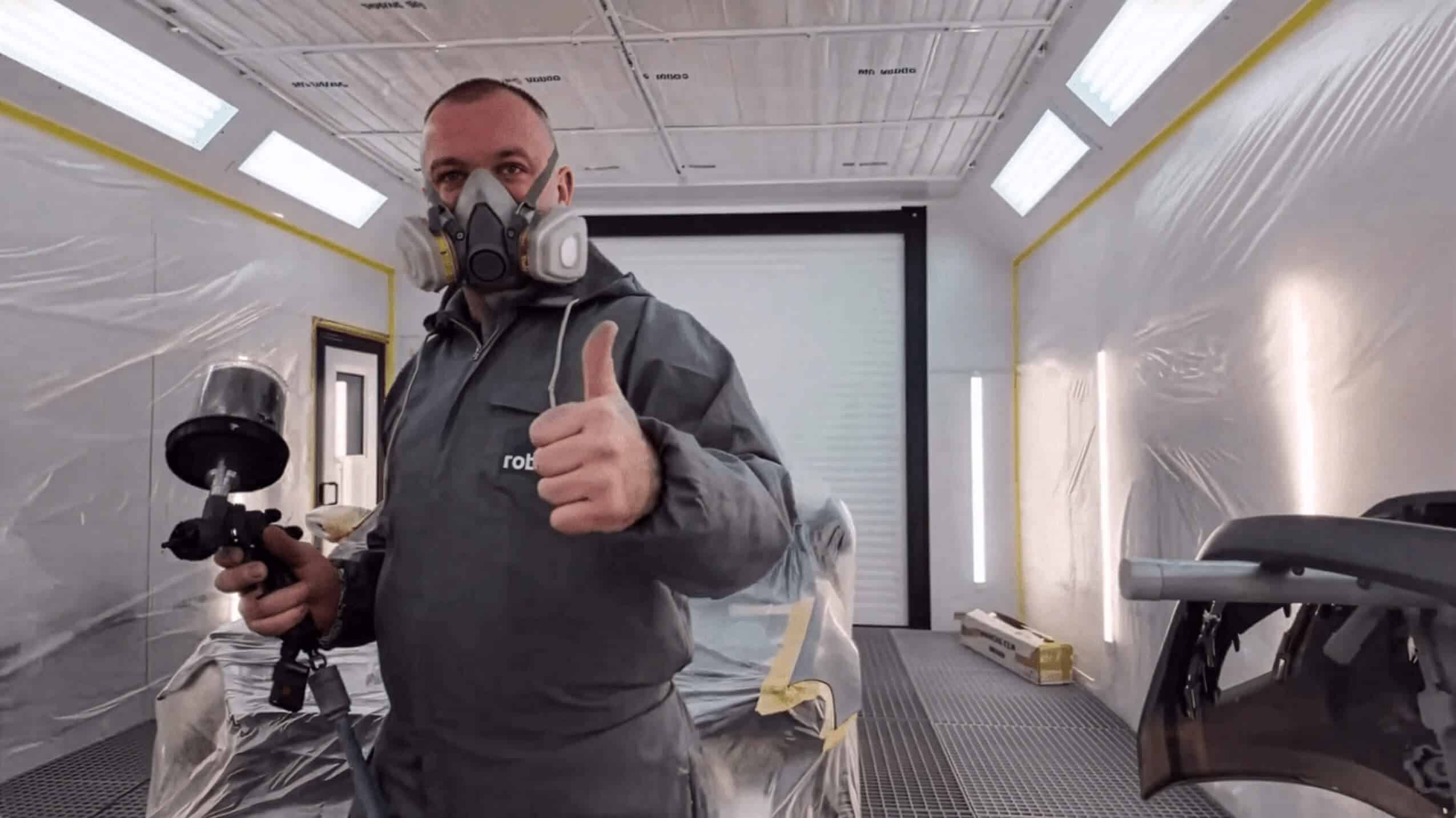
Exhaust Paint Booth for Research and Manufacturing Company “Vertex”
Spray booth Archives - Techservice WEKO LLC
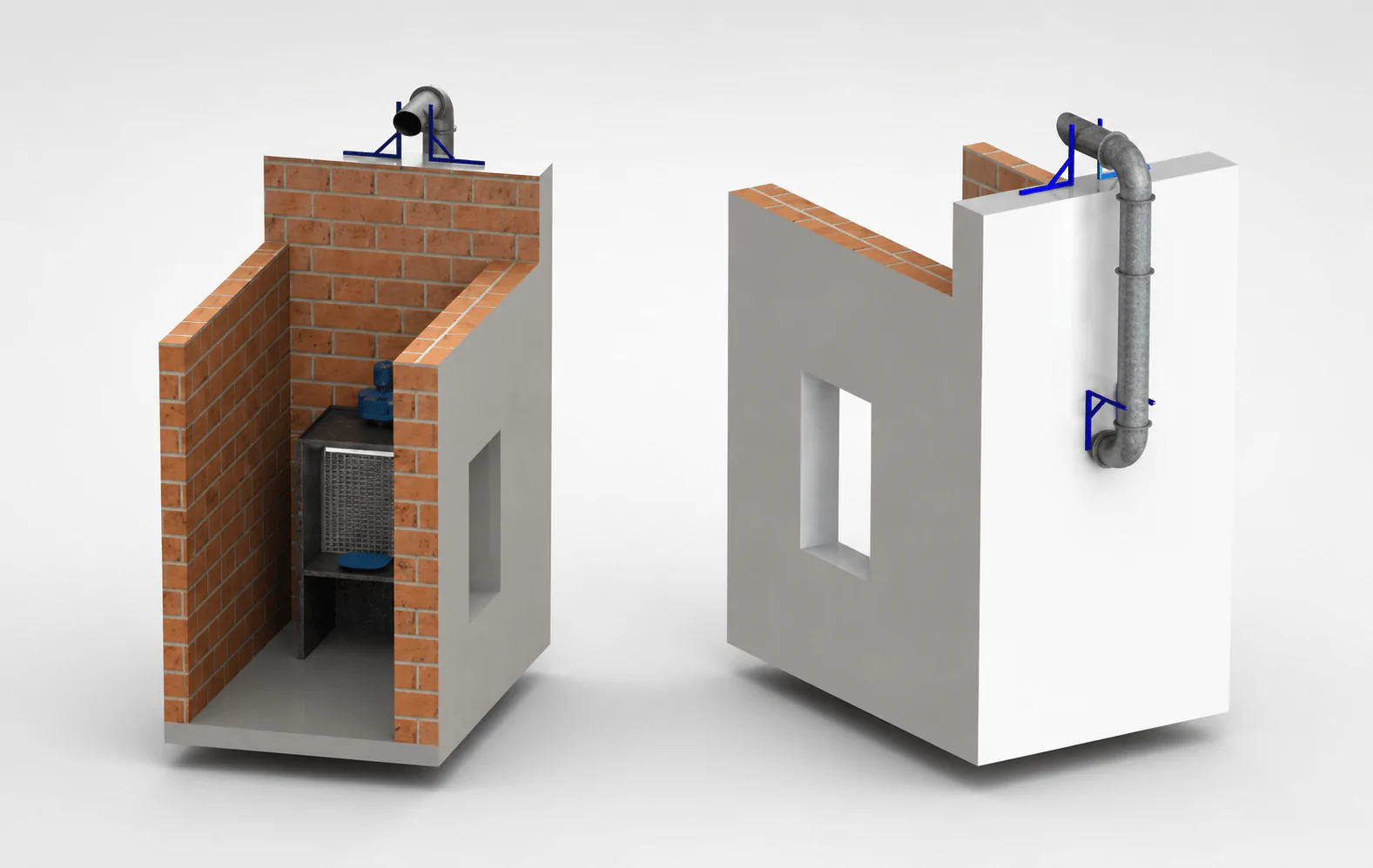
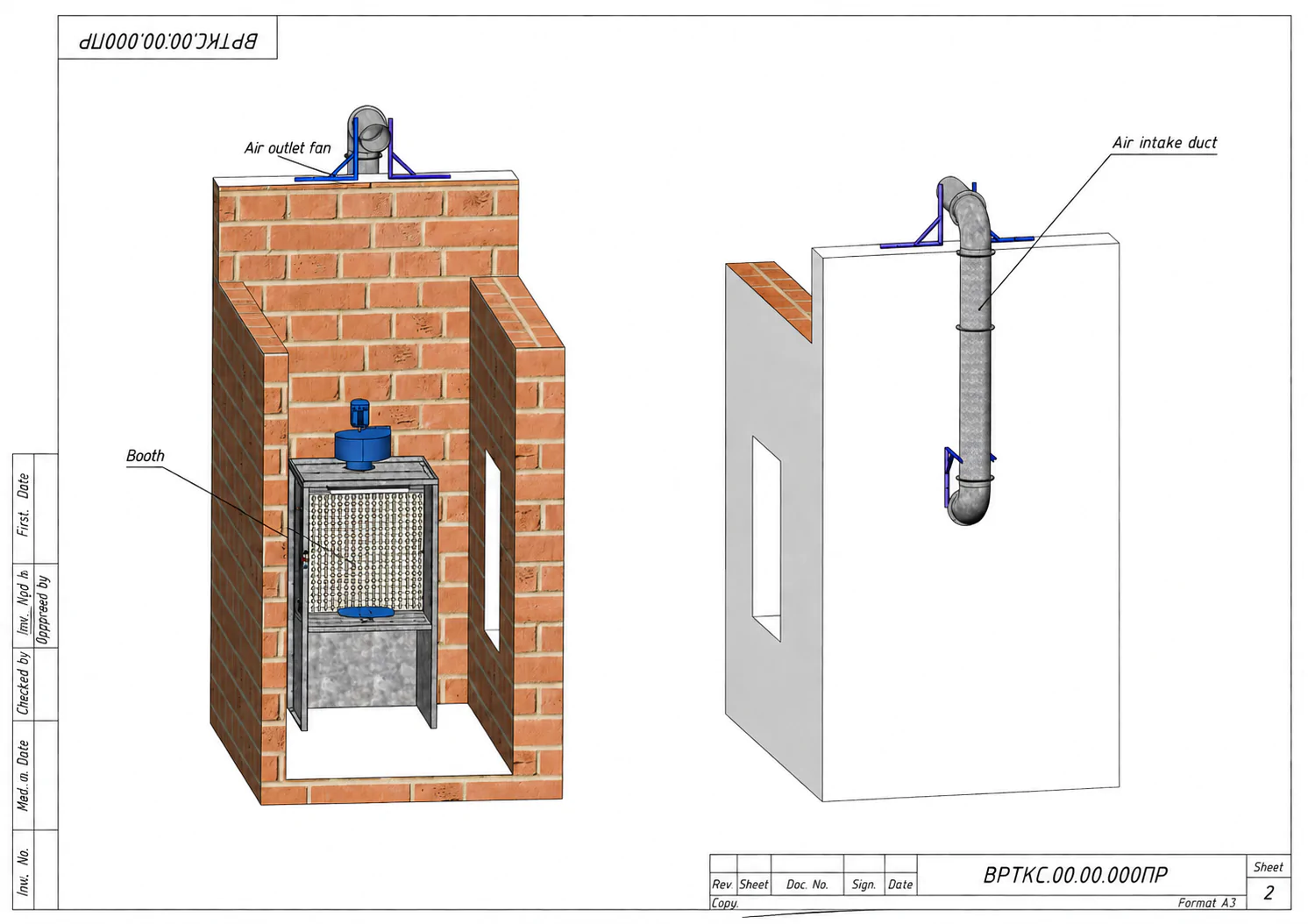
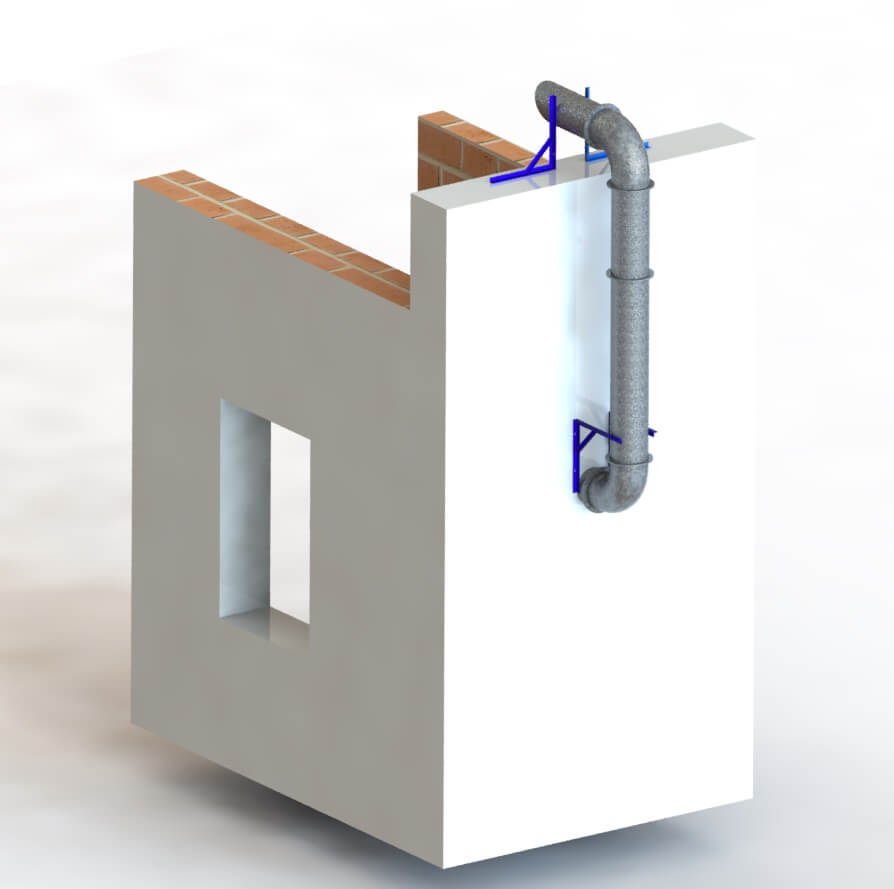
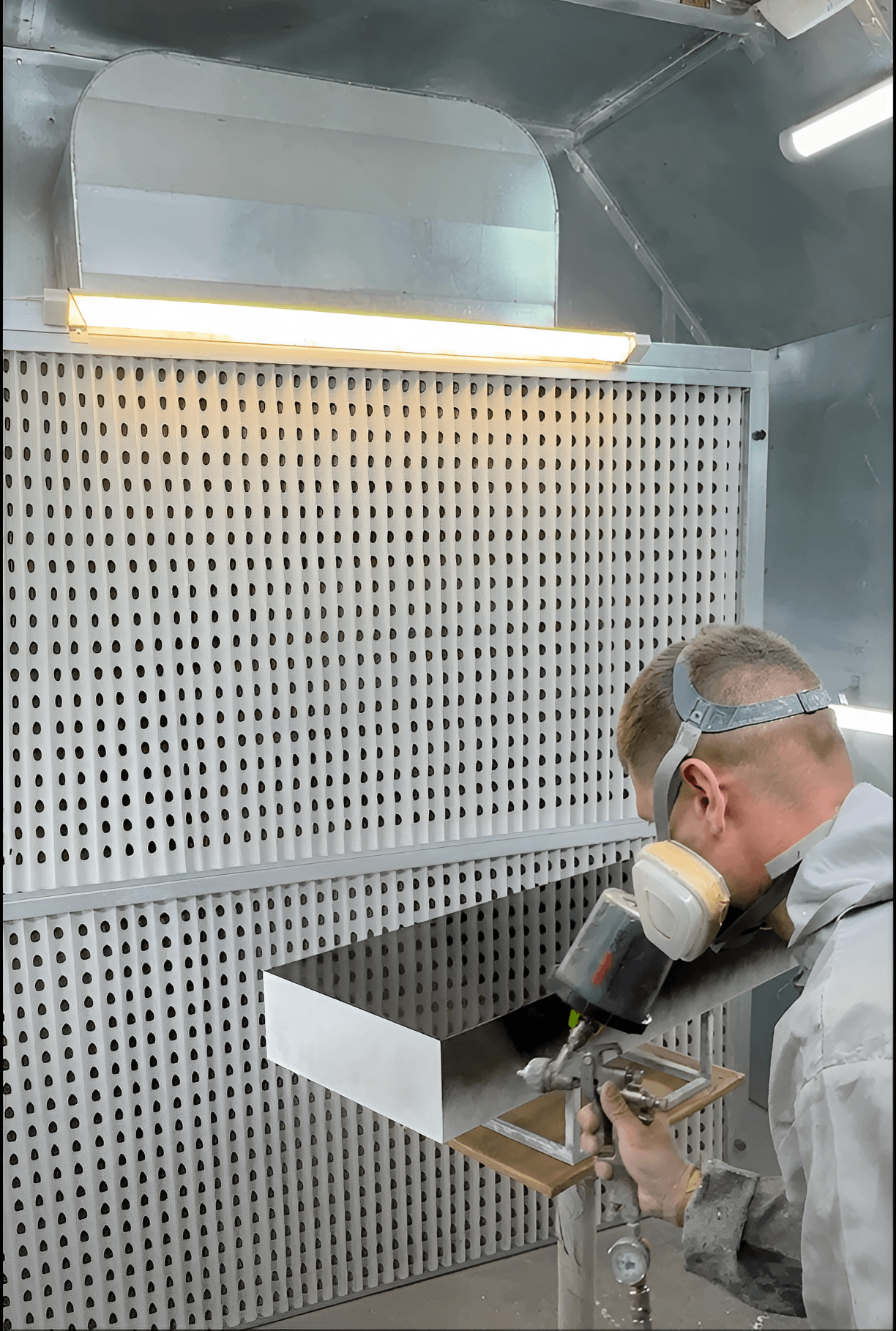
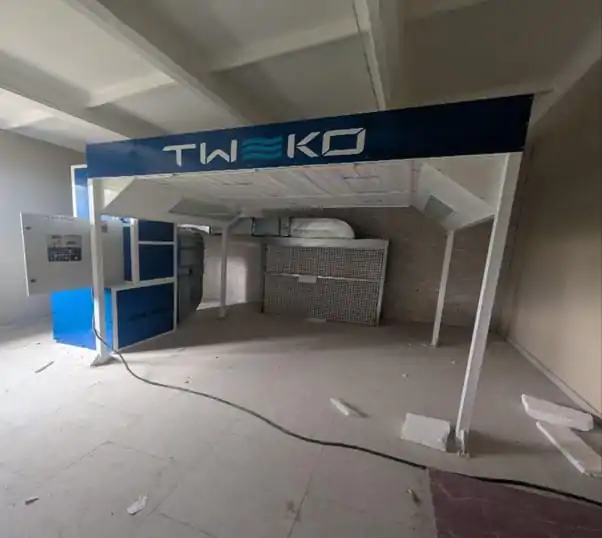
In June 2026, the TWEKO team designed and manufactured a compact ASS Cabin series exhaust paint booth, model ASS-Cabin-1, for a Ukrainian research and manufacturing company. The solution is equipped with a two-stage dry filtration system, a ventilation unit with a capacity of up to 2200 m³/h, and a working area of 1000 × 900 mm, ensuring safe and comfortable painting operations.
TWEKO Solution
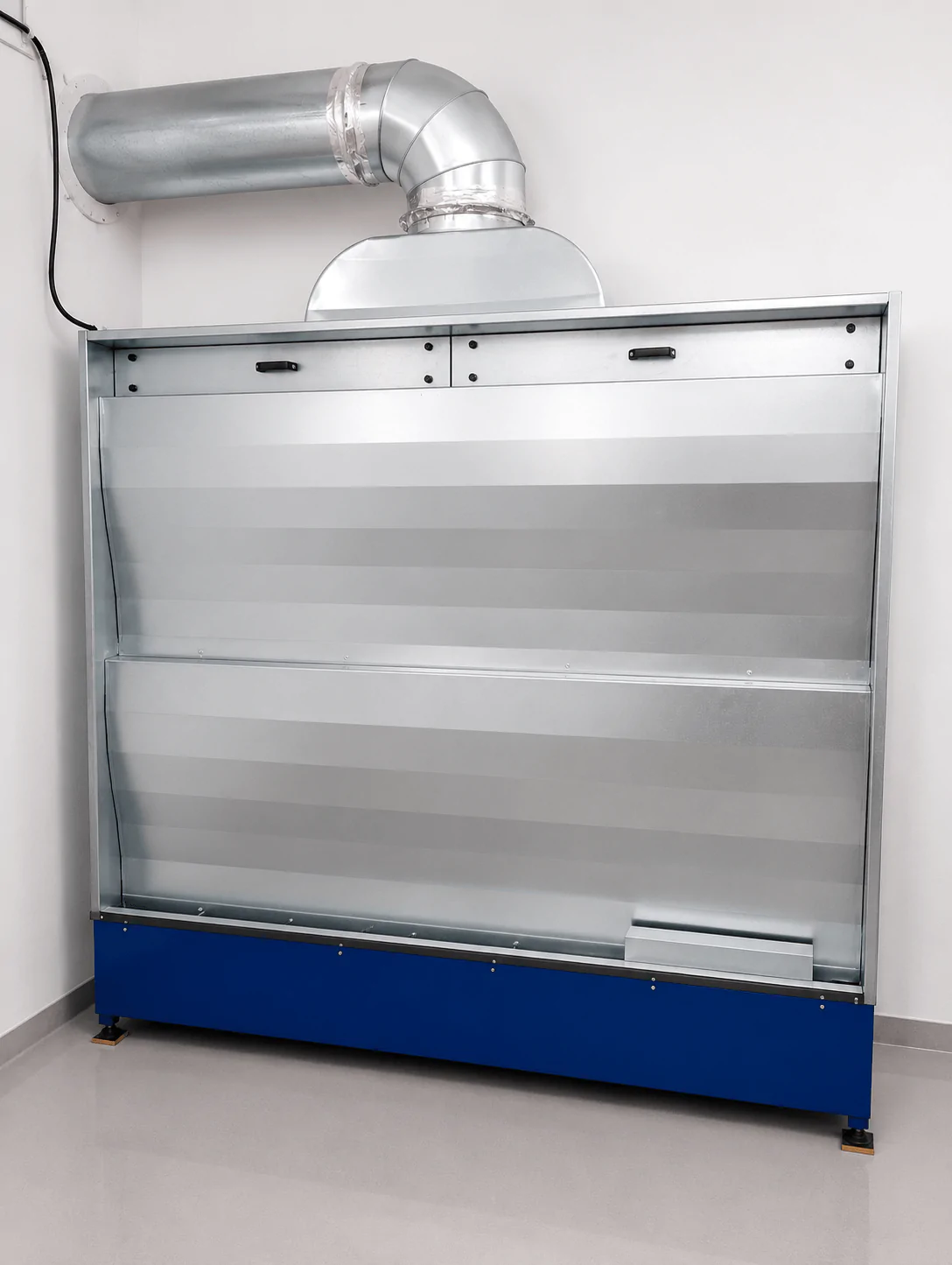
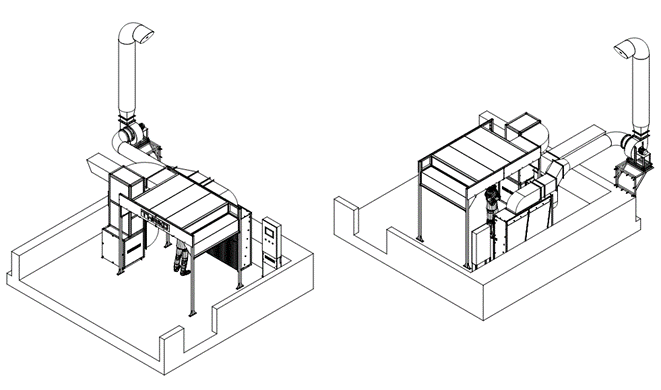
To implement the project, the TWEKO team designed and manufactured a compact ASS Cabin (ASS-Cabin-1) dry-filter exhaust paint booth for applying liquid coatings to small components. The design ensures local removal of paint overspray directly from the spraying area.
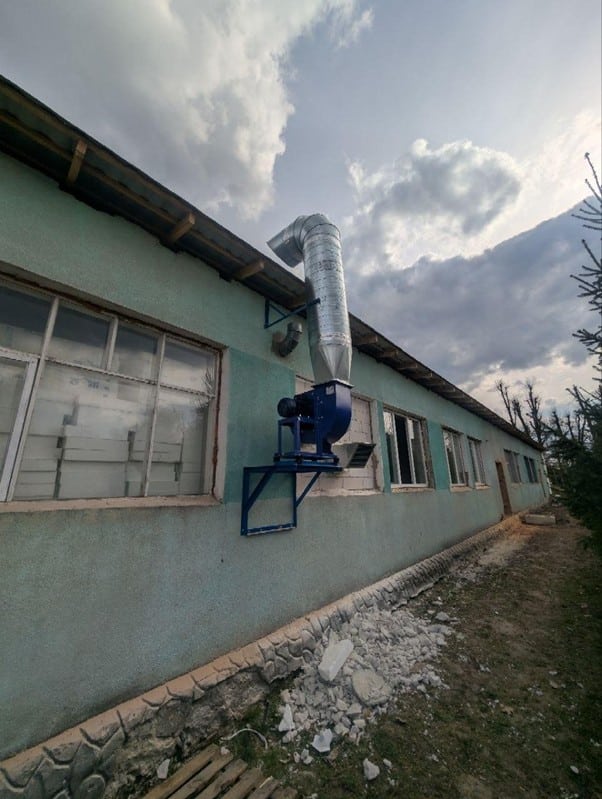
The booth features a two-stage dry air filtration system consisting of a cardboard labyrinth filter for primary filtration and a fiberglass Paintstop filter for fine filtration. The airflow is generated by a medium-pressure centrifugal fan with a capacity of 470–2200 m³/h, providing an air velocity in the working area of 0.25–0.4 m/s. This allows efficient capture of excess coating material and cleaning of the air before discharge into the atmosphere.
The booth has overall dimensions of 1100 × 2410 × 1000 mm and a working area with a width of 1000 mm and height of 900 mm, which is ideal for painting small parts. For operator comfort, a rotary table measuring 450 × 450 mm is provided, along with LED lighting with IP66 protection rating. The ventilation system maintains an air velocity of 0.25–0.4 m/s in the working area, ensuring stable and efficient booth operation.
*The filter holding capacity depends on the type of coating material.
Overall Dimensions
Dimensions of the exhaust booth (W × H × D)
1100 × 2410 × 1000 mm
Working area dimensions (W × H)
1000 × 900 mm
Rotary table size
450 × 450 mm
Weight
145 kg
Filtration
Filtration type
Dry, two-stage
First stage
Cardboard labyrinth filter, area 1 m², holding capacity ≈12 kg/m²*
Second stage
Fiberglass Paintstop filter, area 1 m², holding capacity ≈3.5 kg/m²*
Ventilation Unit
Fan type
Medium-pressure centrifugal fan
Capacity
470–2200 m³/h
Air velocity in the working area
0.25–0.4 m/s
Lighting
Luminaire type
LED, IP66
Luminaire power
18 W
Number of light fixtures
1 pc.
Requirements
Power supply
3 phases / 380 V / 50 Hz
Foundation requirements
Maximum floor level deviation: ±5 mm
* Holding capacity depends on the type of coating material.
When choosing painting equipment, it is important to consider not only the required performance but also the specifics of the technological process. In this project, the compact exhaust paint booth ASS-Cabin-1 proved to be the optimal solution, combining efficient air filtration, operator comfort, and minimal production space requirements.
Need a compact painting solution?
If your production process does not require a full-size paint booth for coating small components, TWEKO specialists will help you select a compact solution that ensures efficient air filtration, comfortable working conditions, and optimal use of production space.
Exhaust Cabinet with Hydro Screen for Paint and Coating Materials Supplier LLC “Gench Ukraine”
Spray booth Archives - Techservice WEKO LLC
For LLC “Gench Ukraine”, TWEKO implemented a project for the manufacture of an exhaust spray cabinet of the AS Hydro series with a hydro screen. The overall size of the cabinet is 2,530 mm. The equipment is complemented by a ductwork system and a three-stage air purification system combining two water filtration stages and one dry filtration stage.
About the Client
LLC “Gench Ukraine” is the official representative of the Turkish manufacturer Kayalar Kimya in Ukraine. The company specializes in the supply of high-quality paint and coating materials for the woodworking, furniture and industrial sectors, and also provides technical support to customers in accordance with the manufacturer’s standards.
Implemented Solution
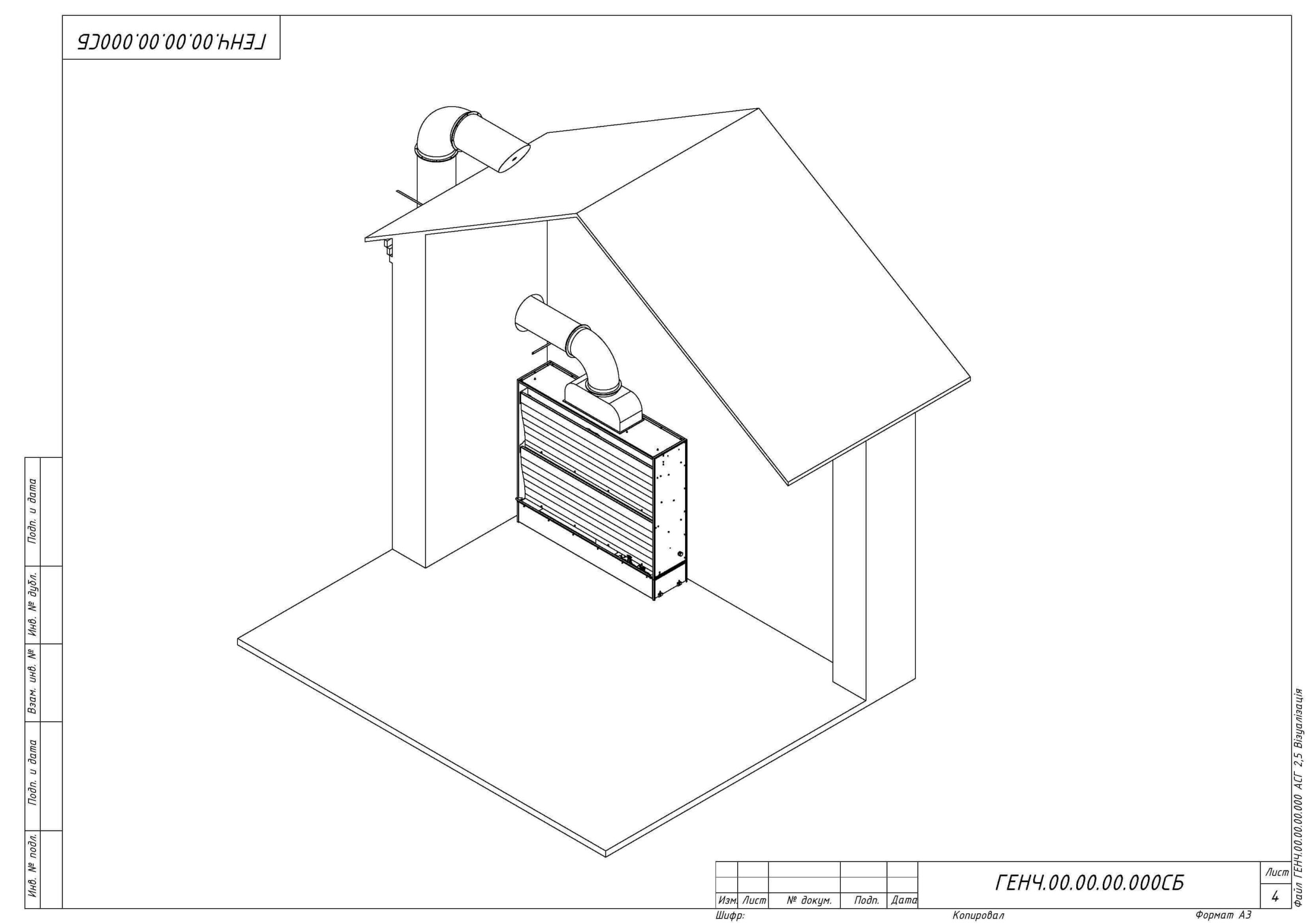
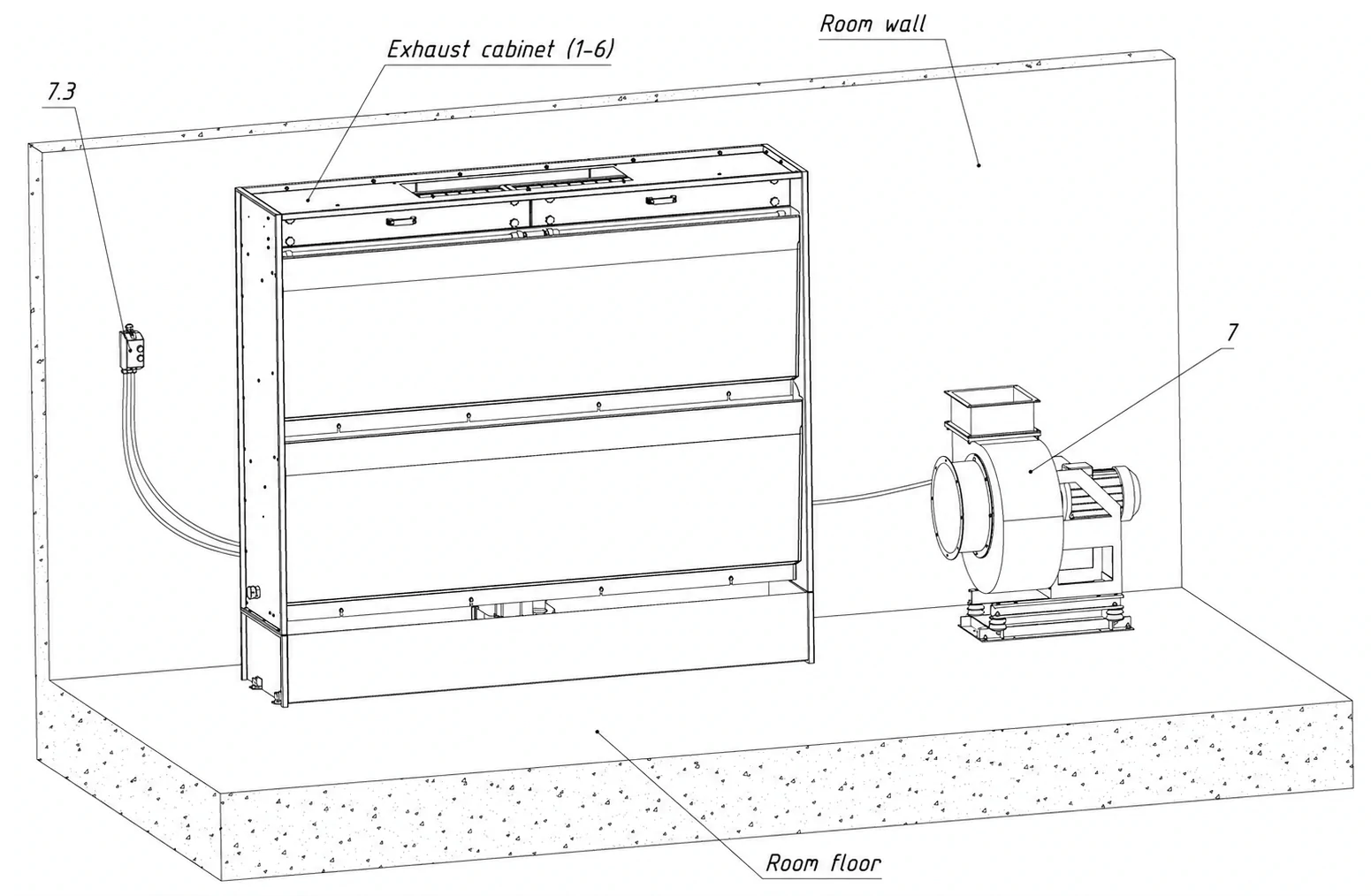
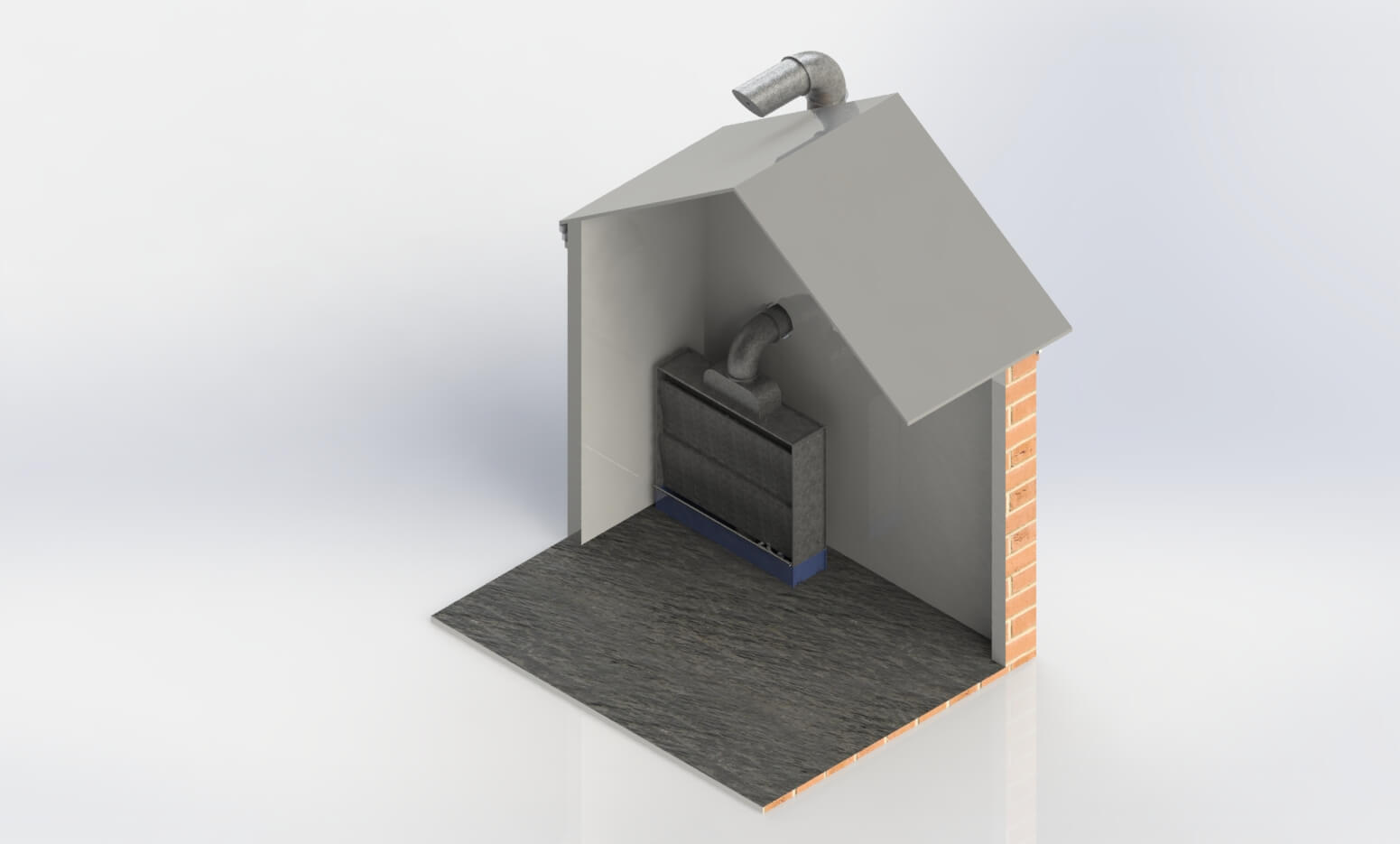
TWEKO manufactured an exhaust spray cabinet of the AS Hydro series with a hydro screen for LLC “Gench Ukraine”. The project also included a ductwork system. The overall size of the cabinet is 2,530 mm, and its weight is 340 kg (excluding water).
A three-stage filtration system is used for air purification, consisting of two water filtration stages and one dry filtration stage. The hydro screen provides the first two water filtration stages — a water curtain and water spray through nozzles — effectively capturing the majority of the paint overspray. The air then passes through a dry fiberglass PaintStop filter for final filtration before discharge into the atmosphere.
The equipment is fitted with a ventilation unit of type VC No. 14-46. The unit uses an explosion-proof No. 4 fan with an AIR 112 MV6 motor rated at 4 kW and 1,000 rpm.
The implemented solution made it possible to equip the production area of LLC “Gench Ukraine” with exhaust equipment adapted to the conditions of spray painting operations. The combination of a hydro screen, two water filtration stages and one dry filtration stage ensures comprehensive air purification from paint overspray.
Do you manufacture paint and coating materials and need efficient air purification during production and spray-painting processes? We will help you select a solution tailored to the specifics of your production — from a standalone exhaust cabinet to a complete spray-and-drying line.
Integration of an Exhaust Cabinet into an Existing Spray Booth
Spray booth Archives - Techservice WEKO LLC
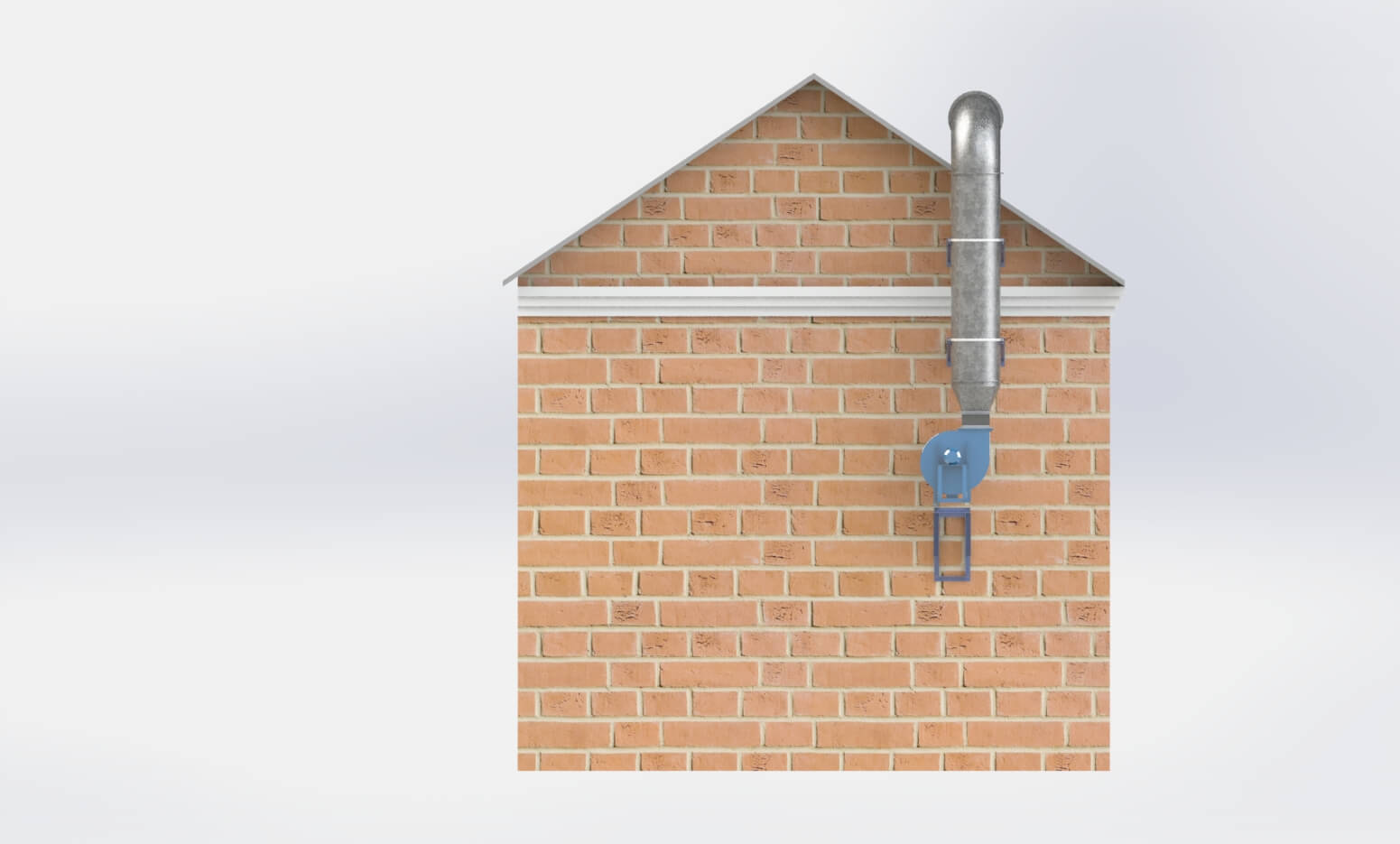
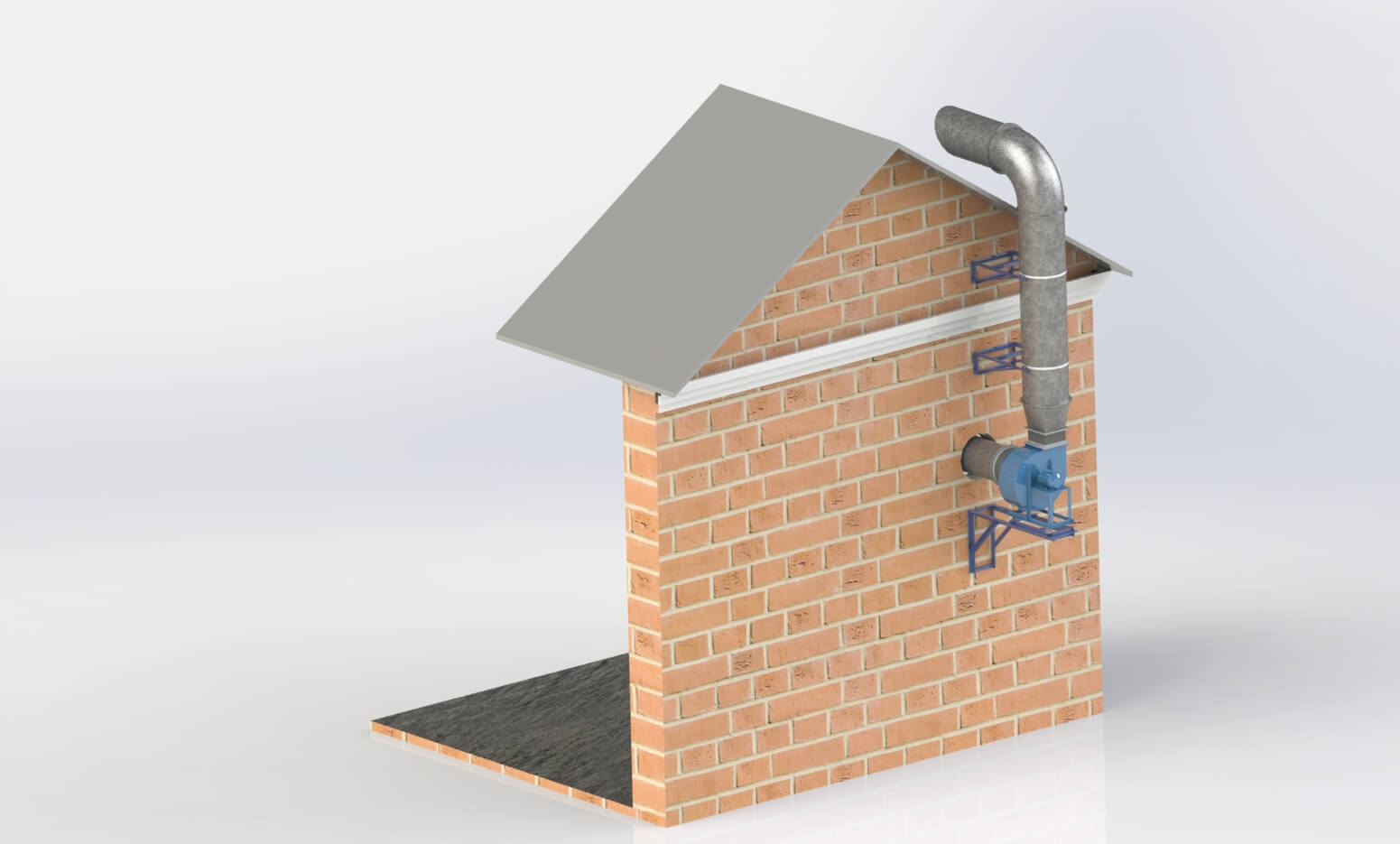
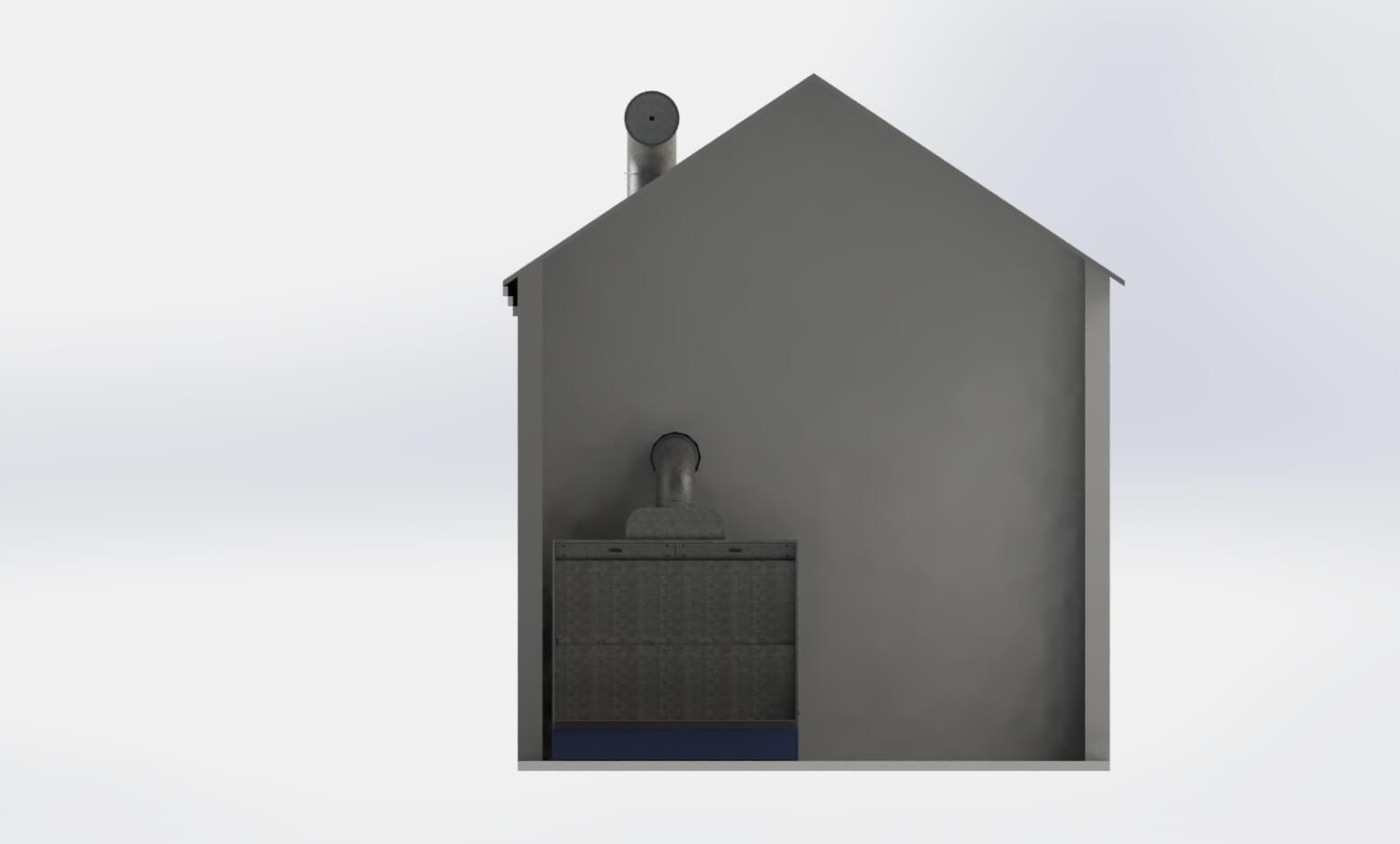
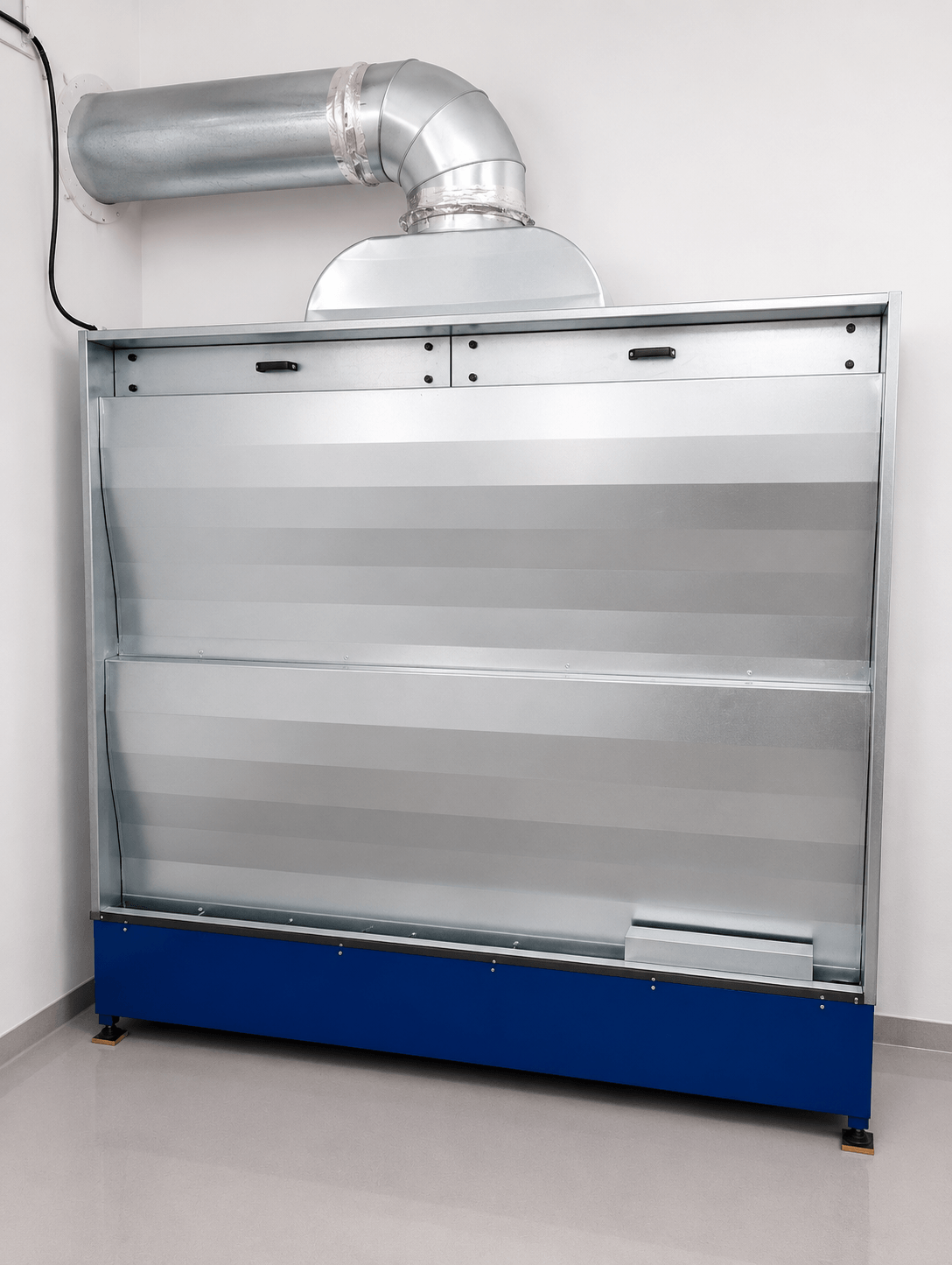
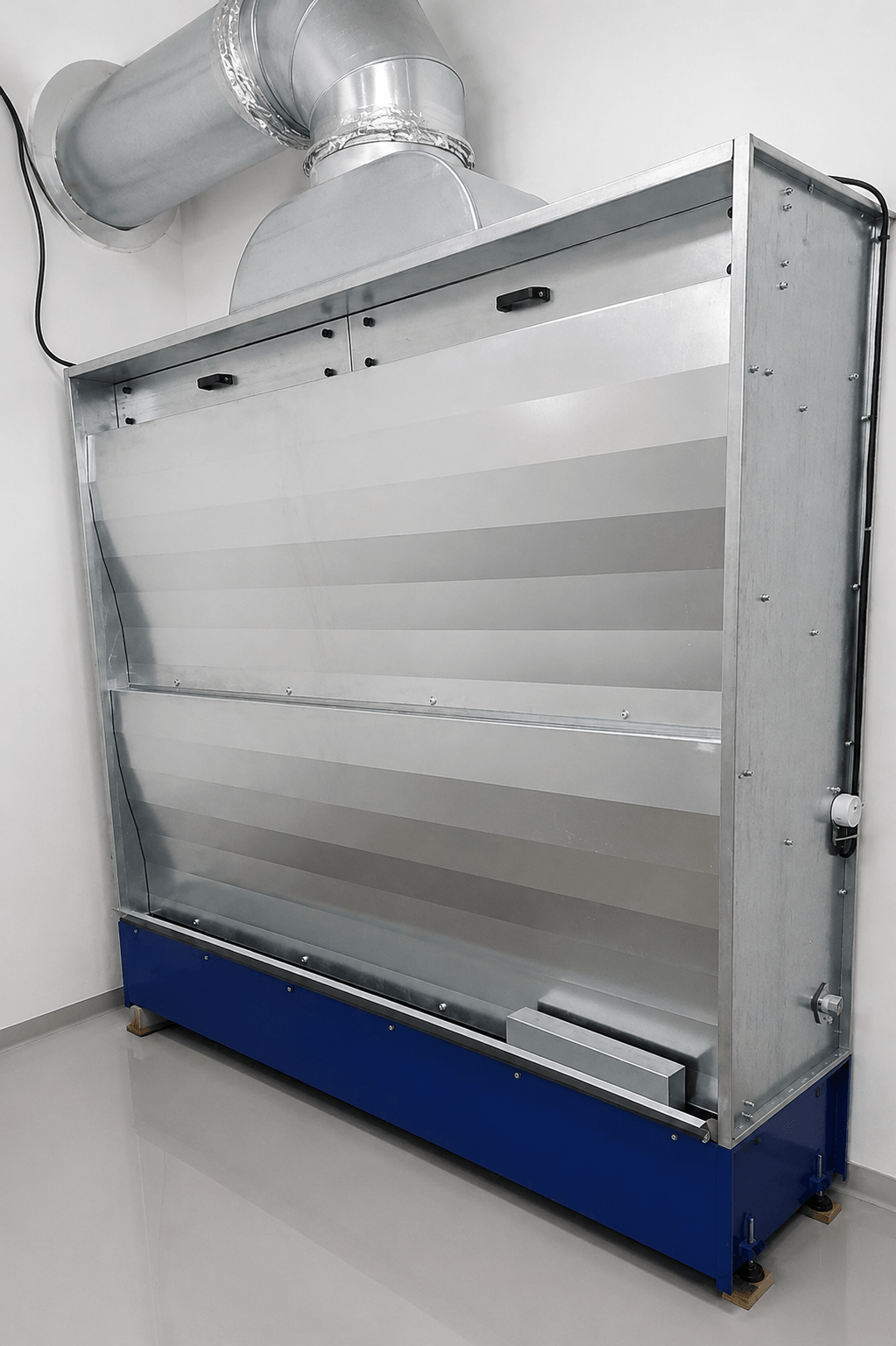
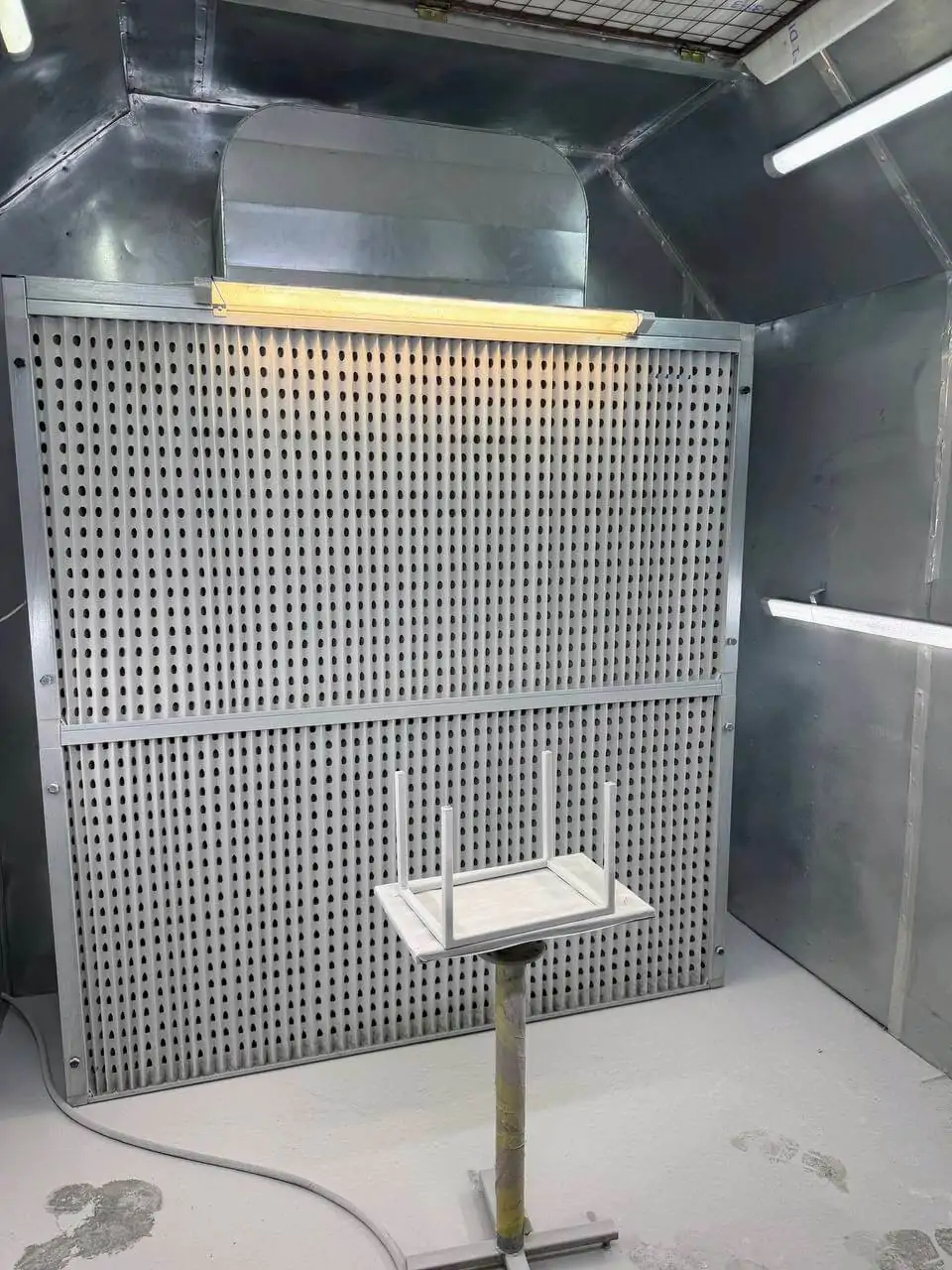
To modernize an existing spray booth, the company TWEKO designed and manufactured an exhaust cabinet of the ASS Compact series. The cabinet is equipped with a two-stage dry filtration system and a ventilation unit with a capacity of up to 6,500 m³/h. This ensures an air velocity of 0.25–0.4 m/s in the working area and efficient removal of paint overspray. Thanks to its custom-engineered design, the new exhaust system was integrated into the existing booth without any structural modifications.
Project Challenge
TWEKO was tasked with modernizing the customer’s existing spray booth by replacing the exhaust cabinet with a more efficient system for removing paint overspray. The new equipment had to be integrated into the existing production facility without reconstructing the booth, while accommodating the existing site constraints and allowing for independent installation by the customer.
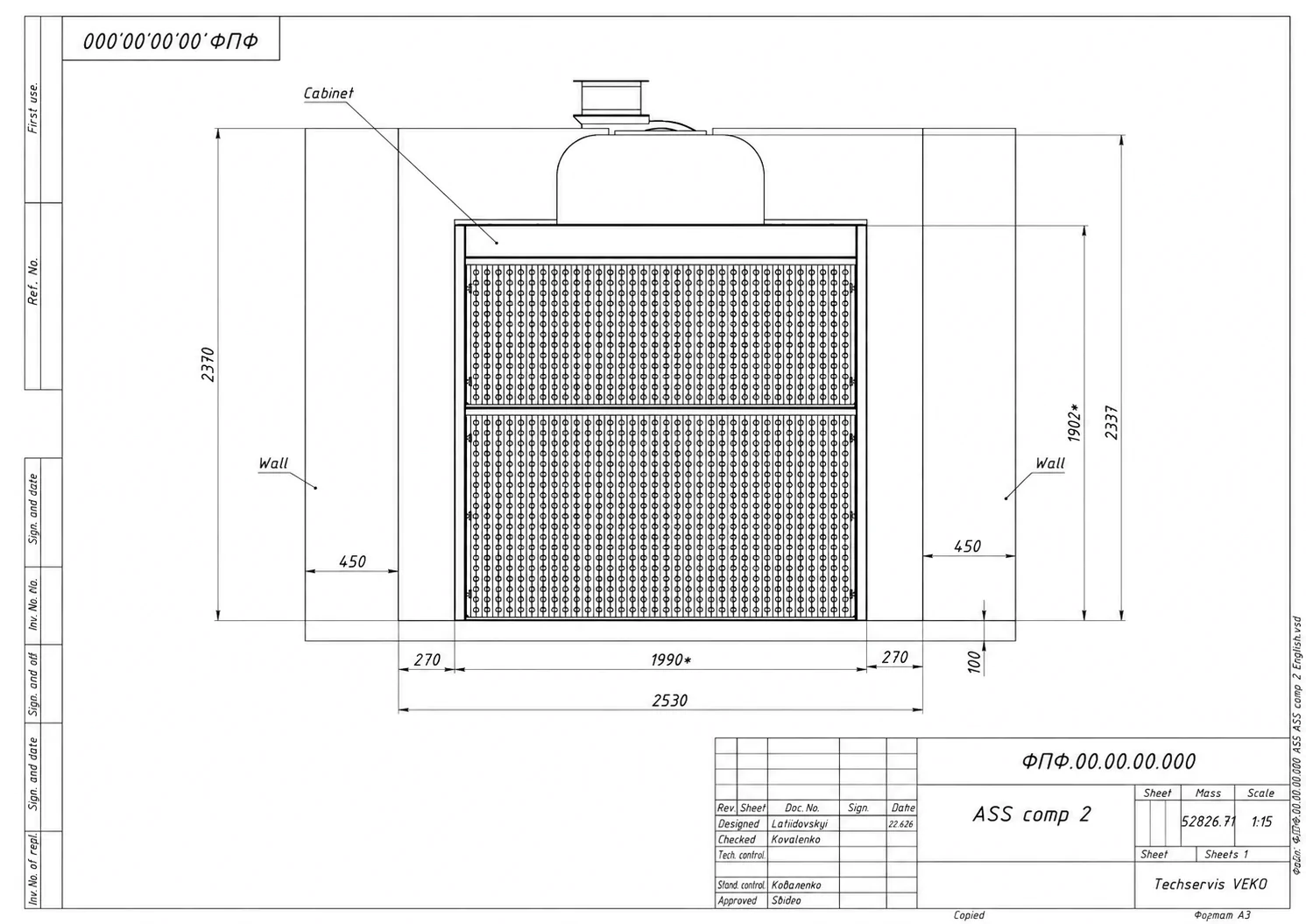
To meet this challenge, TWEKO specialists developed a custom solution based on the ASS Compact exhaust cabinet, adapted to the customer’s existing spray booth. With overall dimensions of 1990 × 2096 × 602 mm and a working area of 1890 × 1946 mm, the cabinet is designed for efficient painting of compact and medium-sized parts.
To remove paint overspray from the exhaust air, the cabinet is equipped with a two-stage dry filtration system consisting of a labyrinth cardboard filter and a fiberglass filter. The required airflow is provided by a centrifugal ventilation unit with a capacity of up to 6,500 m³/h, ensuring the specified air velocity of 0.25–0.4 m/s in the working area.The cabinet was designed and manufactured in a modular configuration, allowing the customer to assemble and install the equipment independently on site. This enabled rapid commissioning and minimized additional installation costs.
Technical Specifications
* Filter holding capacity depends on the type of coating material.
Overall Dimensions
Exhaust cabinet dimensions (W × H × D)
1990 × 2096 × 602 mm
Working area dimensions (W × H)
1890 × 1946 mm
Weight
300 kg
Filtration
Filtration type
Dry, two-stage
First stage
Cardboard labyrinth filter, area 3.8 m², holding capacity 5–20 kg/m²*
Second stage
Fiberglass filter, area 3.7 m², holding capacity ≈3.5 kg/m²*
Ventilation Unit
Fan type
Centrifugal, medium pressure
Fan model
VC 14-46 No. 4
Power
3 kW
Capacity
up to 6,500 m³/h
Air velocity in the working area
0.25–0.4 m/s
Requirements
Power supply
3 phases / 380 V / 50 Hz
* Holding capacity depends on the type of coating.
Modernization of the existing spray booth with the ASS Compact exhaust cabinet significantly improved paint overspray removal efficiency without any reconstruction of the production area. The custom-engineered solution ensured rapid commissioning and comfortable working conditions for painting operations.
Looking to upgrade your existing spray booth?
TWEKO specialists will select the optimal equipment configuration, develop a modernization project, and deliver a solution that integrates seamlessly into your production process.
Painting Area with Water Filtration for Fishing Lure Production
Spray booth Archives - Techservice WEKO LLC
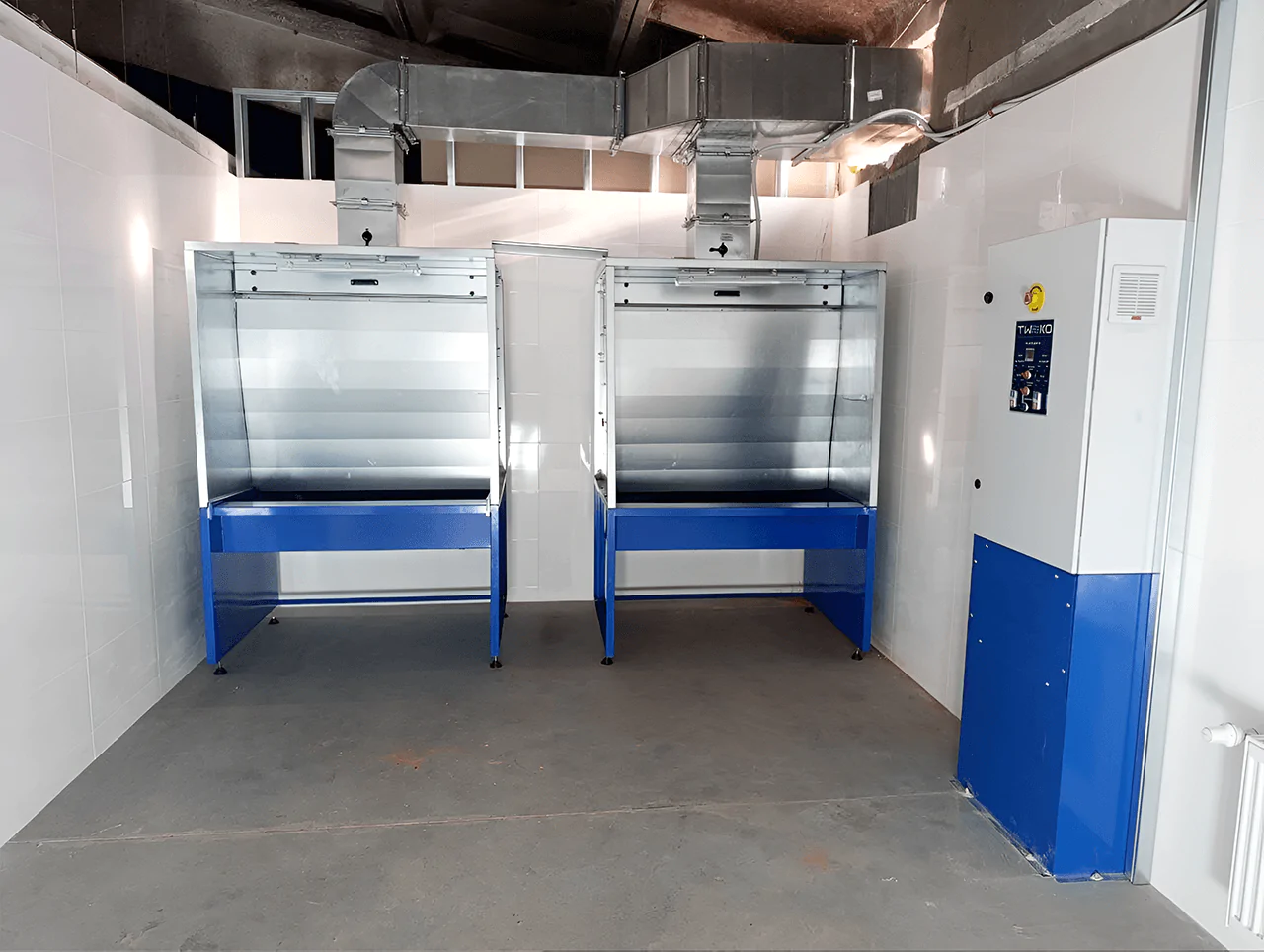
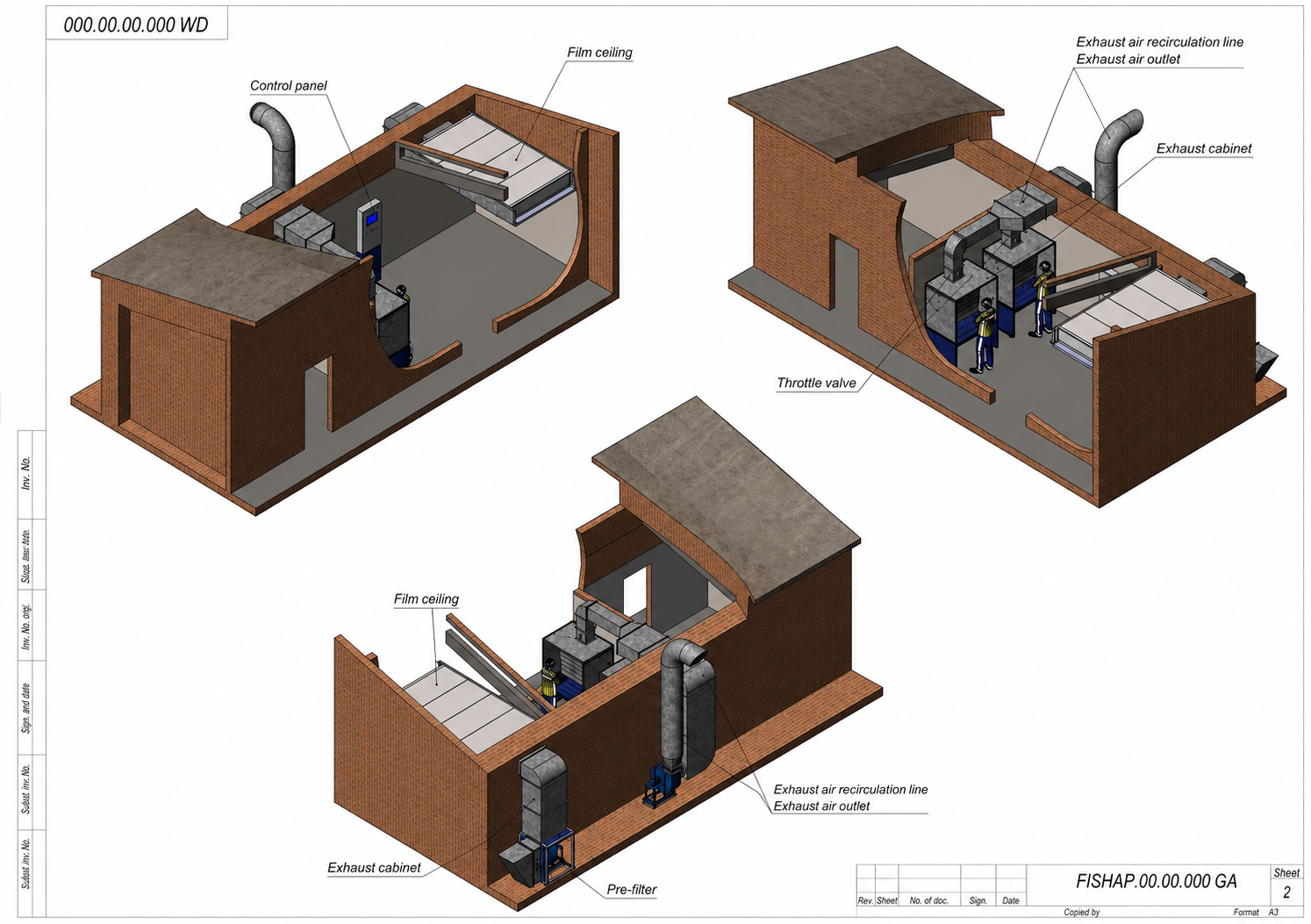
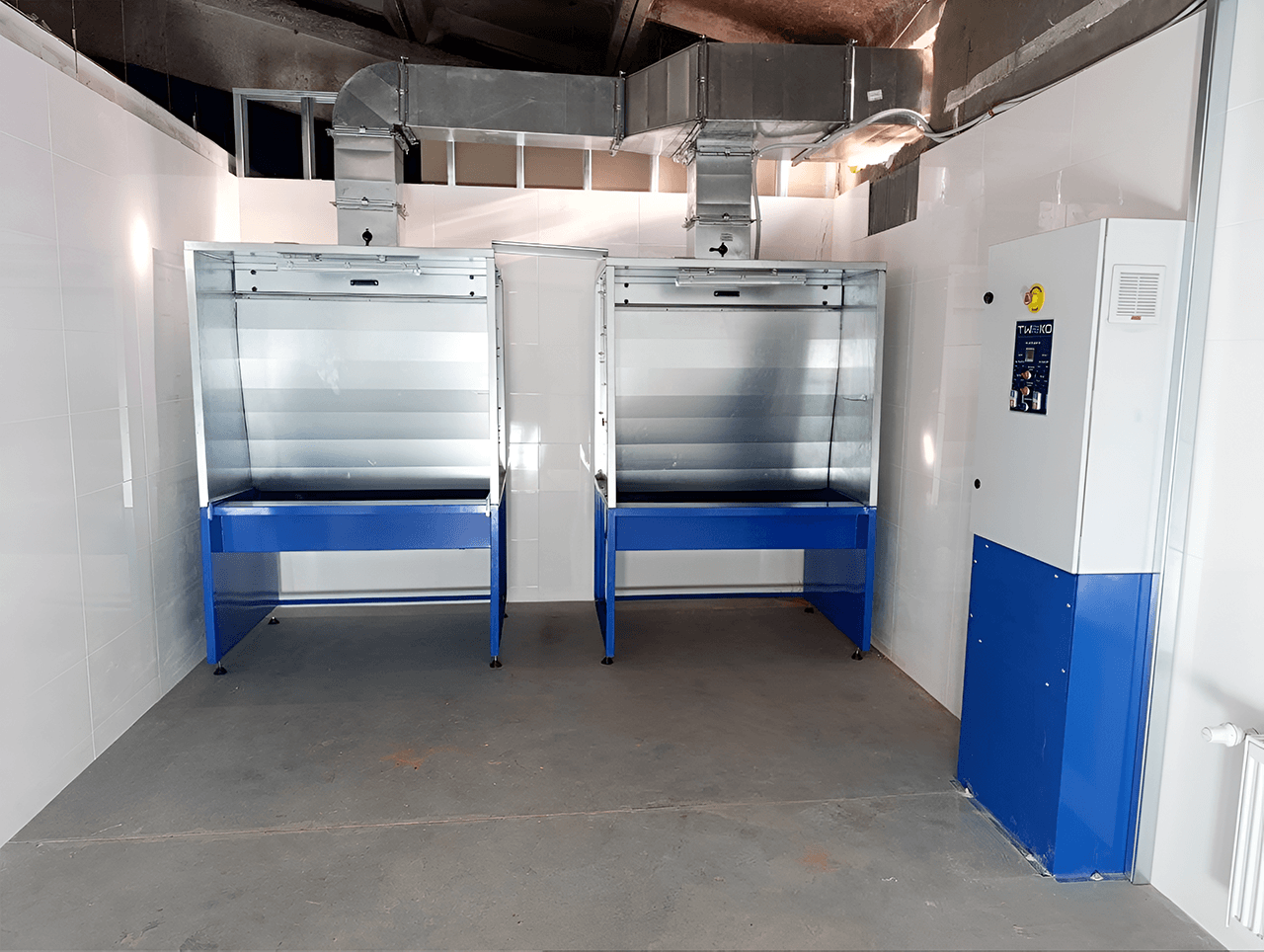
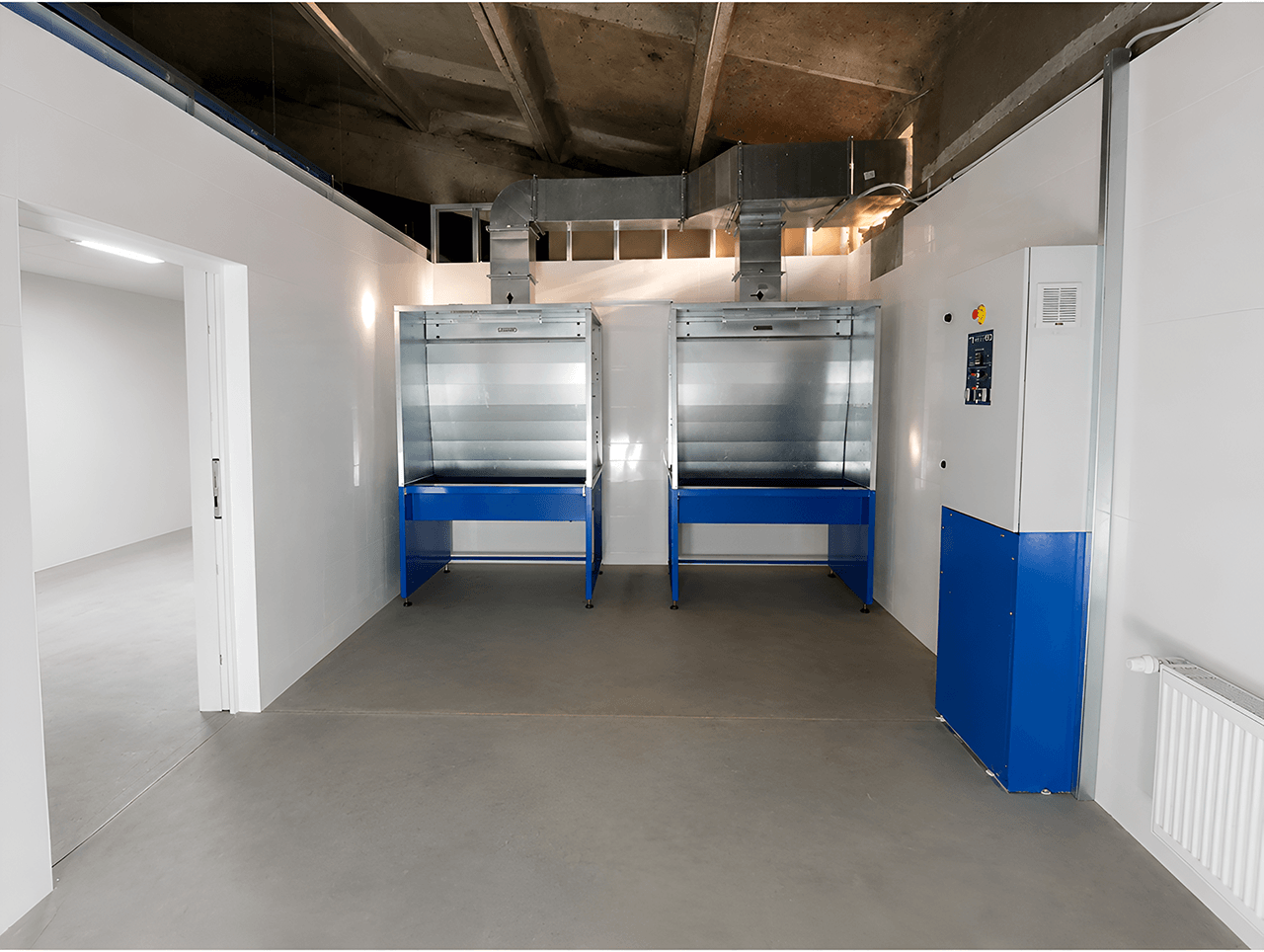
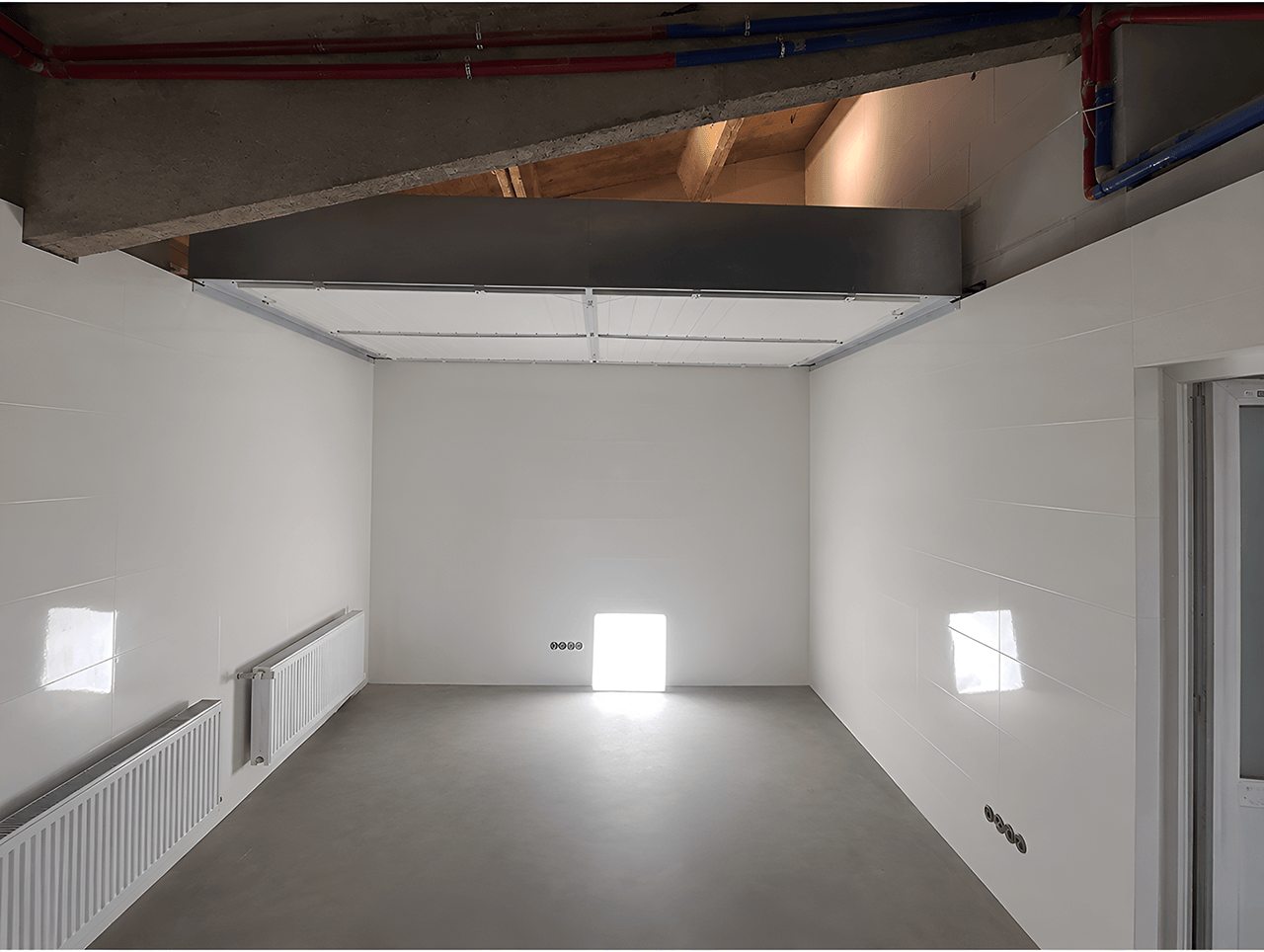
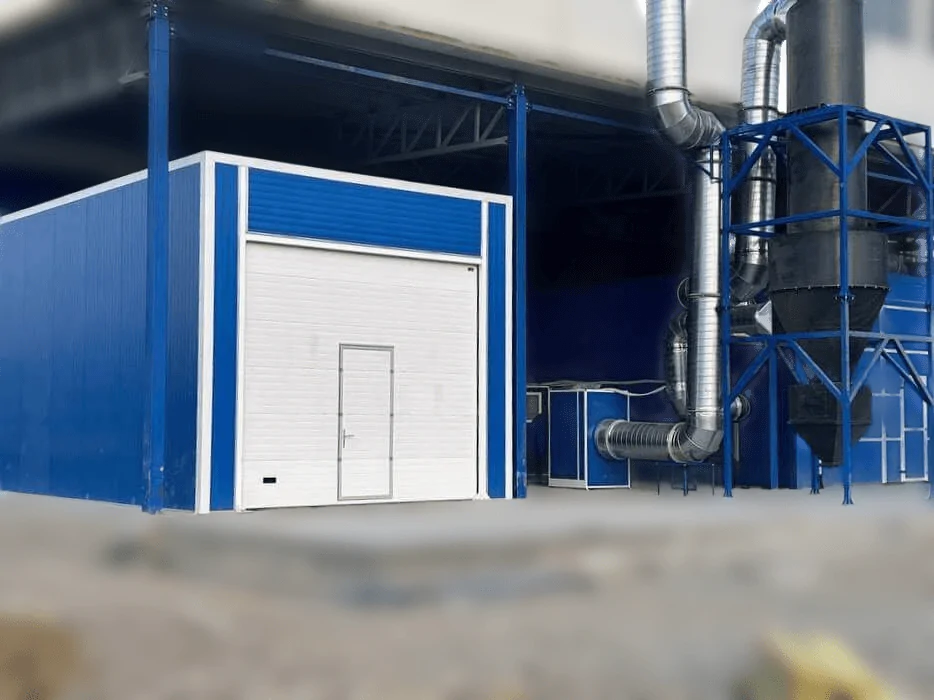
Company TWEKO designed and implemented a painting area for applying liquid coatings on fishing lures based on an FPH-series painting station with water filtration. The complex includes one station equipped with AS Hydro series water-curtain exhaust booths (ASH-1,35) with a working zone of 1000 × 1000 × 500 mm, a three-stage air purification system (two water filtration stages and one dry filtration stage), supply and exhaust ventilation with a capacity of up to 8,000 m³/h with ceiling-mounted supply of filtered air, and centralized control with variable-frequency airflow regulation. The air velocity in the working zone is 0.25–0.4 m/s, which ensures stable conditions for painting operations.
About the Client
LLC “FISHUP” (FishUp) is a Ukrainian manufacturer of spinning lures for sport and recreational fishing with its own product development and production cycle. The company specializes in the production of soft plastic lures that undergo painting, varnishing, and quality control.
After relocating production to a new facility, the company contacted TWEKO with the task of equipping a painting area.
Project Objectives
Within the project, the following tasks had to be completed:
set up a separate painting room based on the existing production facility;
organize the supply of purified and filtered air through the ceiling system;
create a painting workstation that allows multiple operators to work simultaneously;
implement painting over a water curtain to minimize paint rebound and the formation of paint overspray;
ensure the possibility of performing painting and varnishing operations on products in a suspended state;
provide comfortable and safe working conditions with a minimum noise level from the ventilation system.
Proposed Solution
In accordance with the customer’s requirements, TWEKO designed a painting area based on an FPH-series painting station with water filtration, equipped with AS Hydro series water-curtain exhaust booths (ASH-1,35), integrated into a centralized ventilation system with centralized control. The station features a working zone of 1000 × 1000 × 500 mm, is equipped with a 450 × 450 mm rotary table, and provides an air velocity in the working zone of 0.25–0.4 m/s, which meets the requirements for industrial painting operations.
A three-stage filtration system is used for air purification. It combines a water curtain with an area of 0.95 m² and approximately 250 L of circulating water, a water spray system with two nozzles, and a filter cartridge with a PaintStop fiberglass filter with an area of 0.4 m² and a paint-holding capacity of up to 3.5 kg/m² (depending on the type of coating material). This configuration ensures effective capture of paint particles and minimizes paint overspray in the working area.
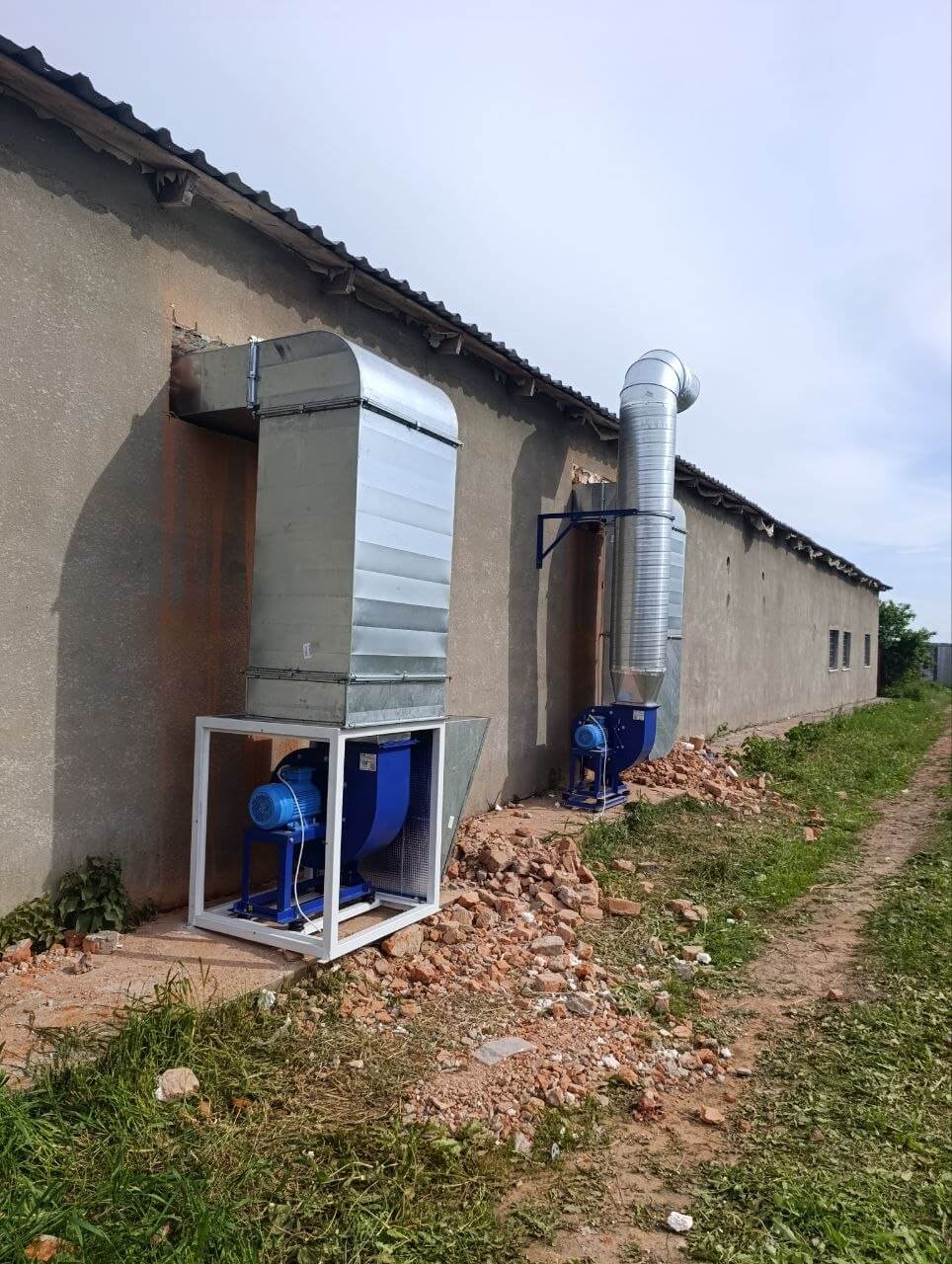
The painting area also includes supply and exhaust ventilation units, a ceiling air supply system, a water circulation system with pumps having a maximum flow rate of up to 7000 l/h, a set of air ducts, LED IP66 lighting, a control panel with automation controls, variable-frequency drives (VFDs) for smooth airflow control, a thermostat, an operating hour meter, and manual air dampers. The complex is powered by a 3×380 V / 50 Hz mains supply.
*The filter’s paint-holding capacity depends on the type of coating material.
Overall Dimensions
Exhaust booth dimensions (W × H × D)
1.08 × 2.34 × 1.00 m
Working zone dimensions (W × H × D)
1.00 × 1.00 × 0.50 m
Rotary table size
0.45 × 0.45 m
Weight (without water)
240 kg
Air velocity in the working zone
0.25–0.40 m/s
Filtration
Number of purification stages
3 stages (2 water + 1 dry)
First stage
Water curtain, area 0.95 m², circulating water volume ≈250 L
Second stage
Water spray system (2 nozzles)
Third stage
Fiberglass filter, area 0.4 m², paint-holding capacity ≈3.5 kg/m²*
Lighting
Light fixture type
LED, IP66
Light fixture power
18 W
Number of light fixtures
1 pc.
Water Circulation System
Maximum flow rate
7000 l/h
Maximum head
7 m
Maximum particle size
5 mm
Requirements
Power supply
3 phases / 380 V / 50 Hz
Foundation requirements
Floor level difference no more than ±5 mm
Looking for an efficient solution for painting small components with effective air filtration? TWEKO specialists will develop and implement a comprehensive solution — from design to commissioning.
Abrasive Blasting and Painting Complex for Large-Sized Products in Heavy Engineering
Spray booth Archives - Techservice WEKO LLC
The company TWEKO has implemented a project for the development, manufacturing, supply, and commissioning of an abrasive blasting complex and a paint and drying booth for a machine-building enterprise. The aim of the project was to introduce a controlled technological process for the preparation and painting of large-sized products, including surface cleaning, coating application, and drying. As a result, the customer received an integrated system that ensures stable process parameters and seamlessly integrates into the existing production infrastructure.
About the Client
A heavy engineering enterprise with many years of experience in the production of large-scale metal structures and machinery. The technological processes include welding, machining, and surface preparation for the application of paint and coating systems. To ensure consistent coating quality on large-sized products, it became necessary to implement controlled conditions for blasting and painting.
Proposed Solution
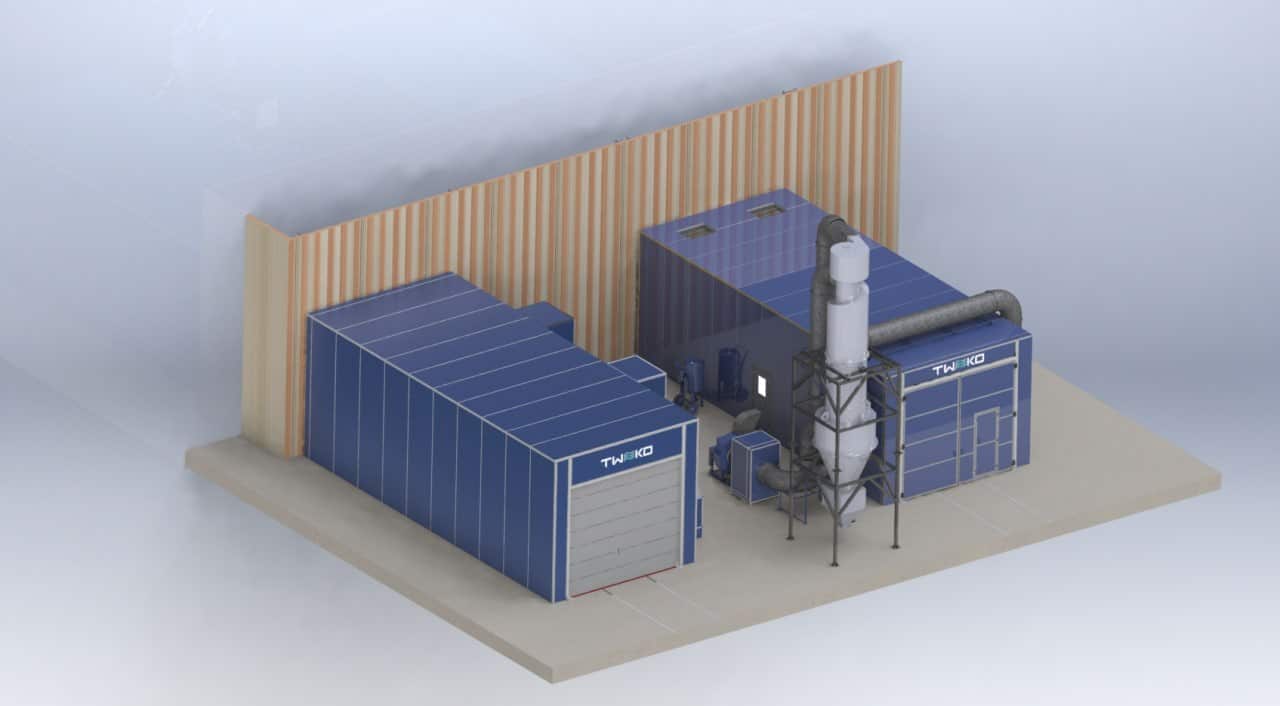
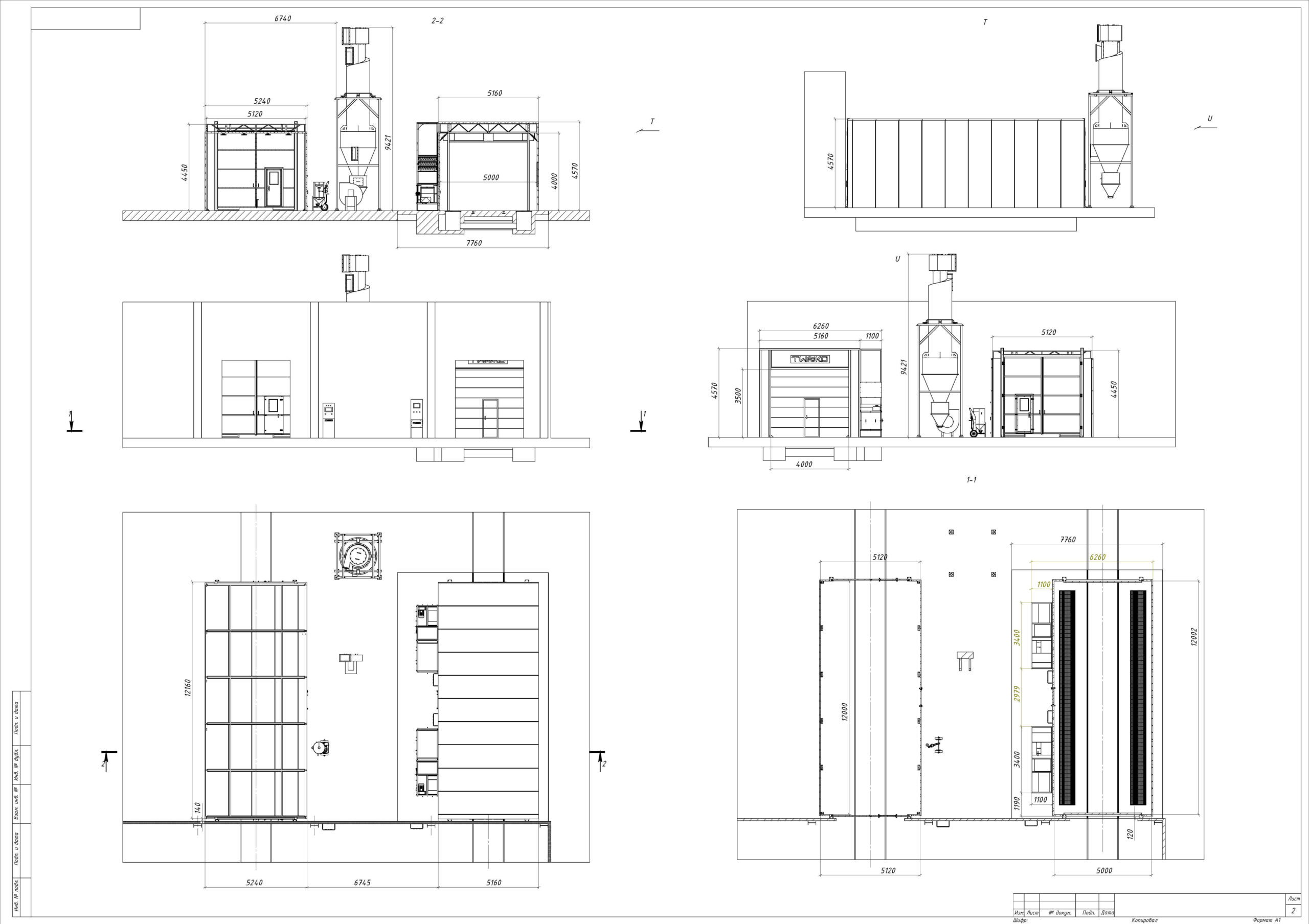
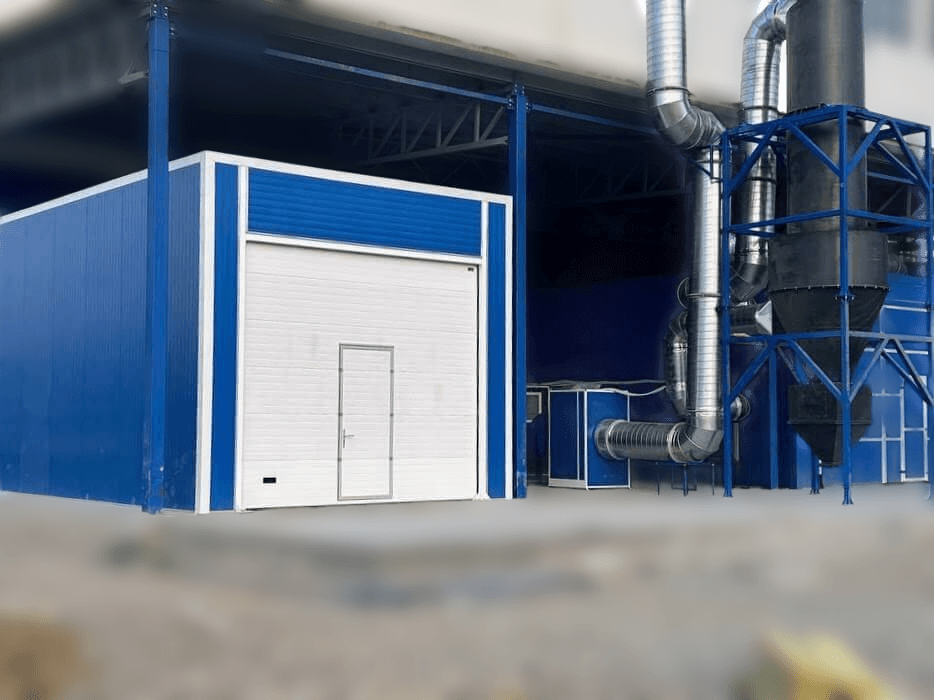
TWEKO specialists implemented an integrated technological complex based on the KASO abrasive blasting booth and the IKFS series paint and drying booth. The solution is adapted for processing large-sized products up to 12 meters in length, taking into account the specific requirements of the customer’s production.
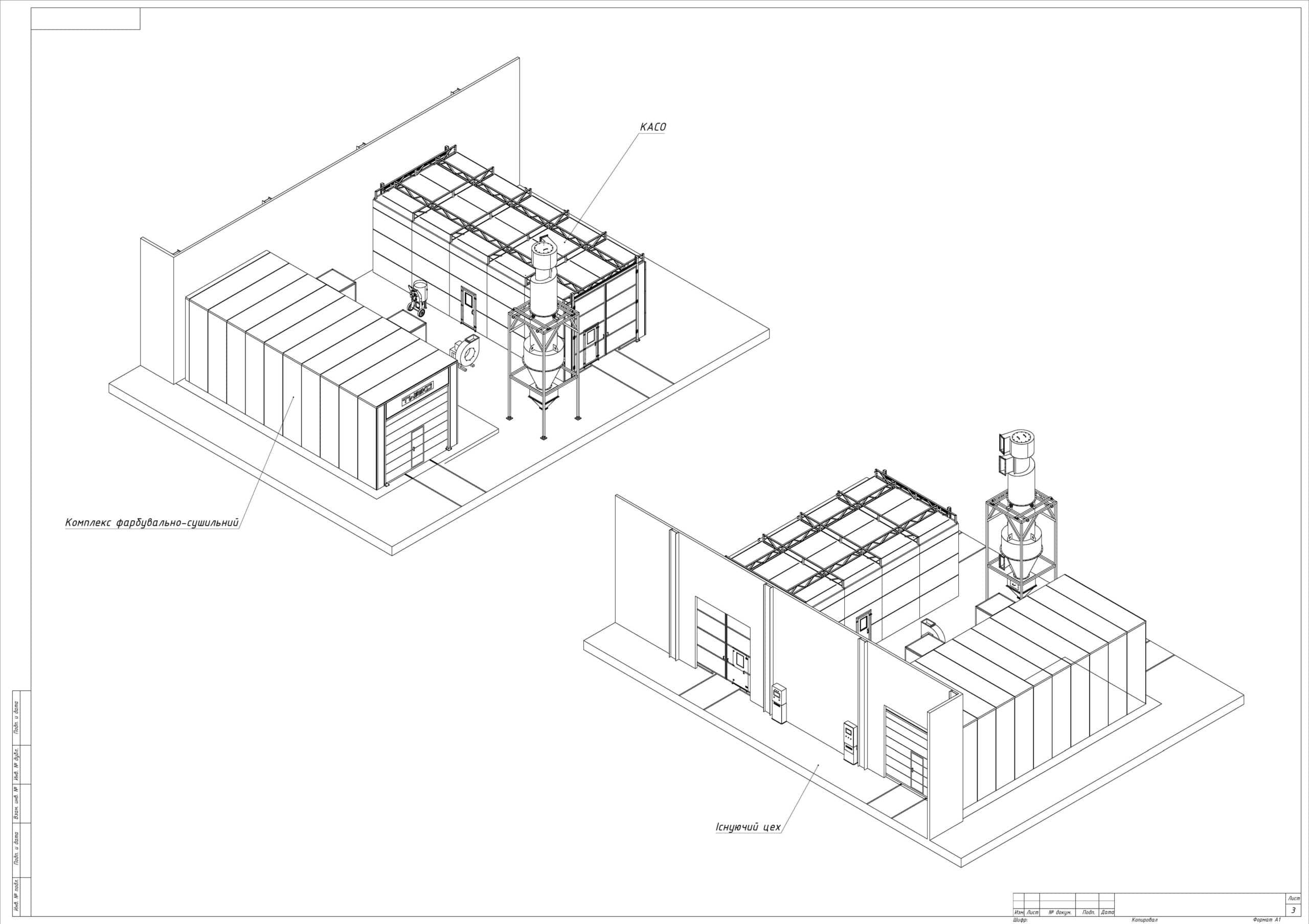
The complex provides a sequential cycle of surface preparation, coating application, and drying, with clear separation of “dirty” and “clean” processes. The booths operate autonomously and are integrated into a unified production workflow, ensuring stable air environment parameters at each stage of processing.
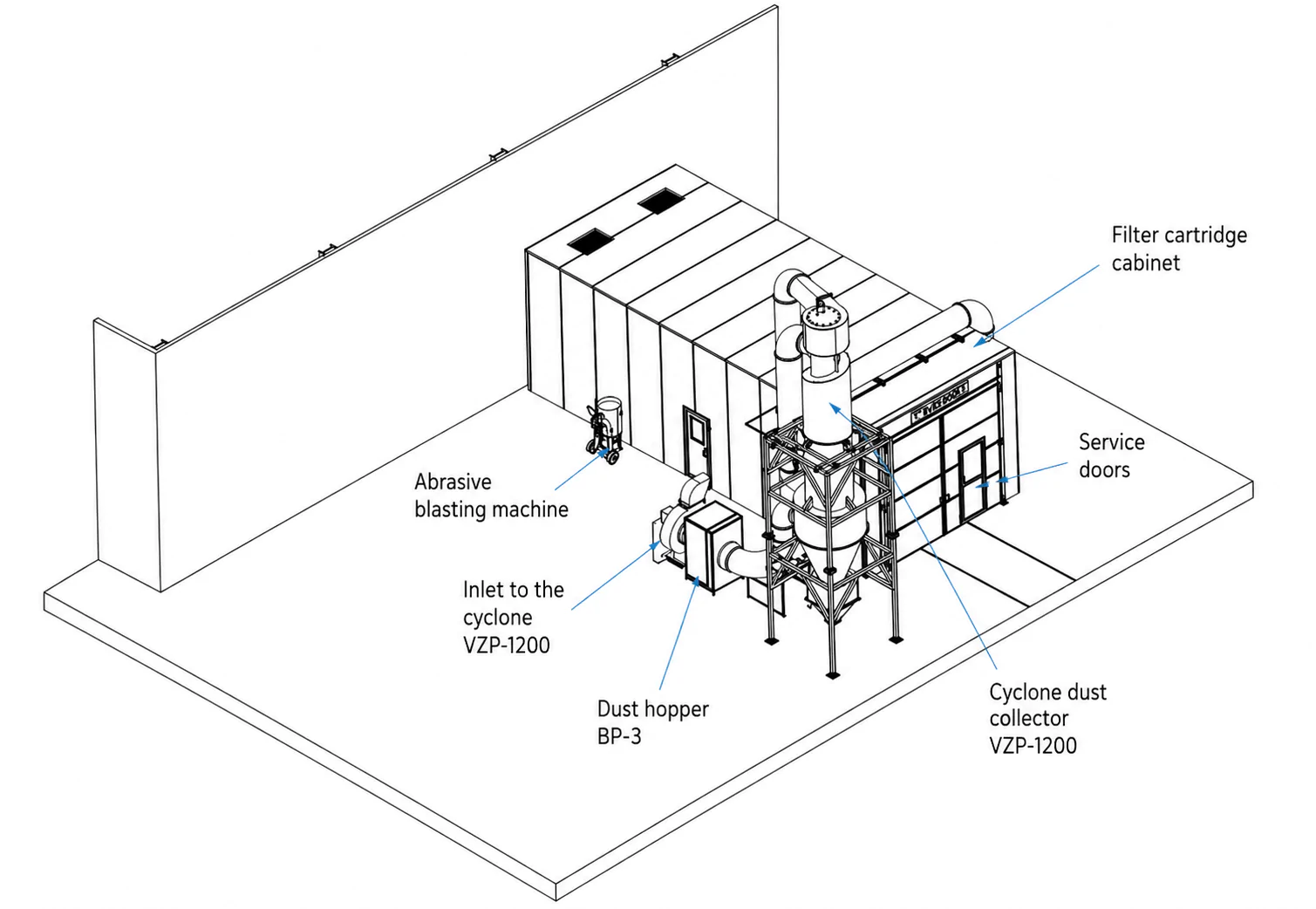
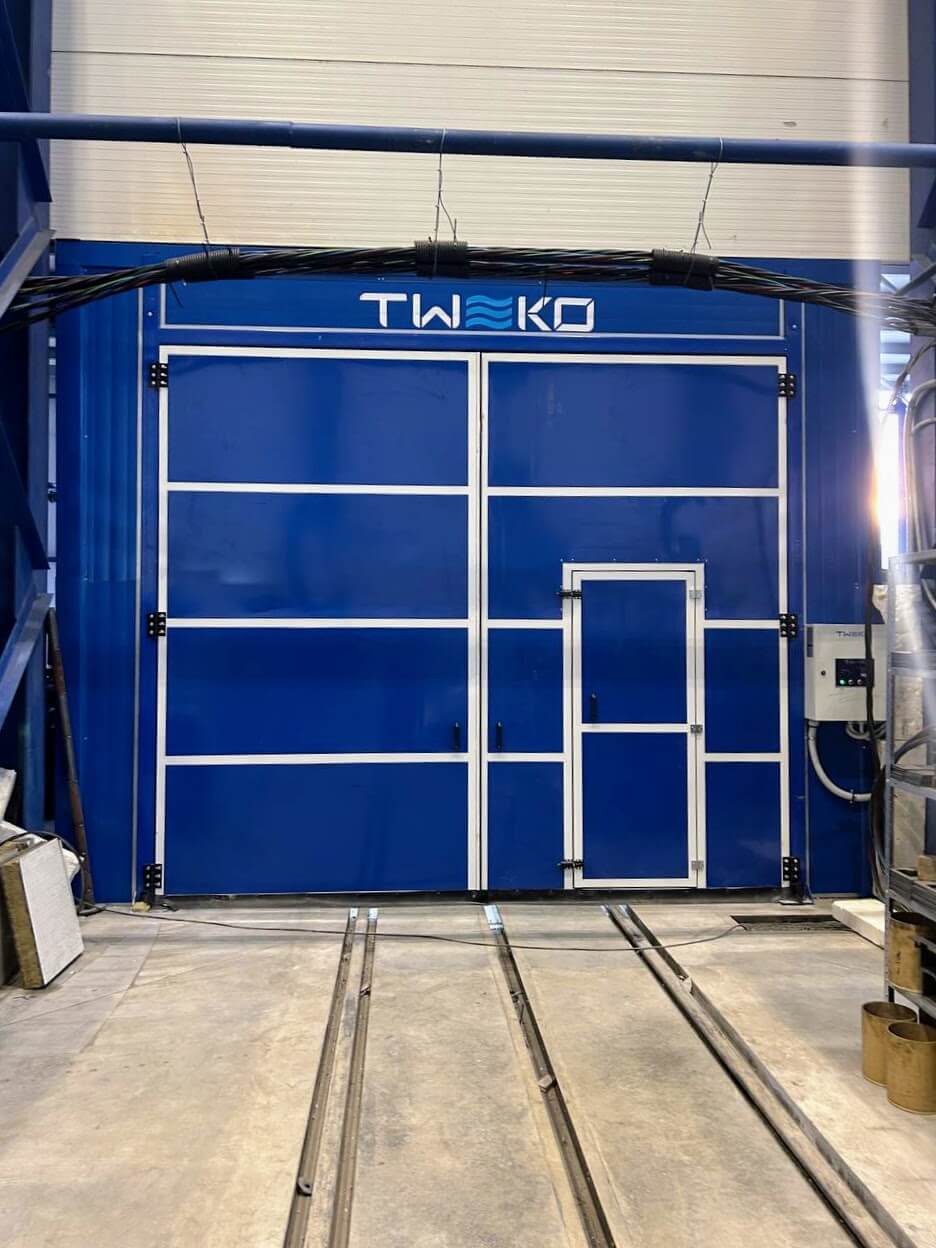
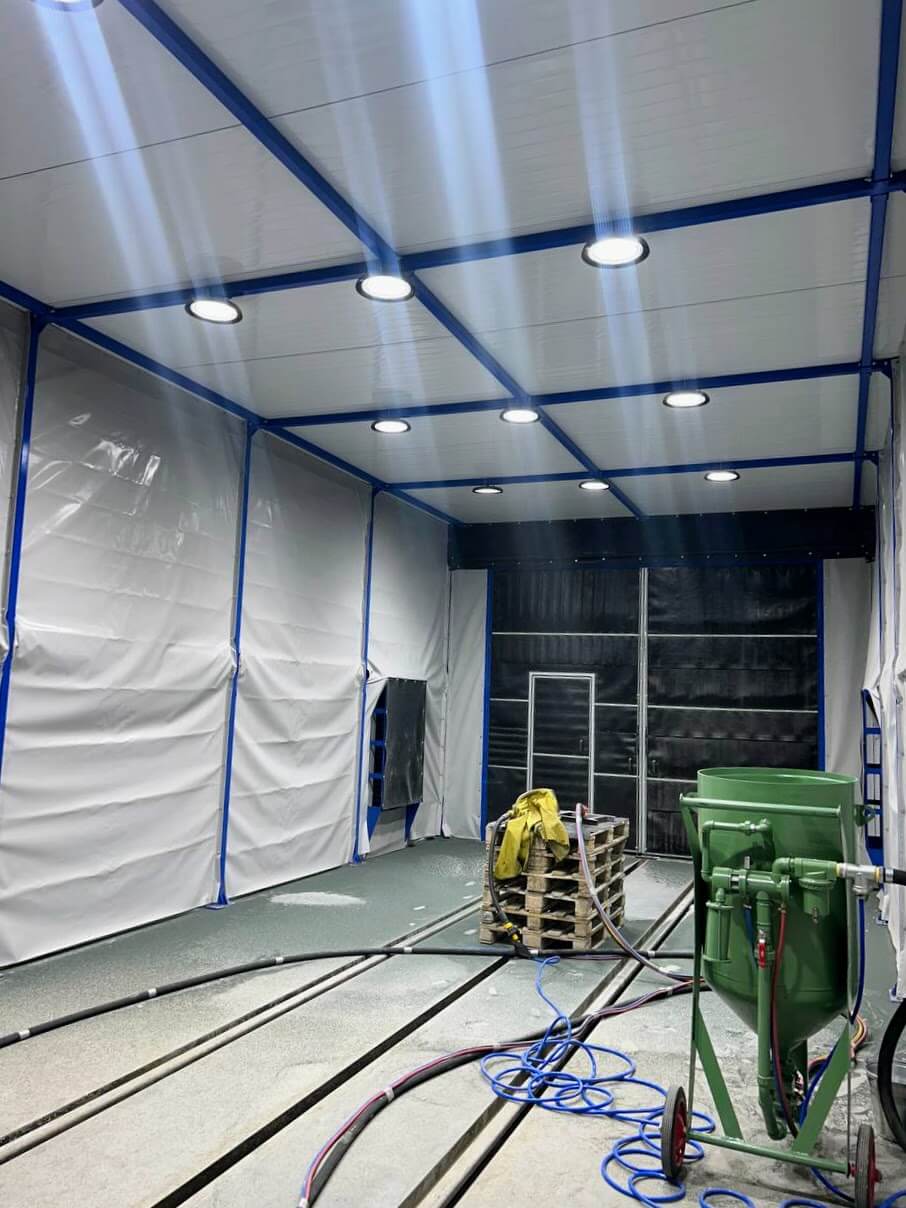
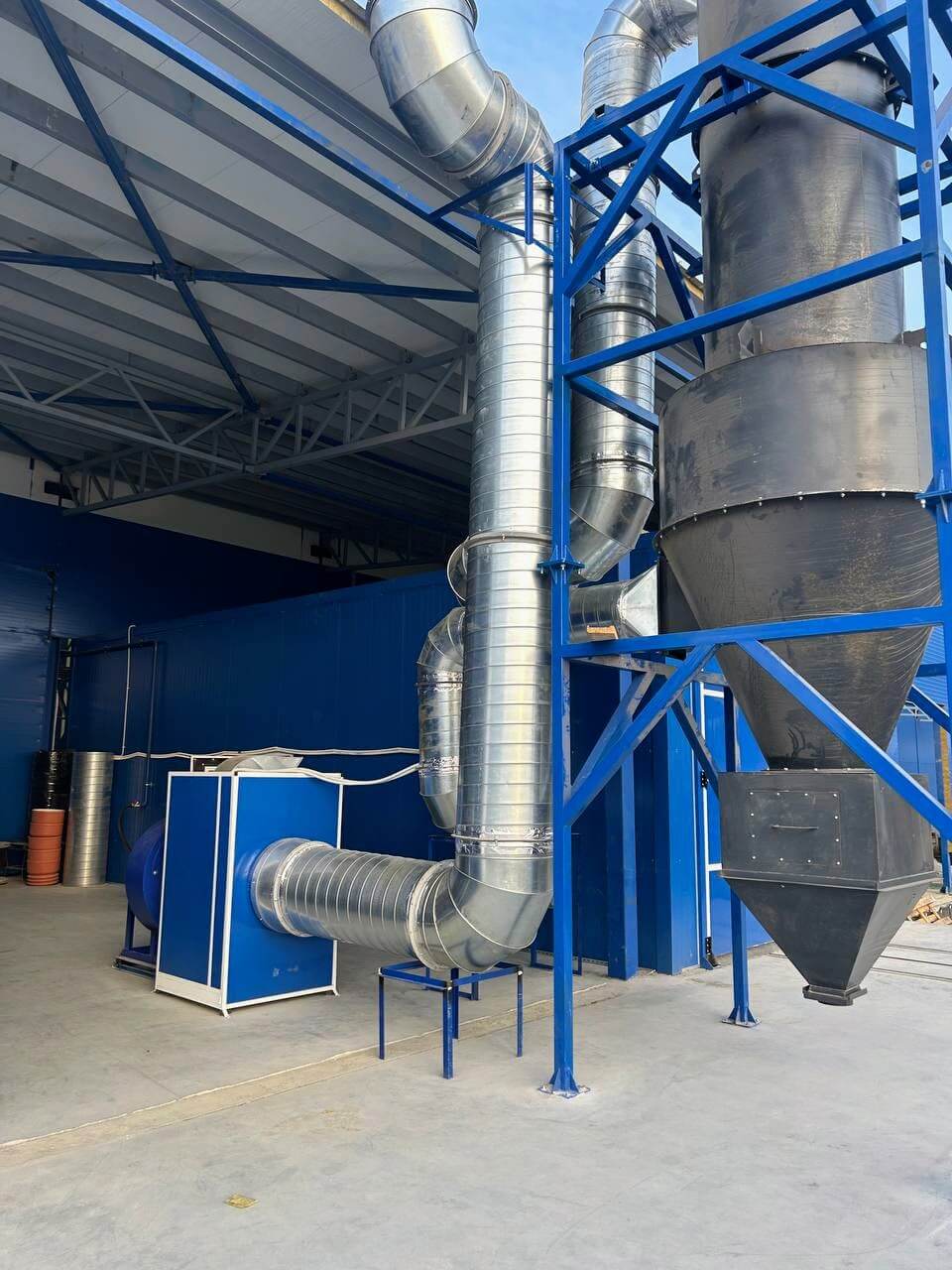
KASO-7 Abrasive Blasting Booth is equipped with an autonomous dust extraction system with abrasive recovery, including a cyclone separator and a filtration unit. The working area of the booth is 12,000 × 4,800 × 3,580 mm, allowing processing of large-sized products. The capacity of the dust extraction system reaches up to 20,000 m³/h, with an air cleaning efficiency of 96–99%.
The system provides continuous dust removal from the working area and automatic separation of abrasive material with its return to the process cycle. The cyclone separates the heavy fraction, while the filtration unit cleans the air before discharge into the atmosphere. The installed power of the dust extraction unit is up to 30 kW, and the noise level outside the booth does not exceed 70 dB.
The equipment enables simultaneous execution of blasting, dust extraction, and abrasive recovery processes, ensuring process stability and reduced abrasive consumption.
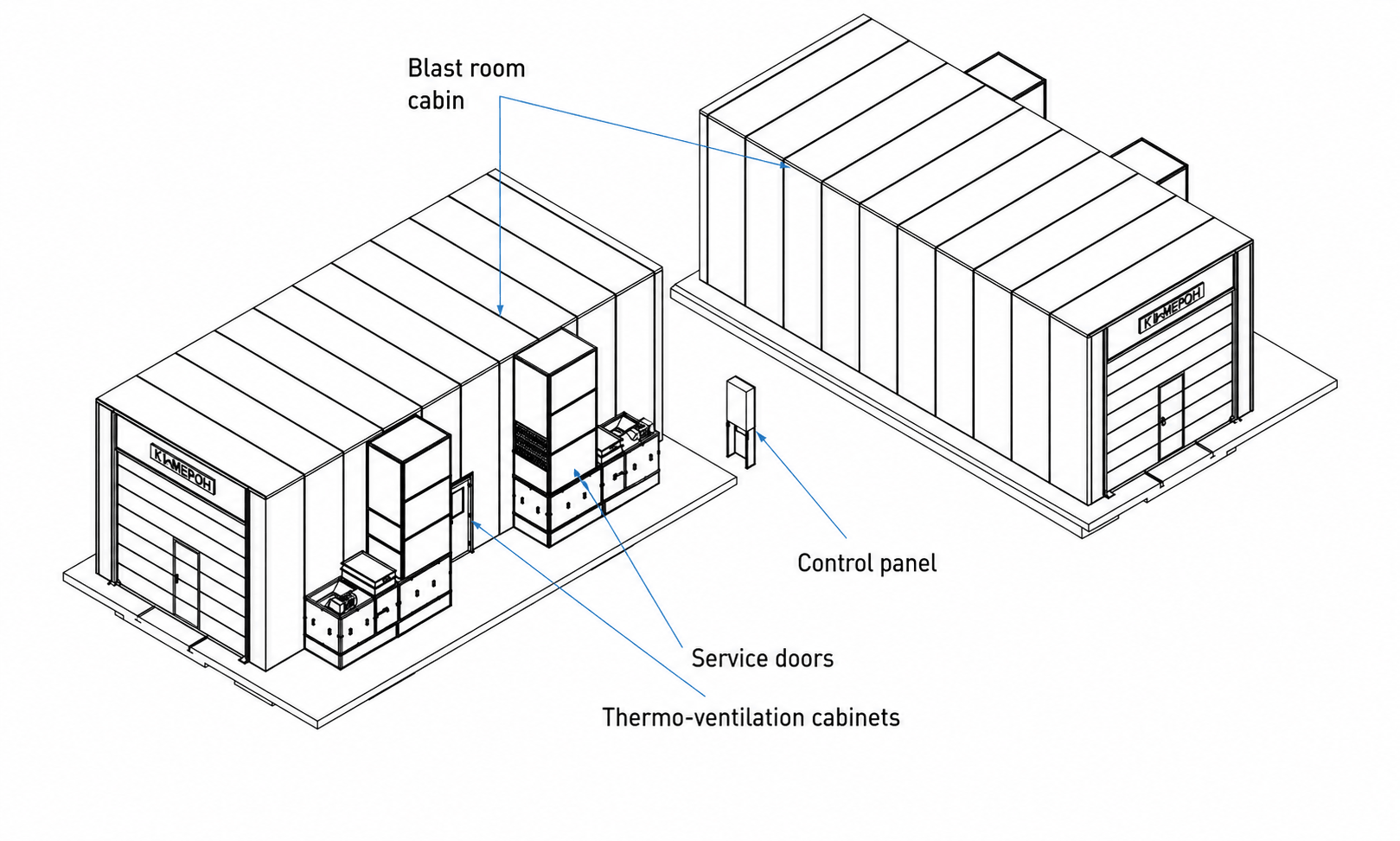
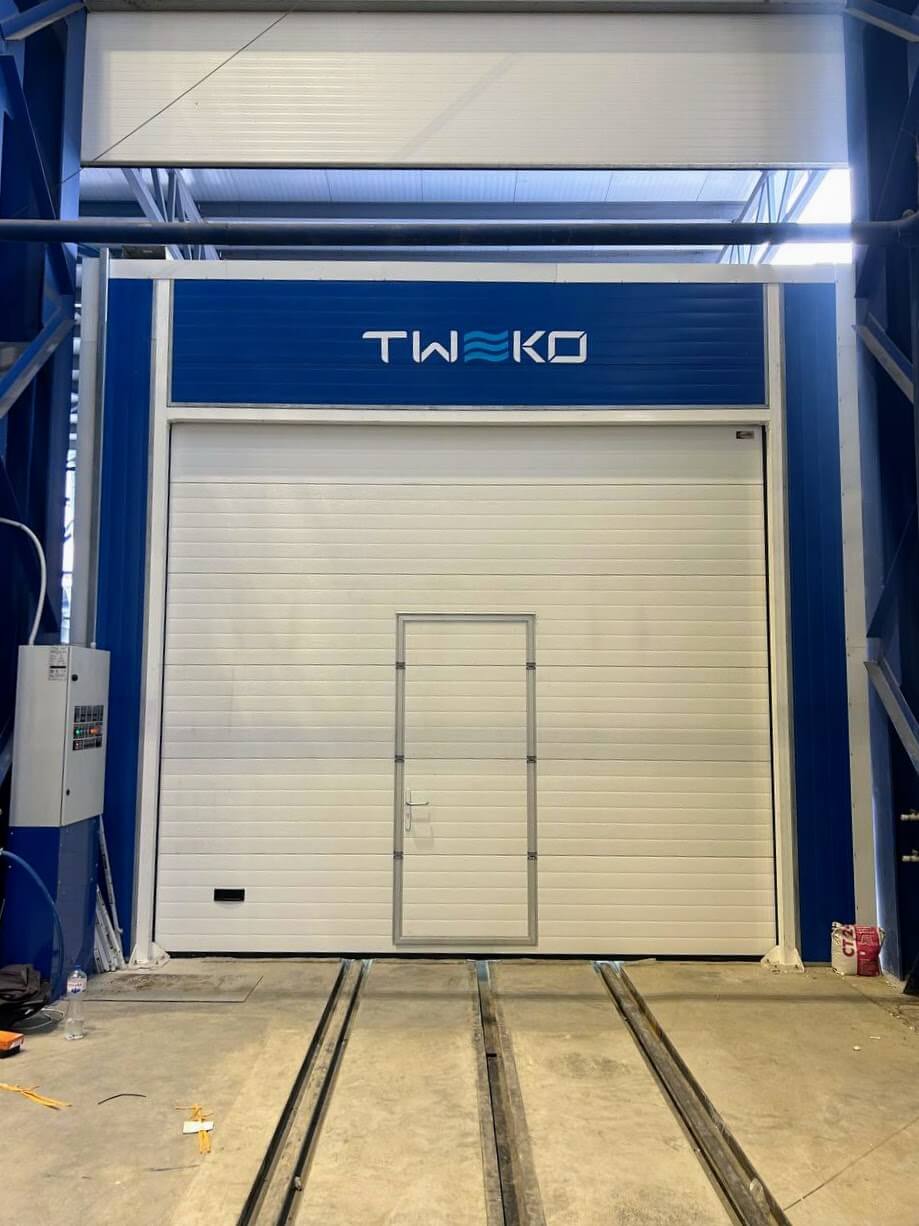
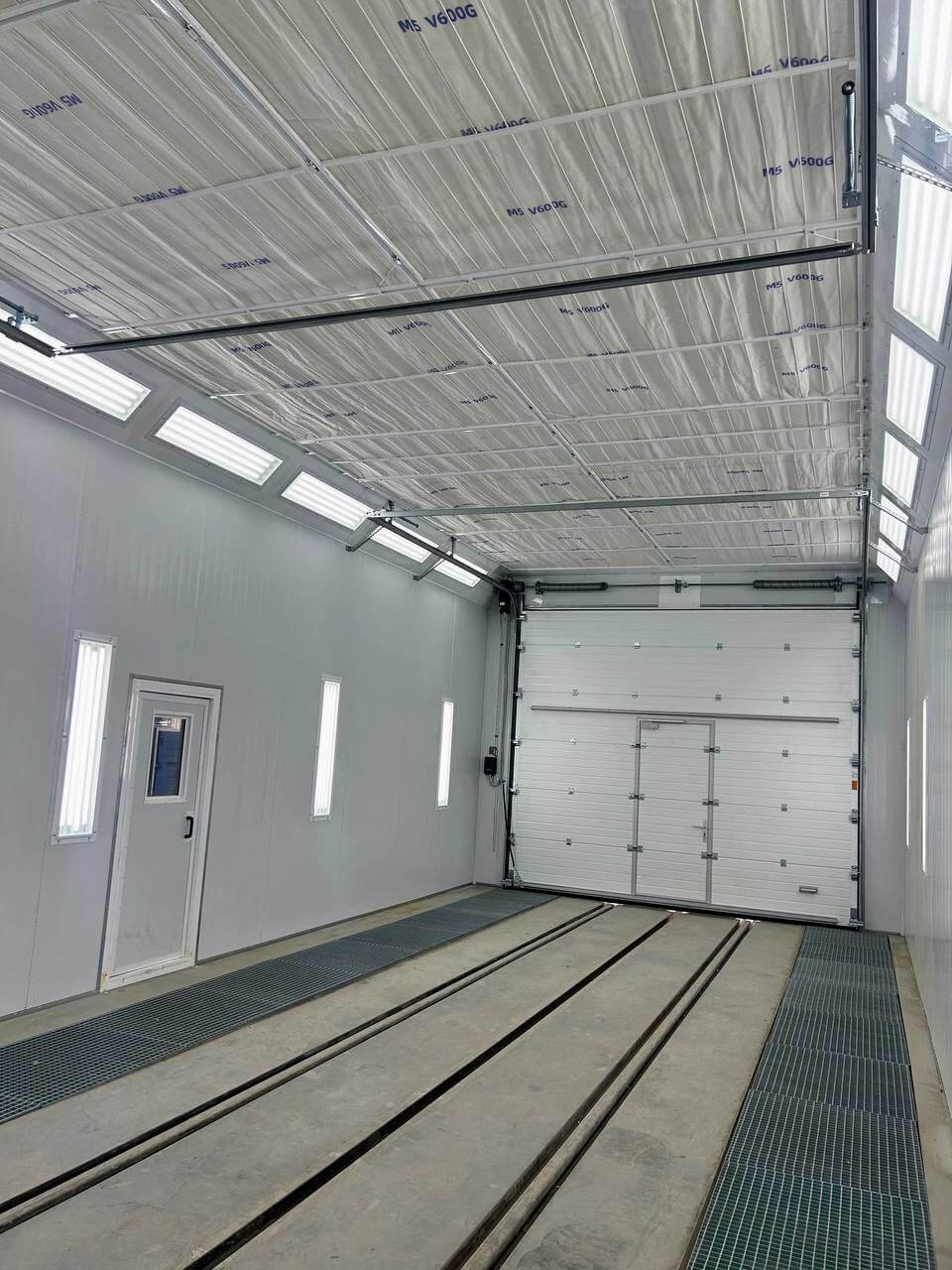
IKFS-14 Paint and Drying Booth is equipped with supply and exhaust ventilation with an air exchange rate of up to 52,000 m³/h, provided by two supply air units with a capacity of 11 kW each and one exhaust unit of 7.5 kW. The working area of the booth is 12,000 × 5,000 × 4,000 mm, allowing processing of large-sized products.
The air treatment system includes multi-stage dry filtration (pre-filters, ceiling filters, and floor filters), ensuring a filtration efficiency of up to 96.7% and uniform airflow distribution within the working area. In painting mode, a positive pressure of 10–30 Pa is maintained to prevent ingress of dust from outside.
Drying is performed using electric heating based on finned tubular heating elements (up to 60 units), with a maximum temperature of up to 80°C. In this mode, air recirculation is implemented with sequential stages: purge, heating, drying, and cooling, ensuring temperature stability and energy efficiency.
The complex is designed with separated technological zones: the abrasive blasting booth operates independently from the paint and drying booth and is equipped with a dedicated dust extraction system with abrasive recovery. A технологical buffer zone (~6.7 m) is provided between the booths, minimizing dust transfer and ensuring separation of “dirty” and “clean” processes.
The system is controlled via a programmable logic controller (PLC) with monitoring of temperature, pressure, drying time, and operating modes.
Project Results
Continuous production processing cycle ensured
Improved surface preparation quality before coating
Abrasive consumption optimized through recirculation
Reduced dust impact on the painting process
Improved working conditions for personnel
Enhanced process controllability through automation
The implemented complex ensures a complete cycle of surface preparation and coating of large-sized products typical for heavy engineering enterprises, including machine beds, frames, housings, and other metal structures. Controlled air parameters and separation of технологical zones ensure consistent coating quality on heavy and geometrically complex products.
The solution is integrated into the existing production infrastructure and can be applied in machine-building, energy, and metallurgical industries where surface preparation and corrosion protection of large-sized products are critical.
Need a solution for surface preparation and coating of large-sized products for your enterprise? Contact TWEKO specialists — we will select the optimal equipment solution according to your dimensions, технологical requirements, and production задач.
Implementation of an FPS Painting Booth in a Vocational Training Facility
Spray booth Archives - Techservice WEKO LLC
TWEKO manufactured and supplied a painting booth of the FPS series for surface preparation and application of coating materials in a training environment. The solution is designed to ensure a stable painting process for workpieces under controlled air conditions.
About the Client
The customer is Radyvyliv Professional Lyceum (Rivne region), a state vocational education institution located in the town of Radyvyliv. The lyceum provides training for skilled workers in various technical fields, including metalworking, welding, and painting operations.
Practical training requires equipment that allows working conditions to be reproduced within a controlled environment.
Project Objectives
Provide supply and exhaust ventilation with a capacity of up to 6000 m³/h for removal of paint aerosol
Implement a multi-stage dry filtration system (pre-filter, ceiling filter, cardboard/labyrinth, fiberglass)
Ensure stable temperature conditions with air heating capability (up to +30°C)
Organize a working area with dimensions 3000×2500×2500 mm considering space limitations
Provide a control system with basic functions: start/stop, temperature control, status indication, and alarm signals
To meet the project requirements, an FPS series painting booth (model FPS-2) in a compact configuration was selected, adapted to the conditions of the training facility. The system is designed to create a directed airflow through the working area using supply and exhaust ventilation and top air supply via a ceiling plenum.
The system operates by supplying filtered air through a ceiling filter and extracting air through exhaust filtration elements. A multi-stage dry filtration system is used to capture dust particles and paint aerosol.
Temperature conditions are maintained by electric heaters for the supply air, allowing operation up to +30°C. The booth is equipped with a control system providing basic monitoring and indication functions.
Project Results
Painting operations organized under controlled conditions
Ventilation and air filtration system implemented
Stable temperature conditions ensured for painting operations
Conditions created for practical training of students
The solution enables painting operations under controlled conditions and can be applied in both educational institutions and industrial environments with similar requirements. The implementation of the FPS painting booth allowed the painting process to be organized in accordance with training needs and spatial constraints.
Need a painting booth for your facility or training center? Contact TWEKO specialists — we will select a solution tailored to your requirements.
Painting and Drying Complex for an Instrumentation Manufacturing Enterprise
Spray booth Archives - Techservice WEKO LLC
TWEKO has successfully commissioned a modern paint and drying complex based on two AKFS Standard series paint and drying booths for one of Ukraine’s leading manufacturers of technological solutions. Each booth delivers a complete cycle: high-quality application of coating materials and controlled drying of complex metal structures. Thanks to a dry filtration system with multi-stage air purification and sustained positive pressure in the working area, the complex ensures consistently high coating quality, even on products with complex geometries.
About the Client
A research and production enterprise operating in the field of instrumentation and systems integration. The company provides a full cycle of complex equipment development — from R&D and engineering to serial production. The enterprise is a key partner of government institutions in the areas of technological security and import substitution. The production processes include machining and coating of metal products with stringent requirements for coating quality and uniformity.
Project Objective
The objective of the project was to ensure painting of large-sized products in a controlled air environment, with the capability to perform a separate drying cycle at regulated temperatures, implement multi-stage air filtration, maintain positive pressure in the booth within the range of 30–60 Pa, ensure uniform vertical airflow, integrate automated process control, and enable handling of heavy products with a load of up to 600 kg per wheel.
Proposed Solution
TWEKO implemented a paint and drying complex based on two identical AKFS series booths, model AKFS-S-7. Each booth has a working area of 7,000 × 4,000 × 2,700 mm, allowing processing of large-sized metal structures.
The ventilation system capacity reaches up to 22,000 m³/h. The total installed power of one booth is up to 135 kW. The noise level is approximately 65 dB in the working area.
The booths provide a complete cycle of painting and drying. Due to their identical configuration, parallel operation is enabled, which increases throughput and minimizes downtime.
The thermo-ventilation system of each booth is equipped with electric heating elements and operates in recirculation mode during the drying phase, ensuring stable temperature conditions while reducing energy consumption.
In painting mode, a vertical airflow pattern is implemented, with air supply through ceiling filters and extraction through floor filters. This configuration ensures efficient removal of paint overspray and uniform coating application.
The ventilation system includes supply and exhaust units with variable frequency drives (VFDs), allowing stable air balance and the required positive pressure to be maintained in the working area.
Air filtration is implemented using a multi-stage system: pre-filtration, ceiling fine filters, and floor filters for capturing paint overspray.
Process control is carried out using a programmable logic controller (PLC), with adjustable parameters including temperature, drying time, and ventilation operation.
Implementation Results
As a result of the project, the enterprise achieved a stable and controlled painting and drying process for large-sized products. The coating application process became uniform and repeatable.
The use of air recirculation optimized energy consumption, while maintaining positive pressure in the working area reduced the ingress of dust and contaminants into the booth.
The implemented complex fully meets the stringent technological requirements for high-quality coating of critical products and has been seamlessly integrated into the company’s production workflow.
Need a solution for painting large-sized products?
We will select the optimal equipment configuration based on your dimensions, technology, and process requirements.
Painting and Drying System for a Ventilation Equipment Manufacturer – LLC “VENTILATION SYSTEMS”
Spray booth Archives - Techservice WEKO LLC
In February 2026, TWEKO completed a project for the delivery, installation, and commissioning of a paint and drying system for a ventilation equipment manufacturer in Kyiv. The solution was designed to establish a fully functional paint shop with integrated painting and drying processes within a single production workflow.
The main objective of the project was to create a modern paint shop equipped with efficient systems to ensure high-quality coating application.
Within the scope of the project, the following tasks were defined:
to set up a paint booth with controlled airflow (up to 8000 m³/h);
to implement a supply air treatment system (coarse and fine filtration);
to ensure efficient removal of paint overspray (water curtain + additional filtration);
to maintain positive pressure inside the booth (10–30 Pa);
to provide heating of supply air (indirect heat exchanger with a diesel burner);
to install a separate drying chamber with temperatures up to 80 °C;
to implement air recirculation in the drying section;
to automate control of painting and drying processes;
to integrate safety systems (temperature monitoring, emergency shutdown);
to ensure integration with utilities (380 V power supply, compressed air 0.6–0.8 MPa);
to comply with fire safety and operational requirements.
To accomplish these objectives, a paint and drying system based on the FSC series booth was implemented. The system integrates painting and drying processes within a single production area while maintaining functional separation between zones.
All tasks were successfully completed. The core of the solution is a paint booth with a water curtain, which captures paint overspray through a combination of water-based separation and dry filtration. This approach reduces aerosol concentration in the working area and improves air cleaning efficiency.
Supply air heating in the paint booth is provided by an indirect heat exchanger equipped with a diesel burner. This design prevents combustion gases from entering the working area and ensures a controlled temperature regime.
The drying chamber is designed as a separate module and operates in air recirculation mode. Heating is provided by electric heating elements, allowing temperatures up to 80 °C and ensuring a stable drying cycle with automatic process control.
The system is operated via a centralized control panel, which provides monitoring of temperature, drying time, fan operation, heating elements, and auxiliary systems. Status indication and emergency shutdown functions are implemented to ensure safe operation when parameters exceed permissible limits.
The system was adapted to the customer’s production facility, taking into account layout constraints, connection to the electrical grid and compressed air system, as well as installation requirements on a prepared foundation with permissible level tolerances.
If your company requires efficient industrial painting solutions, contact us. We will develop a system tailored to your production and technological requirements.
Pass-Through Technological Complex for Abrasive Blasting and Spray Painting
Spray booth Archives - Techservice WEKO LLC
In September 2024, a major Ukrainian machine-building enterprise approached TWEKO with a request to develop and supply a technological complex for a complete production cycle of surface preparation, abrasive blasting, washing, spray painting, and drying of oversized products.
As part of the project, TWEKO selected the optimal equipment configuration, including an abrasive blasting chamber, a spray painting and drying booth, and auxiliary modules. The scope also covered system integration, engineering utilities installation, electrical works, commissioning, and handover of the complex for industrial operation in October 2025.
About the Client
The client is a Ukrainian design-and-manufacturing enterprise in the machine-building sector, specializing in the development, production, maintenance, and repair of specialized automotive and industrial equipment, as well as the supply of components and service support.
The enterprise provides a full range of services, including engineering design, manufacturing, technical maintenance and repair of equipment, as well as component supply and service support.
Thanks to its well-developed production base and the implementation of engineering innovations, the company is one of the stable system manufacturers in its market segment.
Solution
To ensure a complete cycle of surface preparation and coating application, TWEKO implemented a comprehensive technological solution that includes an abrasive blasting chamber, a pass-through paint-drying booth, as well as auxiliary engineering and technological systems integrated into a single production process.
Abrasive Blasting Chamber For the surface preparation stage, an abrasive blasting chamber of the KASO series manufactured by TWEKO was implemented — the KASO-15 pass-through model with a single abrasive blasting working zone. Chambers of the KASO series are designed for industrial cleaning of metal products from rust, scale, old coatings, and other contaminants, ensuring stable surface quality prior to subsequent technological operations.The pass-through layout of the KASO-15 chamber enables continuous processing of oversized assemblies and units and integration of the equipment into a flow-oriented production process, minimizing downtime and manual operations. The chamber design and engineering systems are adapted for intensive industrial operation and meet the requirements of heavy engineering and serial production facilities.The chamber is equipped with:
A mechanized abrasive collection and regeneration system with a closed-loop cycle, including a scraper floor, bucket elevator, separator, and storage hopper, providing automatic return of cleaned abrasive to the working process.
Filtration and ventilation units with cartridge filtration and pulse-jet filter regeneration, designed for effective removal of dust-laden air from the working zone during abrasive blasting operations.
A ventilation system with controlled extraction of dust-laden air, ensuring compliance with permissible sanitary and acoustic parameters in the service area.
An automated control panel with status indication of key chamber components, monitoring operation of ventilation units, abrasive regeneration systems, and transport mechanisms.
Through-type entrance and exit gates designed for processing oversized products in a flow-through mode, as well as personnel service doors equipped with interlocking elements.
Wear-resistant internal protective lining and an industrial lighting system for the working zone, adapted for intensive abrasive blasting conditions.
The chamber structure, engineering systems, and control automation were implemented in accordance with the requirements of the technological process and the operating conditions of the enterprise, ensuring stable industrial operation of the equipment and its full integration into the customer’s production infrastructure.
Paint and Drying Booth For the coating application and drying stages within the complex, a spray painting and drying booth of the IKFS Diagonal series, model IKFS-2-15, was implemented. The booth is designed for processing oversized products under industrial production conditions.The booth is designed with a pass-through layout featuring two working zones and a diagonal airflow arrangement. This configuration ensures uniform air distribution during painting, efficient removal of paint aerosols, and stable drying conditions throughout the entire volume of the product, regardless of its dimensions and geometry.The booth is equipped with:
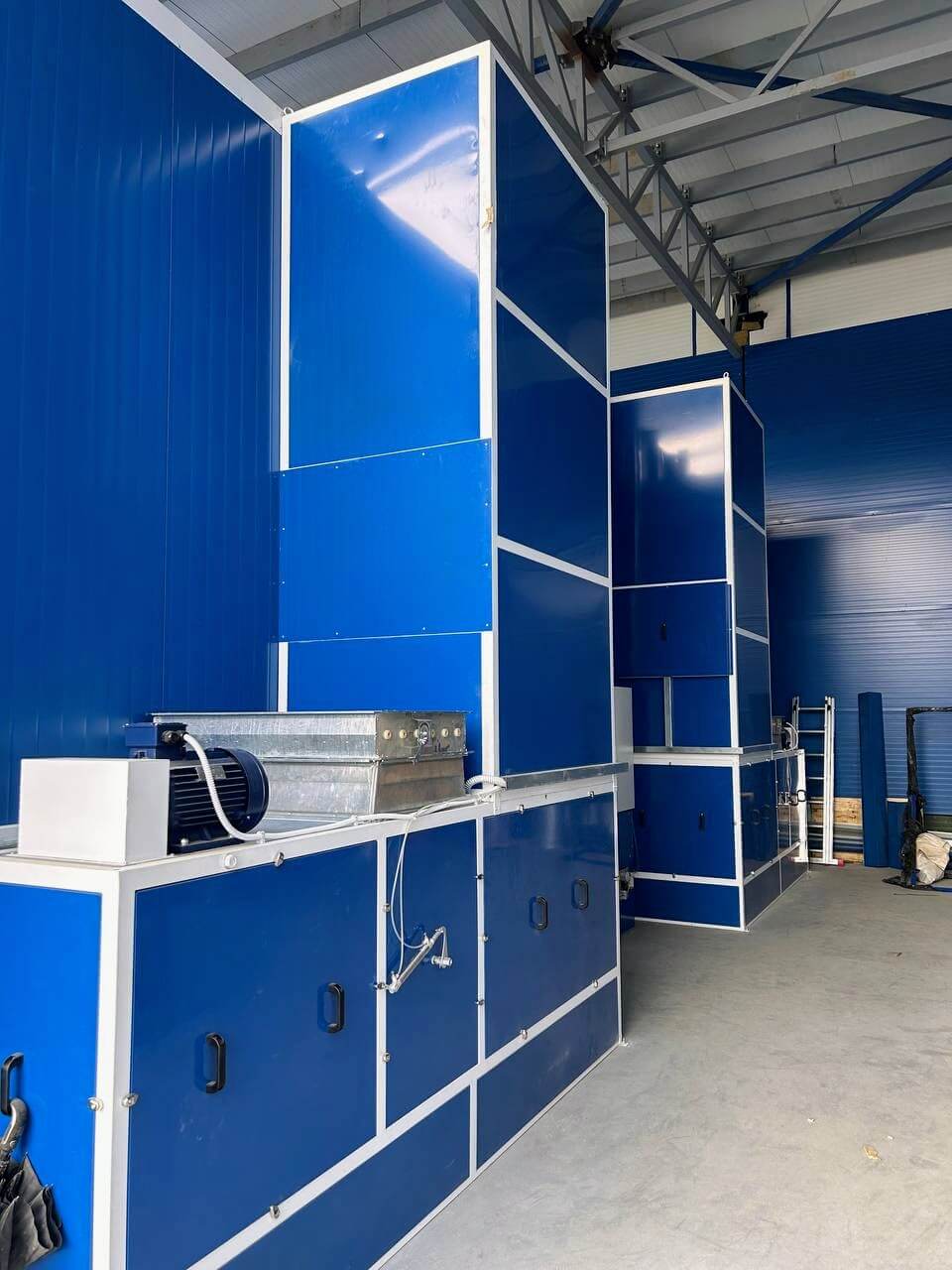
A supply-and-exhaust ventilation system with controlled air exchange, ensuring uniform airflow distribution within the working zones and stable conditions for coating application.
Filtration systems for supply and exhaust air, designed to clean the working zone atmosphere and reduce emissions of paint material aerosols.
Thermal ventilation units integrated into the booth structure, providing air heating, circulation, and automatic maintenance of preset temperature regimes during the drying process.
An automated control system with an operator control panel, enabling management of painting, drying, purging, and cooling modes, as well as monitoring of ventilation and thermal systems.
Technological interlocking and monitoring systems that prevent equipment operation under unacceptable temperature, pressure, or engineering system conditions.
Entrance, exit, and inter-zone gates designed for the flow-through processing of oversized products and ensuring airtightness of working zones during painting and drying.
The booth design, air exchange system, and control automation were implemented in accordance with the technical specification and design documentation, ensuring stable operation of the paint and drying equipment under industrial conditions and its integration into the enterprise’s unified technological process.
All technological modules — the abrasive blasting chamber, the spray painting and drying booth, and auxiliary engineering systems — were integrated into a single technological complex. Within the scope of the project, engineering utilities were installed, electrical installation and commissioning works were carried out, after which the equipment was put into industrial operation within the established timeframe.
Technical Specifications of the Complex
*Equipment configuration and scope according to design and operating documentation
Component
Abrasive Blasting Chamber
Paint and Drying Booth
General Characteristics
Chamber type
Pass-through, single-zone
Pass-through, two-zone
Total length*
≈ 11.5 m
≈ 15.2 m
Dimensions
Internal dimensions (working area)
≈ 11.0 × 6.5 × 5.2 m
≈ 7.5 × 6.0 × 5.0 m (each zone)
Overall dimensions
≈ 11.5 × 10.1 × 5.8 m
≈ 15.2 × 7.3 × 5.7 m
Service Access
Service doors
840 × 1,975 mm, 2 pcs
Provided
Ventilation and Air Exchange
Ventilation type
Filtration and ventilation system
Supply and exhaust ventilation
Ventilation capacity
30,000 m³/h × 2 units
32,500 m³/h — supply
25,000 m³/h — exhaust
Technological Systems
Main purpose
Abrasive blasting surface preparation
Painting and drying of products
Heating system
Not provided
Diesel burners, 2 units
Maximum chamber temperature
—
up to 60 °C
Power Supply and Lighting
Equipment power supply
380 V / 50 Hz
380 V / 50 Hz
Lighting power supply
220 V / 50 Hz
220 V / 50 Hz
Maximum lighting power
up to 2 kW
up to 3 kW
Acoustic Parameters
Noise level outside the chamber
up to 70 dB
up to 70 dB
Key Components of the Abrasive Blasting Chamber (KASO) and Paint & Drying Booth (IKFS)
*Equipment scope and configuration according to design and operating documentation
Component
KASO
IKFS
Cabin
Metal cabin of a pass-through design with a single working zone, equipped with entry and exit gates, personnel service doors, internal wear-resistant protective lining, industrial lighting system, and sealing elements adapted to abrasive blasting operating conditions.
Metal cabin of a pass-through design with two independent working zones, featuring entry, exit, and inter-zone gates, personnel service doors, ceiling and wall-mounted lighting systems, and a sealed structure designed for painting and drying modes.
Material Processing System
Mechanized abrasive collection and regeneration system with a closed-loop cycle, including a scraper floor, bucket elevator (bucket conveyor), separator, storage hopper, and automatic return of cleaned abrasive to the working process.
Paint application and product drying system utilizing thermo-ventilation units, controlled air exchange, and automatic maintenance of specified process parameters.
Filtration and Ventilation System
Filtration and ventilation units with cartridge filtration and pulse-jet filter cleaning, air duct systems, and efficient extraction of dust-laden air from the working zone.
Supply and exhaust ventilation system with side exhaust plenums, filtration systems for supply and exhaust air, and controlled air flow distribution within the working zones of the booth.
Material Flow and Working Area
Pass-through processing layout for large-scale products and heavy assemblies, eliminating the need for reverse movement or intermediate technological operations.
Pass-through painting and drying layout for large-format products with division into two independent working zones for sequential or parallel processing.
Heating / Drying System
Not provided. The chamber is designed exclusively for abrasive blasting surface preparation without thermal treatment.
Thermo-ventilation units integrated into the booth structure, providing air heating, circulation, and automatic maintenance of drying modes.
Control System
Automated control panels with status indication of main units, monitoring of ventilation operation, abrasive regeneration systems, and material transport mechanisms.
Automated control panel with a programmable logic controller (PLC), pressure and temperature sensors, temperature controller, timers, and hour meter.
Safety and Operation
Impact-resistant industrial lighting, protective internal lining elements, interlock systems, centralized equipment operation monitoring, and interlocking of technological units.
Fire protection dampers, pressure monitoring in working zones, technological interlock systems, air flow control, and protection against operation under unacceptable parameters.
Project Implementation
The project was implemented in stages and covered the period from September 2024 to October 2025, involving TWEKO’s engineering, design, manufacturing, and service departments, as well as the customer’s construction and installation contractors.
Engineering Design and Solution Approval ▼
At the initial stage, the customer’s technical requirements were analyzed, taking into account the dimensions and weight of large-format products, their transportation inside the chambers, and the specific conditions of the production site.
development of layout solutions for the abrasive blasting chamber and the pass-through spray painting and drying booth with division into two working zones;
determination of the placement of thermo-ventilation units, ventilation, and filtration systems;
definition of requirements for foundations, pits, canopies, and engineering utilities;
preparation of recommendations for the compressor system (room dimensions, operating conditions, temperature requirements).
The design solutions were refined in close cooperation with the customer and their construction organization.
Development of Design Documentation ▼
drawings of the KASO abrasive blasting chamber and IKFS spray painting and drying booth;
drawings of frames, gates, partitions, and ceiling structures;
documentation for the scraper floor, separator, bucket elevator, and abrasive storage hopper;
schematics of ventilation systems, side exhaust plenums, and air ducts;
recommendations for pneumatic pipelines and compressor system integration.
The documentation was used for in-house equipment manufacturing and for coordinating work with contractors.
Manufacturing and Equipment Preparation ▼
metal structures of the chambers;
abrasive collection and regeneration systems;
ventilation and filtration units;
automation and control components.
Equipment was assembled and shipped in stages in accordance with the readiness of the construction works on site.
Installation and On-Site Integration ▼
installation of chamber frames and enclosure structures;
installation of the scraper floor, conveyors, separator, and abrasive hopper;
installation of ventilation units, air ducts, and filtration systems;
installation of thermo-ventilation units for the spray painting and drying booth;
routing of electrical and pneumatic utilities;
integration of control panels and automation systems.
Installation was carried out in accordance with approved procedures and under technical supervision.
Commissioning and Start-Up ▼
verification of ventilation and filtration system performance;
configuration and testing of automation and control systems;
inspection of abrasive collection and regeneration system operation;
preparation of the complex for operation with a single-zone KASO chamber and a two-zone IKFS booth.
The complex was commissioned for industrial operation in October 2025 with the issuance of the full set of technical documentation.
Operating Principle of the Complex
The technological complex is designed according to a pass-through layout and ensures the sequential execution of surface preparation, coating application, and drying operations for oversized assemblies and components.
Abrasive Blasting (KASO-15)
The workpiece is fed into the abrasive blasting chamber through the entrance gate and positioned within the working zone. Surface treatment is carried out using abrasive blasting units with a centralized abrasive supply and regeneration system.
During the blasting process:
spent abrasive falls onto the scraper floor;
is mechanically transported to the separator;
is cleaned and separated from contaminants;
is returned to the storage hopper for reuse.
Dust-laden air from the working zone is extracted through filtration and ventilation units, where it is cleaned before discharge. The operation of the abrasive recovery system, ventilation, and auxiliary mechanisms is coordinated via control panels.
Painting and Drying (IKFS-2-15)
After surface preparation is completed, the workpiece is transferred to the spray painting and drying booth, which is also designed as a pass-through, two-zone system. The booth allows painting and drying operations to be carried out in separate zones or enables parallel processing of two workpieces.
During painting:
a controlled air exchange is maintained inside the booth;
air is supplied via the intake ventilation system and extracted through side exhaust plenums;
exhaust air passes through filtration before discharge.
In drying mode:
thermo-ventilation units are activated;
the control system ensures air circulation and maintains the specified process parameters;
upon completion of drying, the booth switches to purge and cooling mode.
Control and System Interaction
All stages of the complex operation are integrated into a single control system, which enables:
management of operating modes for each chamber;
coordination of ventilation, abrasive regeneration, and drying processes;
safe and stable operation of the equipment.
Thanks to the pass-through layout and the two-zone organization of working areas, the complex is integrated into a continuous production flow and adapted to the actual operational needs of the customer.
Results for the Customer
As a result of the project implementation, the customer received a fully functional technological complex integrated into the enterprise’s production infrastructure and adapted for processing oversized products and assemblies with complex geometry.
The implemented solution provided:
a closed production cycle for surface preparation, painting, and drying within a single complex, without the need to involve external production facilities;
a pass-through processing logic with a two-zone paint and drying section, enabling flexible production planning and adaptation to current operational tasks;
stable equipment operation under intensive industrial conditions due to robust industrial design, automated control systems, and regulated installation;
controlled processing conditions at each stage of the technological process — from abrasive blasting to painting and drying;
the possibility of further development of the production area, taking into account the embedded engineering solutions and modernization reserves;
reduced technological risks through the use of coordinated design solutions and standardized installation and commissioning procedures.
The complex was commissioned for industrial operation with the transfer of a complete set of technical documentation, enabling the customer to switch to standard operating mode without additional equipment modifications.
Conclusion
The completed project demonstrated TWEKO’s capabilities in delivering comprehensive engineering solutions for industrial enterprises — from technical concept development and design to manufacturing, installation, and commissioning of equipment for industrial operation.
Within the scope of the project, a technological complex for abrasive blasting and paint-and-dry processing was designed and integrated, tailored for handling oversized products and adapted to the customer’s real production conditions. The pass-through layout, two-zone organization of working areas, and coordinated interaction of all engineering systems ensured stable and controlled operation of the complex.
The project was implemented in compliance with applicable technical requirements, safety standards, and site-specific production conditions, confirming the effectiveness of a systematic engineering approach to complex industrial challenges. The achieved result provides a solid foundation for further development of the customer’s production facilities and scaling of technological processes.
If your enterprise requires a customized technological solution for surface preparation, painting, and drying operations, the TWEKO team is ready to propose an optimal equipment configuration tailored to your production specifics and real operating conditions.
Industrial Paint Booth and Drying Chamber for a Polymer Products Manufacturer
Spray booth Archives - Techservice WEKO LLC
TWEKO implemented a project for the design, manufacturing, and commissioning of a paint booth and drying chamber of the AKFS Standart series for an industrial enterprise.
The booth is integrated into the coating production area and is designed for the application of liquid coating materials by manual pneumatic spraying, followed by controlled drying of products.
A supply and exhaust ventilation system with a capacity of up to 22,000 m³/h, combined with dry multi-stage air filtration and an indirect heating system based on a diesel burner, ensures stable coating conditions, efficient removal of paint aerosol, and uniform drying of coatings at temperatures up to 80 °C.
The installation of the system enabled the customer to establish a controlled coating process and significantly improve the consistency of coating quality in production.
About the client
The project customer is a Ukrainian industrial enterprise specializing in the production of polymer and technical components for mechanical engineering, electronics, and other engineering applications.
The company combines its own manufacturing facilities with engineering development, producing components and structural elements for industrial use.
During production, many products require protective and decorative coating. Stable coating quality requires controlled painting conditions, including stable temperature, clean air supply, efficient removal of coating aerosol, and uniform drying.
Due to the specific nature of its products, the enterprise required a specialized paint booth and drying chamber capable of handling long workpieces while maintaining stable ventilation and temperature parameters and ensuring safe working conditions for operators.
Solution
To meet the customer’s production requirements, a paint booth and drying chamber of the AKFS Standart series, model AKFS-S-7, equipped with a dry air filtration system, was designed, manufactured, and commissioned.
The system was specifically adapted for processing long workpieces and provides stable conditions for the application of liquid coatings and subsequent drying in a controlled environment.
The working area of the booth measures 7000 × 4000 × 2700 mm, allowing large or long components to be coated without dimensional restrictions.
The booth enclosure is built as a panel structure made of sandwich panels with mineral wool insulation, providing effective thermal insulation and stable temperature conditions during drying.
The ventilation system operates on the principle of supply and exhaust air exchange with a capacity of up to 22,000 m³/h.
This configuration creates a uniform downward airflow in the working zone, ensuring efficient removal of paint aerosol and maintaining positive pressure of 10–30 Pa, which prevents dust from entering the booth during coating operations.
Air purification is achieved through a dry multi-stage filtration system consisting of a pre-filter, ceiling fine filters, and floor filter elements designed to capture coating particles.
The drying system uses an indirect heating heat exchanger with a diesel burner. This configuration enables stable drying temperatures of up to 80 °C while ensuring uniform heating of products in recirculation mode.
System operation is controlled via an electrical control panel equipped with a thermostat, timers, and system status indicators. Operators can adjust painting and drying modes and monitor temperature, process time, and ventilation system operation.
*Equipment configuration according to design and operational documentation
Parameter
Paint Booth and Drying Chamber AKFS-S-7
Dimensions
Internal dimensions (working area)
7000 × 4000 × 2700 mm
External dimensions
10020 × 4160 × 3210 mm
Working volume
≈ 75.6 m³
Ventilation and airflow
Ventilation type
Supply and exhaust ventilation
Ventilation capacity
Up to 22,000 m³/h
Supply fan
Centrifugal fan, electric motor 7.5 kW, 1000 rpm
Exhaust fan
Centrifugal fan, electric motor 7.5 kW, 1500 rpm
Operating positive pressure
10–30 Pa
Air filtration
Filtration type
Dry multi-stage filtration
Pre-filter
Acrylic coarse air filter
Ceiling filters
Fine filtration filters for supply air
Floor filters
Fiberglass filters for capturing paint aerosol
Heating and drying system
Heating type
Indirect heat exchanger
Burner
Diesel burner
Maximum drying temperature
Up to 80 °C
Recommended painting temperature
≈ 22 °C
Power supply and lighting
Equipment power supply
380 V / 50 Hz
Lighting
LED lighting, color temperature 6500 K
Total electrical power
Up to 17 kW
Acoustic parameters
Noise level inside the booth
Up to 65 dB
Noise level outside the booth
Up to 70 dB
Design features of the booth
Panel enclosure structure.
The booth enclosure is made of sandwich panels with mineral wool insulation approximately 60 mm thick.
The panels form a rigid enclosure that provides effective thermal insulation and stable temperature conditions during coating and drying operations.
Controlled airflow.
The supply and exhaust ventilation system with a capacity of up to 22,000 m³/h creates a stable downward airflow in the working area.
This ensures efficient removal of coating aerosol and maintains positive pressure inside the booth.
Such airflow configuration minimizes turbulence and reduces the risk of coating particles settling on the surface of workpieces.
Multi-stage dry filtration.
The air filtration system includes pre-filters, ceiling filters, and floor filter elements.
This configuration ensures effective purification of supply air and reliable capture of coating particles from the exhaust airflow.
Indirect heating system.
Air heating in drying mode is performed through an indirect heat exchanger equipped with a diesel burner.
This allows stable drying temperatures of up to 80 °C while preventing combustion products from entering the working air inside the booth.
Ease of operation.
The booth is equipped with electrically operated roller doors and service access doors.
A dedicated lighting system provides comfortable and safe working conditions for operators during coating operations.
Project implementation
The project was implemented in several stages and included engineering, design, manufacturing, and installation works aimed at creating a controlled environment for coating and drying industrial products.
Design and engineering development ▼
At the initial stage, the customer’s technical requirements were analyzed, taking into account the dimensions of the workpieces, coating technology, and installation conditions at the production facility.
analysis of the coating process and technological requirements;
determination of optimal dimensions of the working area;
development of the paint booth layout and equipment configuration;
design of the ventilation and air filtration system;
coordination of equipment placement, heat generator location, and control system configuration.
Engineering solutions were refined in cooperation with the customer’s technical specialists.
Development of design documentation ▼
Based on the approved technical solutions, a full set of engineering documentation was prepared for equipment manufacturing.
design drawings of the paint booth enclosure;
documentation for structural elements and sandwich panels;
design documentation for doors, gates, and lighting systems;
ventilation unit and air duct diagrams;
electrical schematics of control and automation systems.
The documentation was used for manufacturing and for coordinating installation works at the site.
Manufacturing and equipment preparation ▼
Equipment manufacturing was carried out at TWEKO production facilities in accordance with the approved engineering documentation.
manufacturing of booth structural elements;
production of panel enclosure components;
preparation of ventilation and filtration equipment;
assembly of the heat exchanger and burner system;
preparation of electrical equipment and control panel.
After manufacturing, the equipment was prepared for transportation and installation.
Installation and integration at the production site ▼
Installation works were carried out according to the approved project documentation and included integration of the booth into the customer’s production infrastructure.
installation of the booth enclosure and structural elements;
installation of sandwich panels and ceiling elements;
installation of doors and access systems;
installation of ventilation units and air ducts;
connection of heating and ventilation systems;
installation of electrical and pneumatic connections.
All installation works were performed with technical supervision from TWEKO engineers.
Commissioning and system start-up ▼
After installation, a complete commissioning procedure was carried out to verify the operation of all system components.
testing of ventilation and air filtration systems;
adjustment of heating and drying parameters;
verification of control and automation systems;
testing of coating and drying operating modes;
preparation of the equipment for industrial operation.
After successful testing, the booth was commissioned and handed over to the customer together with the full set of technical documentation.
What the customer received
Installation of the AKFS-S-7 paint booth and drying chamber allowed the manufacturer of polymer and technical components to establish a stable and fully controlled coating process.
The system provides the necessary technological conditions for coating products of various configurations, including clean air in the working area, controlled downward airflow, stable temperature conditions, and efficient removal of coating aerosol.
Stable coating conditions.
The supply and exhaust ventilation system ensures controlled airflow and effective removal of paint aerosol from the working zone.
Improved coating quality.
Multi-stage air filtration reduces the ingress of dust and foreign particles and minimizes the risk of coating defects such as dust inclusions or uneven coating thickness.
Efficient drying process.
The indirect heating system with a heat exchanger and diesel burner ensures uniform heating of products and stable drying temperatures.
Safe and comfortable working conditions.
Controlled airflow, air filtration, and proper lighting provide a safe and convenient working environment for operators.
Integration into the production process.
The booth became part of the coating production area, enabling coating operations to be carried out in a controlled environment without the influence of external factors.
Need a similar solution?
TWEKO engineers design and manufacture paint booths and coating systems tailored to the specific technological requirements of industrial enterprises.
We will help you select the optimal configuration based on the dimensions of your products, required productivity, and the characteristics of your production facility.
Contact our engineers to discuss your project and receive a professional consultation.
Industrial Surface Preparation and Painting Line for Large Metal Structures
The customer is a mechanical engineering enterprise specializing in the design, manufacture, and service maintenance of industrial equipment. The company works with metal products and assemblies where consistent manufacturing quality, long-term coating durability, and repeatable process performance are critically important.
The enterprise delivers comprehensive solutions for industrial clients, covering equipment engineering, fabrication of metal structures, installation, and commissioning of engineering systems for industrial operation.
The company’s primary focus is the development of reliable and efficient process equipment that optimizes production workflows, ensures high quality of finished products, and delivers strong economic efficiency during operation.
Solution
Within the project, TWEKO developed, manufactured, supplied, and commissioned a comprehensive process solution for the preparation and finishing of metal products. The solution combines abrasive blasting, paint application, and subsequent drying under controlled conditions. The equipment layout was designed with consideration for product dimensions, production intensity, and requirements for stable surface preparation quality and coating application consistency.
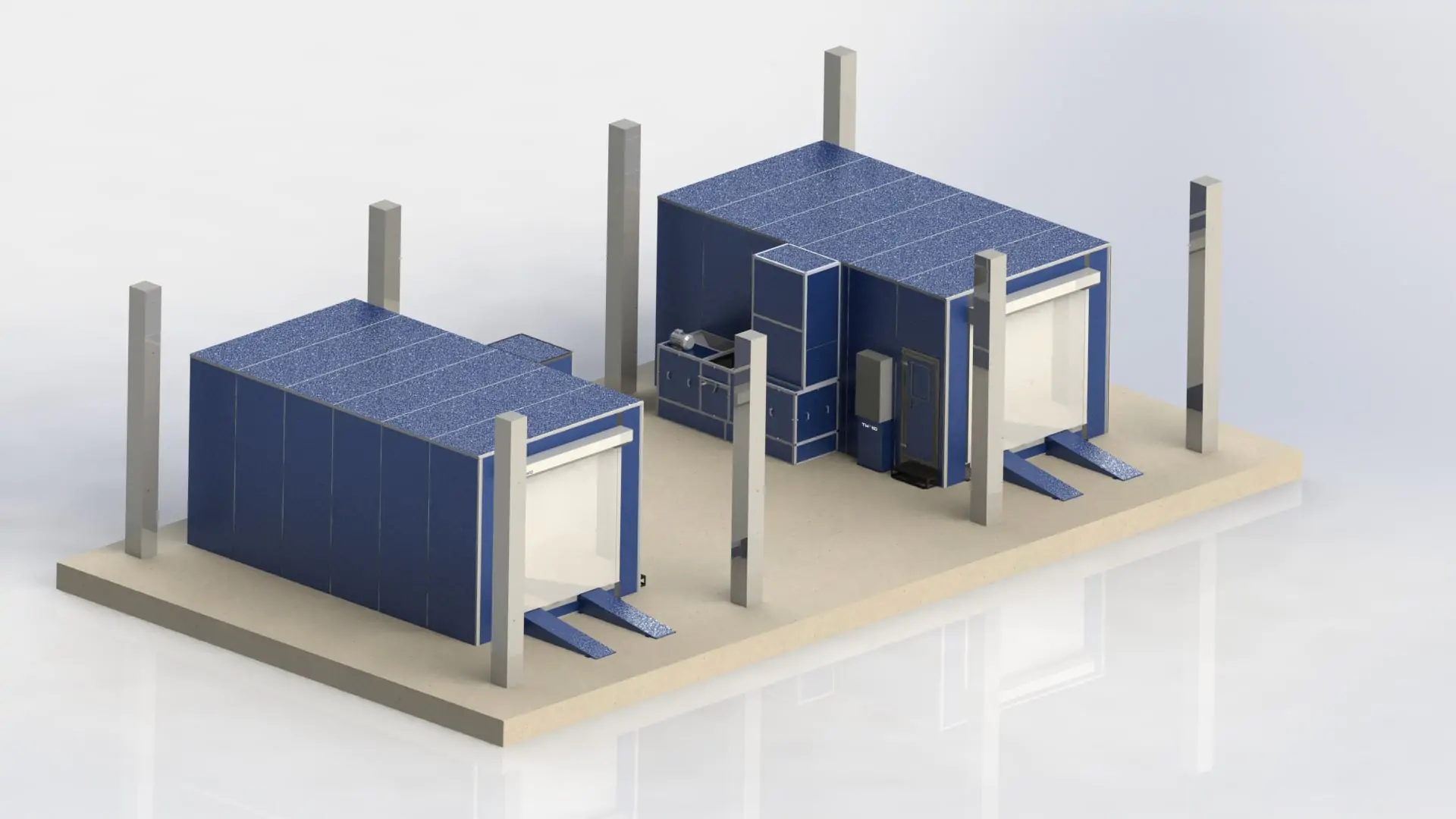
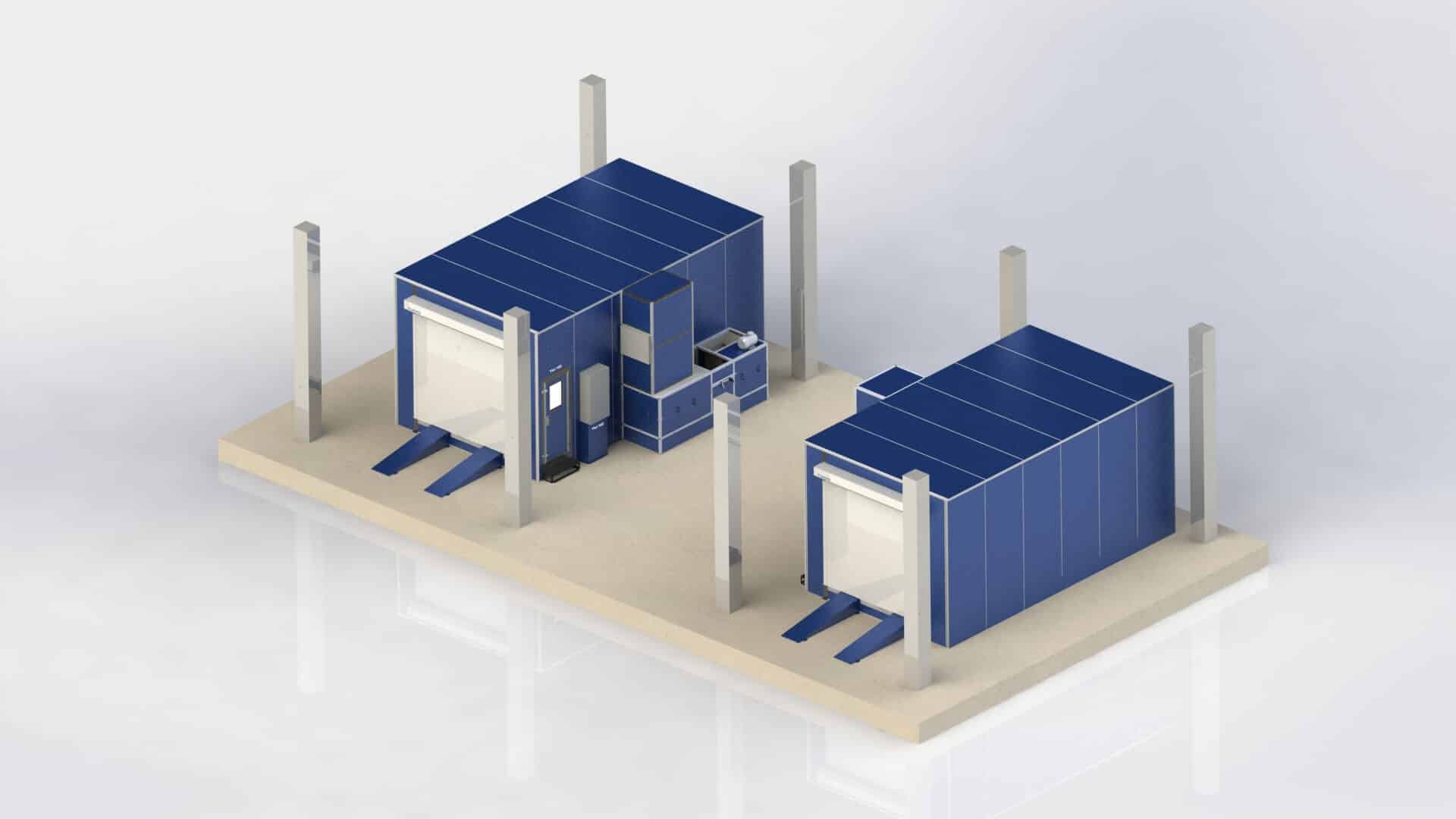
The solution is built on a modular principle and includes two key process areas: KASO series abrasive blasting chambers and IKFS series paint-spray and drying booths with integrated thermo-ventilation modules. This approach enabled a controlled production cycle for surface preparation and coating application with predictable results at every stage.
Abrasive Blasting Chambers For mechanical surface preparation of metal products, the complex includes two industrial-grade abrasive blasting chambers — KASO-12 and KASO-15 — designed for processing large and heavy components. The chambers remove mill scale, corrosion, and process contaminants while forming the required surface roughness profile prior to painting.Both chambers share a unified structural and engineering architecture, including abrasive collection and recycling systems, ventilation, filtration, and automated control. The key difference between the two chambers is the size of the working area, which allows efficient distribution of production flow based on product dimensions and helps optimize equipment utilization.Structurally, the chambers are manufactured as metal-frame cabins with internal wear-resistant lining, designed for operation under intensive abrasive load. The layout provides convenient service access and safe processing of oversized products within the production workflow.Spent abrasive collection from the working area is implemented via a mechanized scraper floor, which continuously transports material to subsequent processing units without operator intervention.Abrasive delivery to the blasting process is performed by a bucket elevator, after which the media passes through a separator to remove dust, fine fractions, and foreign inclusions. Cleaned abrasive is accumulated in a hopper and returned to the process, ensuring stable blasting parameters and rational media consumption.For dust removal and maintenance of the specified air regime, the chambers are equipped with an industrial-grade filtration and ventilation system that provides controlled air exchange in the blasting zone.
Chamber operation is controlled from a centralized control panel that coordinates key units and enables integration into the overall surface preparation line before painting.
Paint-Spray and Drying Booths For coating application and subsequent processing, the complex includes a paint-spray and drying section based on industrial-grade IKFS series booths. The solution is intended for large metal structures and provides stable painting and drying conditions with predictable results at each stage of the process.The IKFS paint-spray and drying booths operate in conjunction with the upstream abrasive blasting area, forming a complete technological cycle for surface preparation and coating application. The booth design and engineering systems are aimed at maintaining a controlled air regime, uniform thermal load, and high-quality final surface finish.
Composition and Configuration of the Paint-Spray and Drying Section
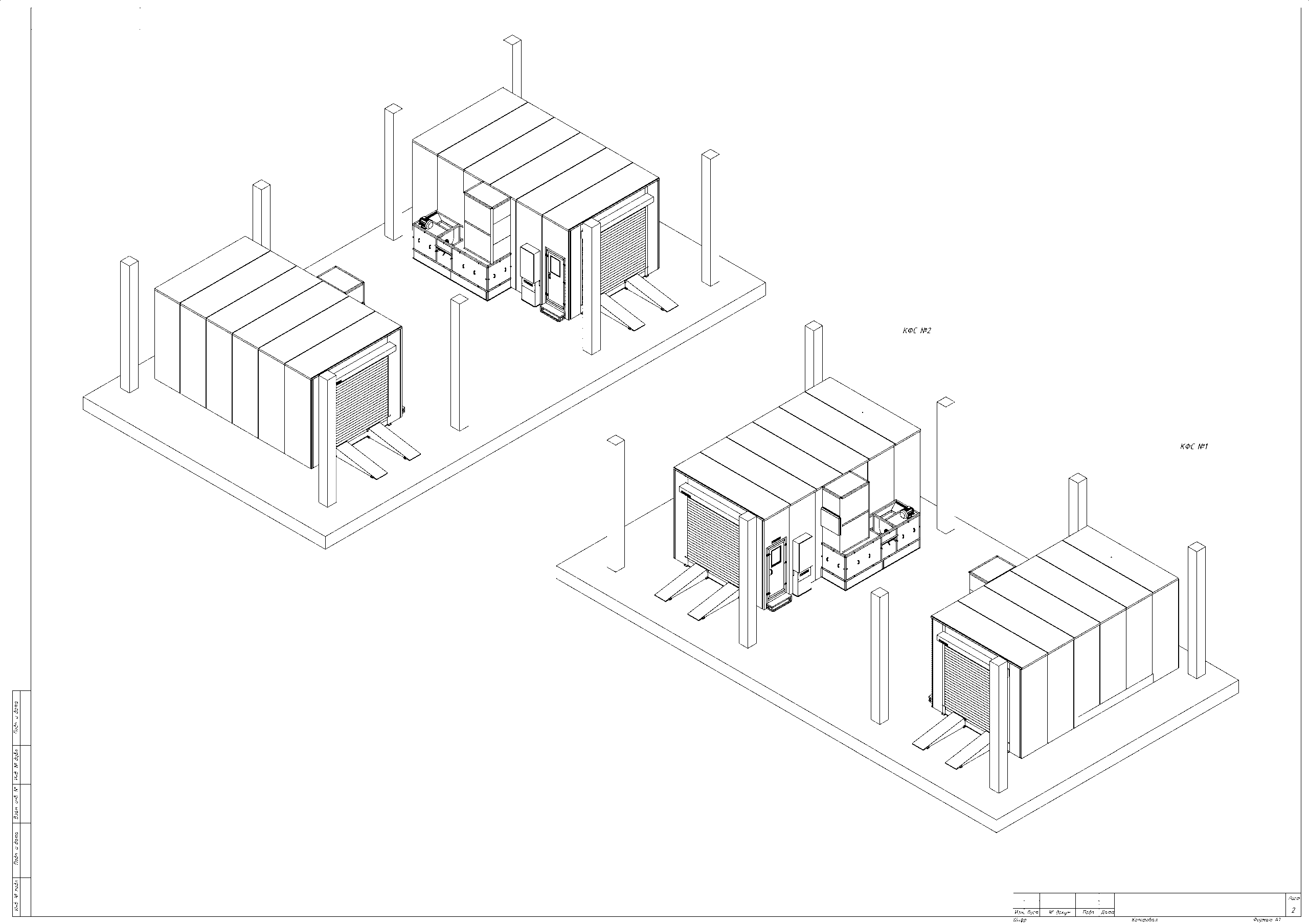
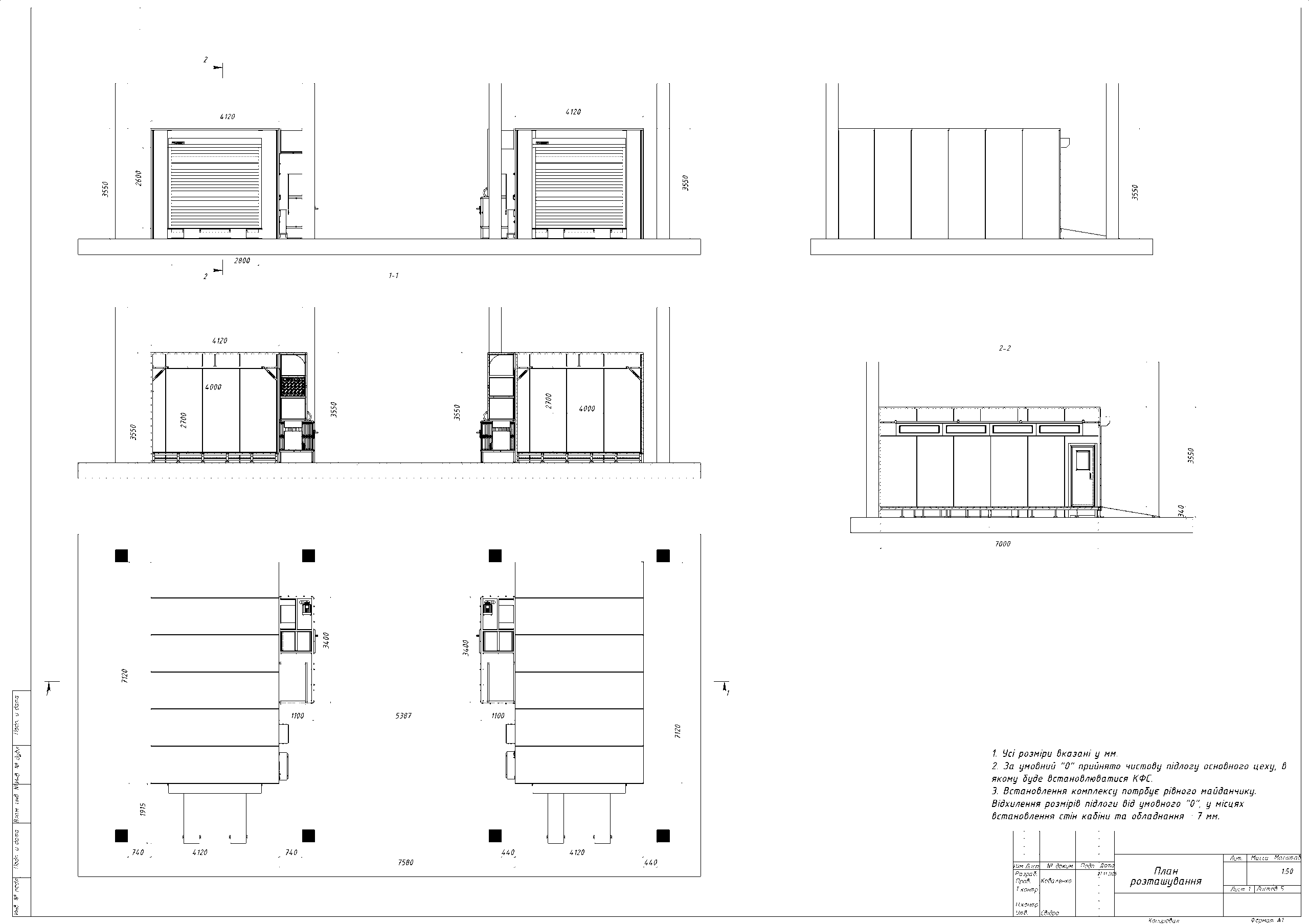
The project included the installation of four paint-spray and drying booths:
two IKFS series booths, model IKFS-12 — for painting and drying products of standard and medium dimensions;
one IKFS series booth, model IKFS-15 — for processing longer and more massive products;
one IKFS Diagonal booth, model IKFS-D-12 — for products with complex geometry or increased dimensions, using a diagonal airflow pattern that обеспечивает efficient air exchange and uniform painting and drying conditions.
This configuration formed a flexible paint-spray and drying section with parallel operation capability, optimal load distribution, and adaptation of the production process to different product sizes.
The booths are manufactured as metal-frame structures with thermally and acoustically insulated panel enclosures, forming a closed working volume with controlled microclimate parameters. This design ensures process stability during painting and effective coating curing during drying.
Airflow organization is implemented via a controlled supply-and-exhaust scheme with multi-stage filtration. This maintains clean air in the painting zone, minimizes dust ingress, and ensures uniform air distribution throughout the booth volume.
Air heating is provided by thermo-ventilation modules with indirect heat exchange, preventing combustion products from contacting the working air. The booths operate in several modes — painting, drying, and cooling — with automated transitions between stages according to a predefined algorithm.
The IKFS-12 booths are intended for serial painting of standard-sized products and обеспечують high productivity due to the capability of parallel operation. This configuration enables even distribution of production load and execution of painting operations without взаимні downtime between product streams.
The IKFS-15 booth is designed for processing extra-long products or complex metal structures where an expanded working space is required. This booth enables painting of large components without compromising coating uniformity or drying quality.
The IKFS-D-12 Diagonal booth implements a specialized diagonal airflow scheme that differs fundamentally from the classic linear layout of paint-spray and drying booths. Air is supplied and extracted at an angle to the longitudinal axis of the product, which helps create uniform airflow around complex-shaped or oversized structures along their entire length and height.
This airflow scheme is especially effective for painting products with variable cross-sections, large surface areas, or localized zones with increased coating thickness, where stable thermal and airflow balance is critical.
Operating Principle of the Complex ▼
The complex provides a fully closed technological cycle for anti-corrosion treatment of large metal structures — from abrasive blasting to painting and drying under controlled conditions. All process stages are integrated into a single production chain and operate according to coordinated algorithms.
Stage 1. Abrasive Blasting (KASO series chambers)
Surface preparation is performed by abrasive blasting to remove corrosion, mill scale, and process contaminants to the required cleanliness level. The process takes place in the enclosed volume of KASO series chambers with controlled air environment parameters.
Spent abrasive and removed contaminants (rust, mill scale, dust) are collected by a mechanized scraper floor with four conveyors. The mixture is transported by a bucket elevator to a separator, where it is разделена: usable abrasive is cleaned and returned to the hopper for reuse, while dust and waste are removed from the system.
Contaminated air is extracted by an aspiration system with subsequent multi-stage filtration, ensuring stable and safe working conditions for personnel.
Stage 2. Painting and Drying (IKFS series booths)
Painting Mode
Paint application is carried out in the isolated working space of IKFS series paint-spray and drying booths with controlled air environment parameters.
Drying Mode
Coating curing occurs automatically using air recirculation. The cycle includes purge, temperature ramp-up, drying at temperatures up to 80 °C, and controlled cooling.
*Parameters are provided according to design and operating documentation
Parameter
Abrasive Blasting Chambers
(KASO-12 / KASO-15)
Paint-Spray and Drying Booths
(IKFS-12 / IKFS-15)
Paint-Spray and Drying Booth
IKFS Diagonal (IKFS-D-12)
General Characteristics
Equipment Type
Abrasive blasting chamber
Paint-spray and drying booth
Paint-spray and drying booth
Purpose
Mechanical surface preparation of metal products
Painting and drying of metal products
Painting and drying of products with complex geometry
Quantity
2 chambers
3 booths
1 booth
Dimensional Parameters
Internal dimensions (L × W × H)
12,000 × 6,000 × 5,000 mm
15,000 × 6,000 × 5,000 mm
12,000 × 6,000 × 5,000 mm
15,000 × 6,000 × 5,000 mm
12,000 × 6,000 × 5,000 mm
Maximum product dimensions
up to 9,000 mm
up to 9,000 mm
special технологічні scenarios
Process Systems
Abrasive recovery system
Mechanical, closed loop
—
—
Floor type
Mechanized scraper floor
Filtration floor
Filtration floor
Heating system
Not provided
Diesel burners
Diesel burner
Maximum temperature
—
up to 80 °C
up to 80 °C
Ventilation and Filtration
Ventilation type
Filtration and ventilation
Supply and exhaust
Supply and exhaust (diagonal airflow scheme)
Ventilation capacity
30,000 m³/h
30,000 m³/h × 2
30,000 m³/h × 1
Filtration type
Cartridge, multi-stage
Dry, multi-stage
Dry, multi-stage
Operating Parameters
Surface preparation grade
up to Sa 3 (ISO 8501-1)
—
—
Noise level outside the equipment
up to 70 dB
up to 70 dB
up to 70 dB
Power supply
380 V / 50 Hz
380 V / 50 Hz
380 V / 50 Hz
Result for the Customer
As a result of the project, a modern industrial complex for mechanical surface preparation and coating application followed by drying under controlled conditions was created, designed for processing large metal products.
The customer received:
the ability to process large products in chambers of different sizes, adapted to product specifics and production routing;
a closed-loop process with abrasive recycling, reducing material consumption and minimizing production waste;
efficient dry air filtration systems in blasting and painting zones, ensuring stable working conditions;
energy-efficient drying modes using air recirculation and controlled thermal load;
manufacturer warranty obligations and equipment service life designed for long-term intensive industrial operation.
Conclusions
The comprehensive modernization of the surface preparation and painting area implemented by TWEKO is an example of effective collaboration between a Ukrainian process equipment manufacturer and an industrial enterprise in the mechanical engineering sector.
Thanks to an individual approach — from detailed on-site assessment and technical specification development to equipment manufacturing, installation, and commissioning — the customer received a modern process complex. It includes two KASO series abrasive blasting chambers, three IKFS series paint-spray and drying booths, and one IKFS-D booth, integrated into a single production process.
The equipment is adapted for intensive two-shift operation and processing of large metal structures, ensuring:
high surface preparation quality and consistent coating application;
reduced processing time and optimized operating costs;
compliance with safety, environmental, and occupational health requirements.
All project stages were completed within the agreed timeframe — from equipment delivery to full industrial commissioning. As of the preparation of this case study, the complex operates reliably, without downtime or customer remarks.
Need a comprehensive solution for surface preparation, painting, and drying of large metal structures?
We support projects end-to-end — from requirement analysis and equipment layout to installation, commissioning, and industrial startup.
Custom Paint Booth Configuration for an Automotive Service Facility in Spain
Spray booth Archives - Techservice WEKO LLC
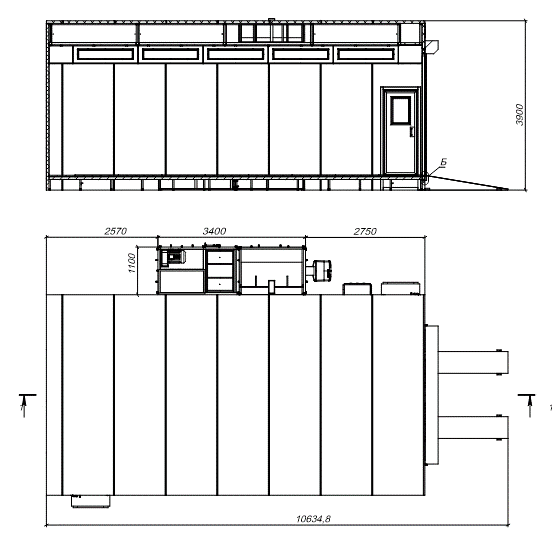
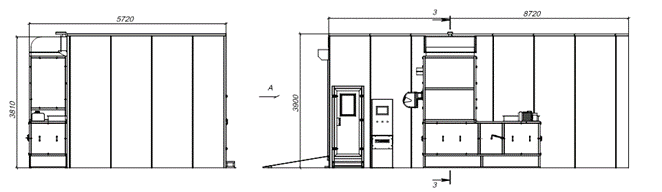
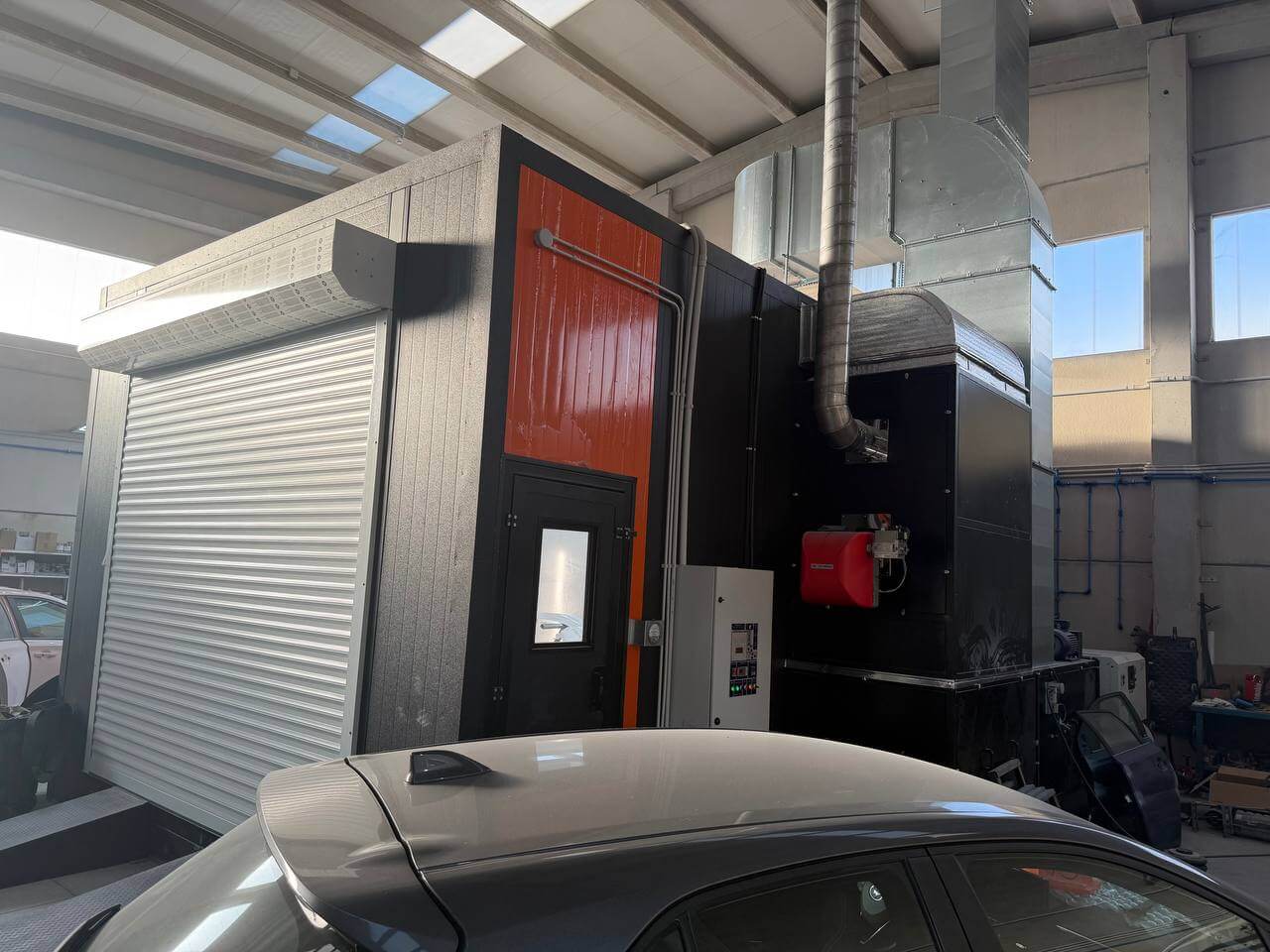
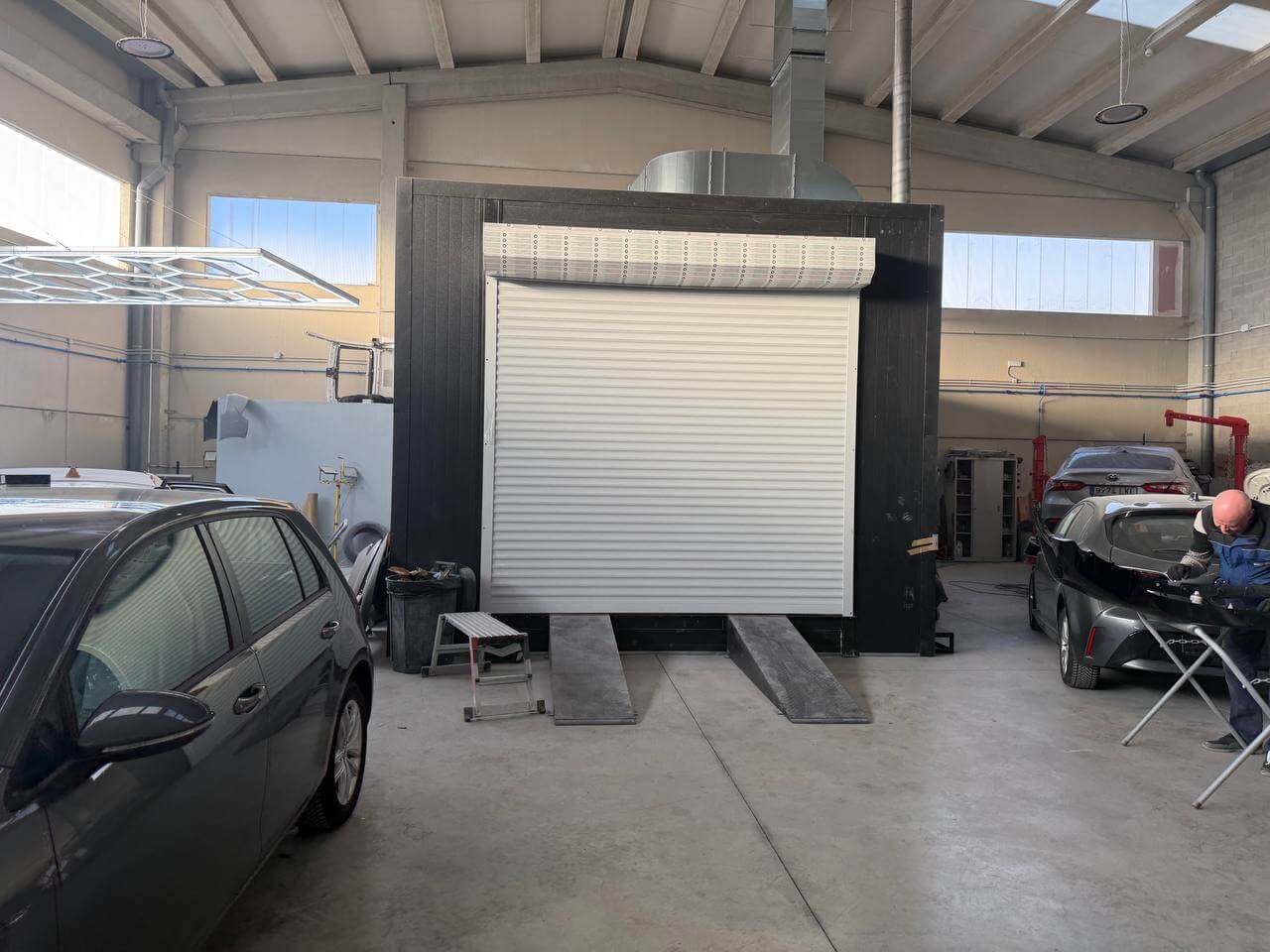
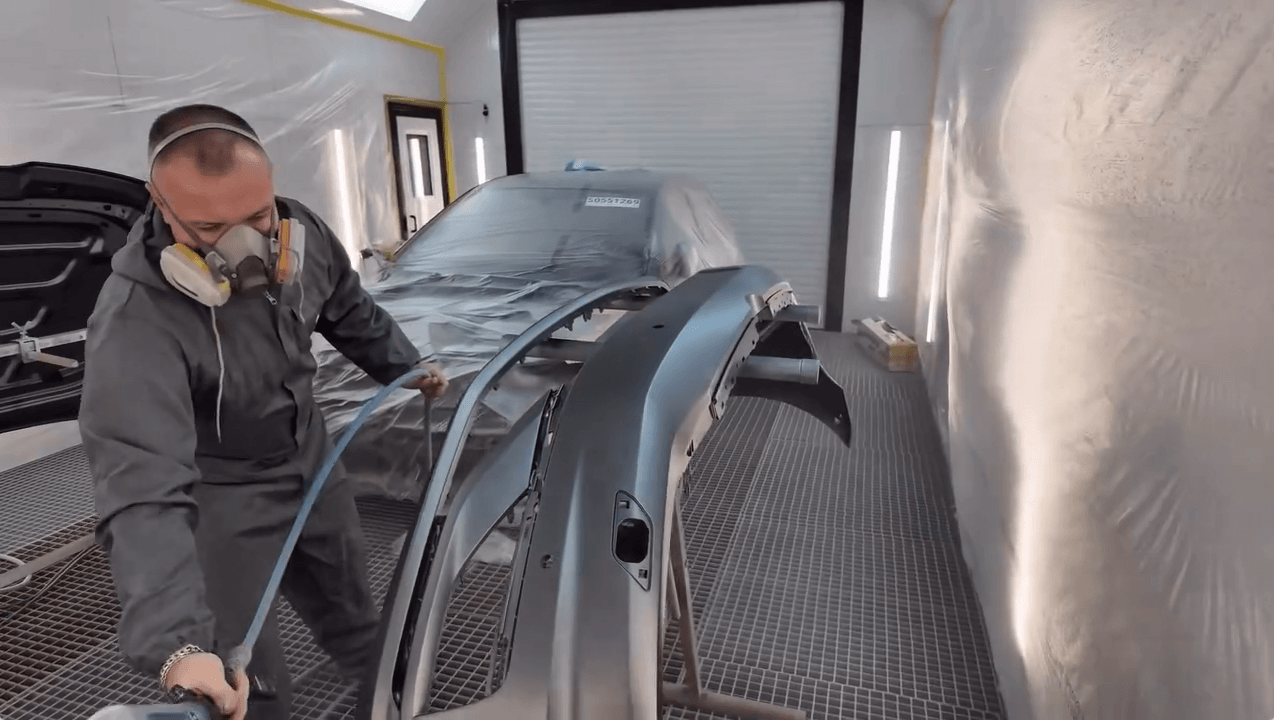
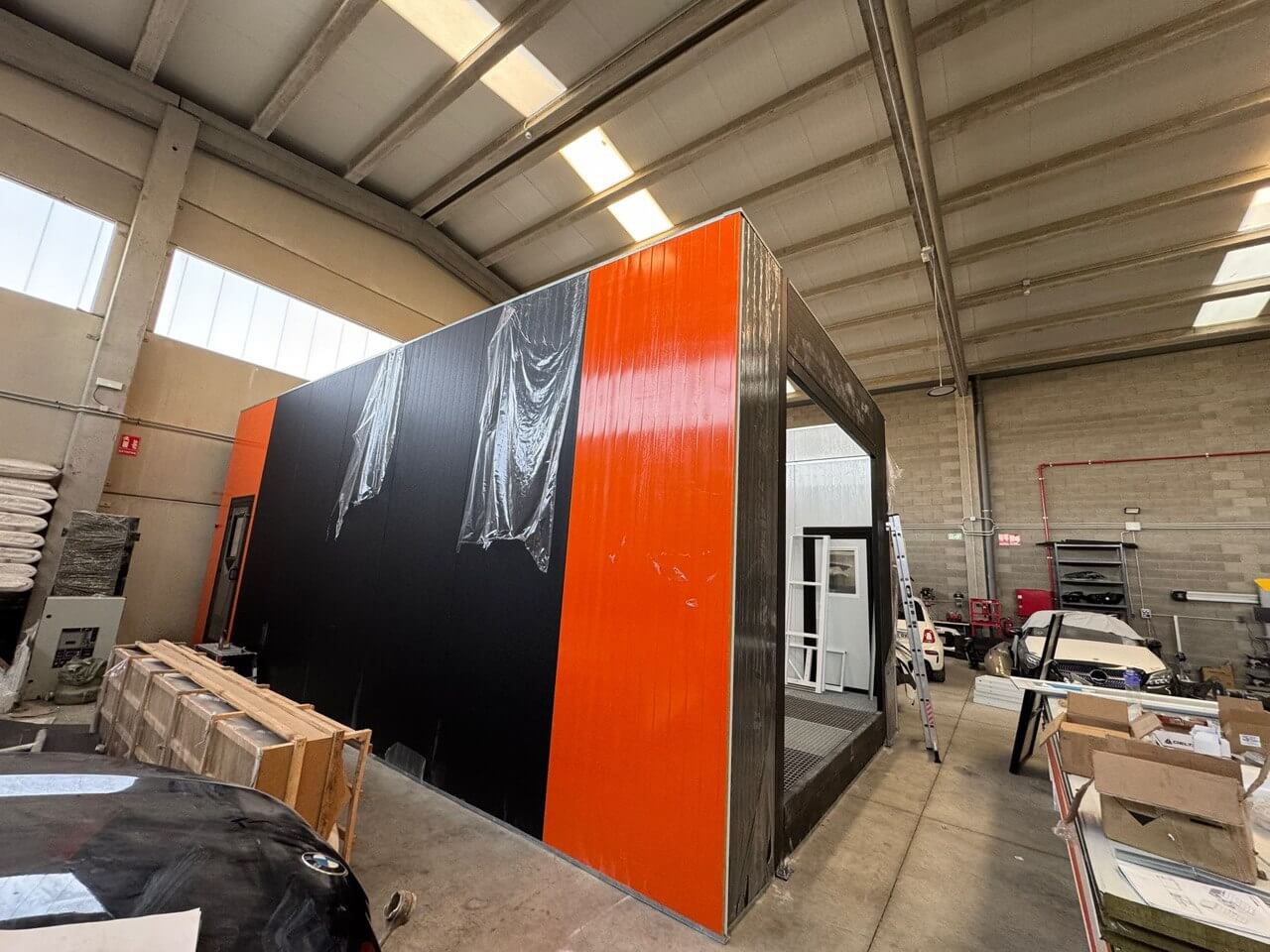
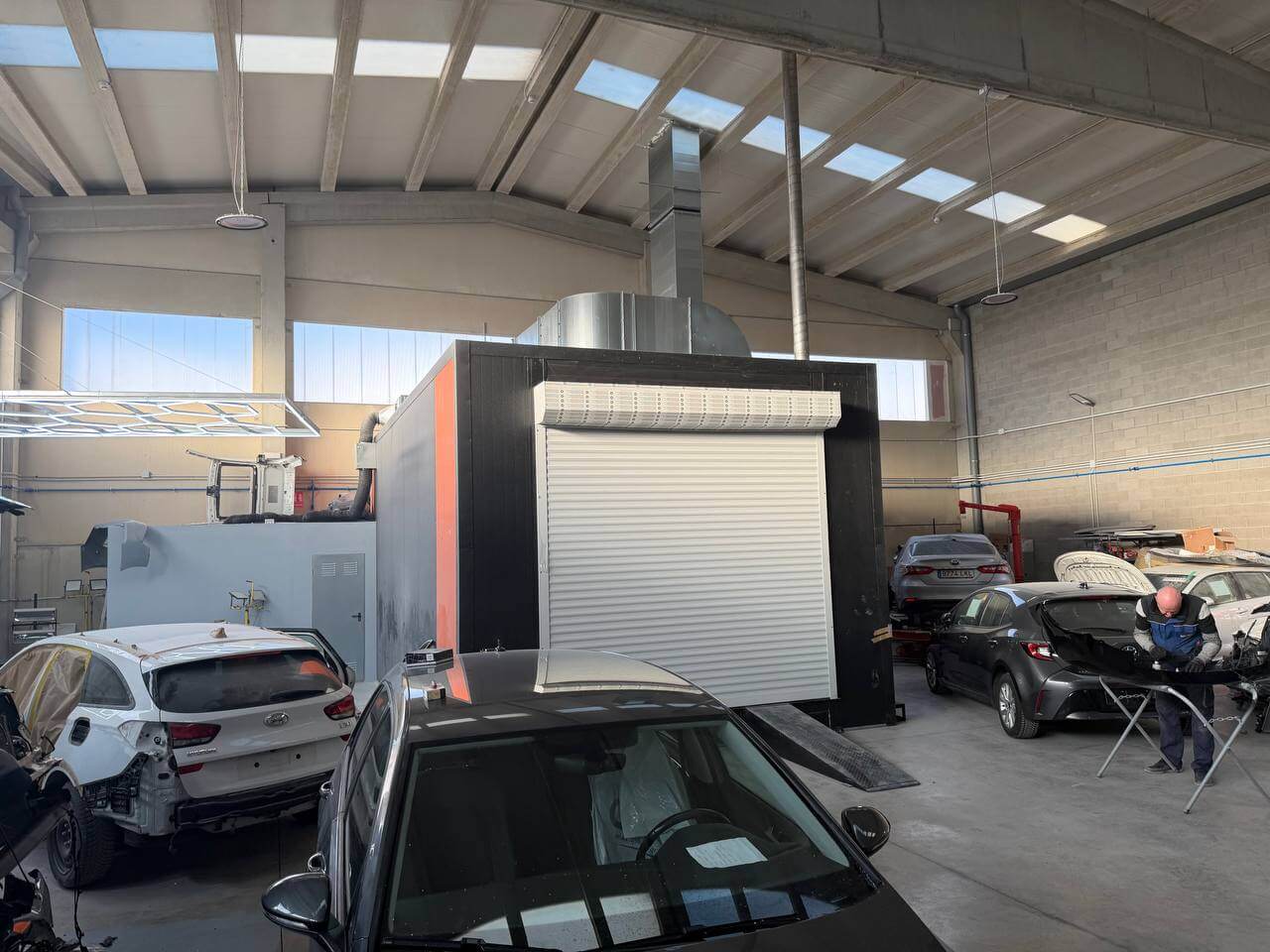
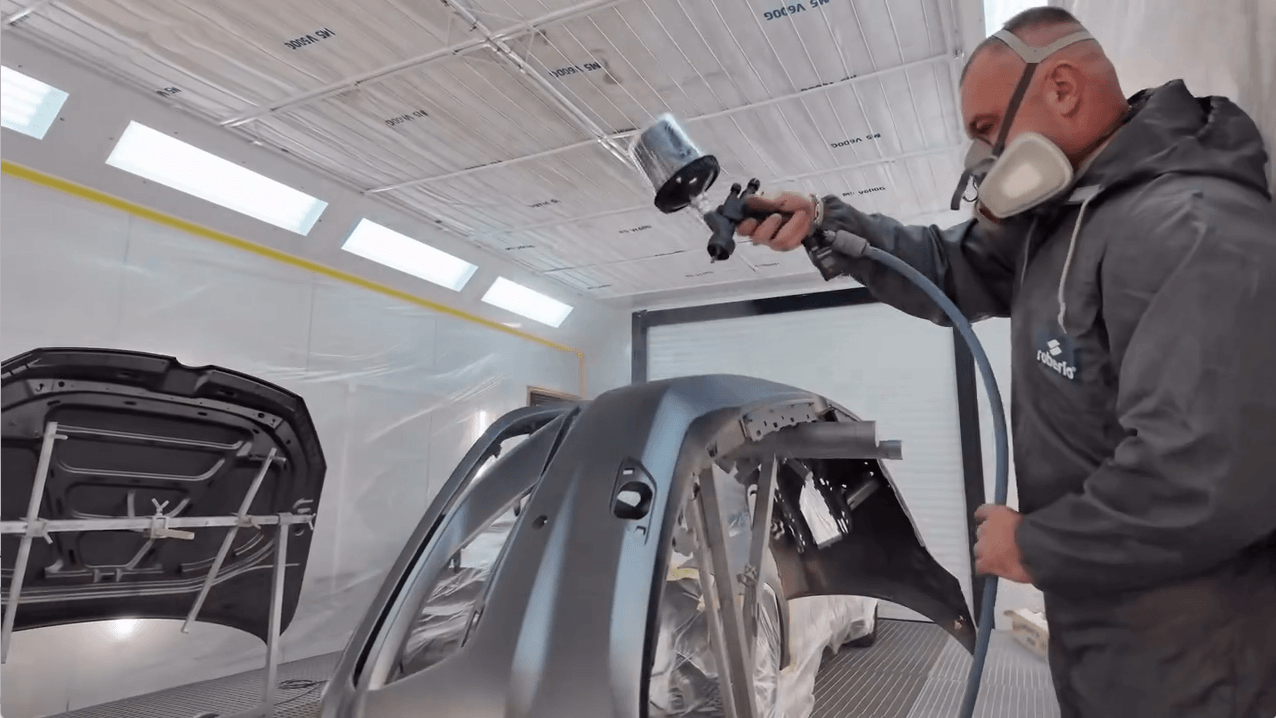
TWEKO successfully delivered a turnkey project involving the design, manufacturing, and commissioning of a spray and drying booth from the AKFS series for RIOMAX GRUPO (Spain). The solution provides surface preparation, paint application, and drying processes within a controlled environment. The booth, with a working area of 8600 × 4500 × 3340 mm, is equipped with a dry filtration system and ventilation capacity of up to 27,000 m³/h. A key feature of the project is the customized layout with a side-mounted air handling unit, which allowed seamless integration into an existing facility with limited space while minimizing duct length. Additionally, the booth was manufactured in colors adapted to the client’s corporate identity and equipped with roll-up doors and an external control panel.
About the Client
RIOMAX GRUPO is a Spanish company based in Catalonia (Girona province), operating in the automotive sector and providing services including vehicle sales, rental, maintenance, and repair. One of its key activities is bodywork repair and painting, which require stable process conditions and consistent coating quality control.
Project Challenge
Due to the expansion of production capacity, the client required the implementation of a paint booth solution capable of ensuring controlled air parameters, process stability, and compliance with technological requirements.
Proposed Solution: Engineering Adaptation to Facility Constraints
To meet the project requirements, an AKFS series spray booth, model AKFS-S-9 with dry filtration, was selected. Considering the limitations of the existing production space, a custom layout was implemented: the booth was installed directly against the wall with a side-mounted air handling unit. This approach optimized space utilization and reduced ductwork length.
The booth was manufactured in colors aligned with the client’s corporate identity: a grey body with orange accents instead of the standard TWEKO light blue finish.
The project also includes roll-up doors and an external control panel, ensuring convenient operator access and integration into the existing production infrastructure.
Working area dimensions: 8600 × 4500 × 3340 mm — suitable for processing passenger vehicles and medium-sized commercial vehicles.
Ventilation performance: airflow capacity up to 27,000 m³/h ensures stable air exchange and maintains positive pressure of 10–30 Pa, reducing the risk of dust contamination in the painting zone.
Thermal system: a diesel burner combined with an indirect heat exchanger provides drying temperatures up to 60°C with adjustable режимs.
Filtration: a multi-stage dry filtration system (pre-filters, ceiling filters, labyrinth filters, and fiberglass filters) ensures air purification throughout all process stages.
Lighting: LED lighting (6500 lm) provides sufficient illumination of the working area.
Operational Characteristics
The total installed power of the equipment is approximately 20 kW. The noise level inside the working area does not exceed 65 dB. All painting and drying processes are controlled via an external control panel with temperature, time, and pressure regulation.
Project Results
The implementation of the AKFS-S-9 spray booth enabled RIOMAX GRUPO to establish a stable painting and drying process under controlled conditions. The multi-stage filtration system and maintained positive pressure reduce the risk of dust entering the painting zone.
The air recirculation mode during drying reduces energy consumption while maintaining a stable temperature regime. The customized layout ensured integration into the existing facility without structural modifications.
The equipment operation complies with ventilation, temperature control, and safety requirements in accordance with the technical documentation. The implemented solution provides a complete painting and drying cycle and can be adapted to other production environments.
Do you have a similar task?
We will select the optimal equipment configuration based on your production requirements and facility conditions.
![2-1[1]](https://t-weko.com/wp-content/uploads/sites/18/2026/07/2-11.jpg)
![fopf-3[1]](https://t-weko.com/wp-content/uploads/sites/18/2026/08/fopf-31.jpg)
![fopf-4[1]](https://t-weko.com/wp-content/uploads/sites/18/2026/08/fopf-41.jpg)
![fishap-4[1]](https://t-weko.com/wp-content/uploads/sites/18/2026/05/fishap-41.jpg)
![fishap-5[1]](https://t-weko.com/wp-content/uploads/sites/18/2026/05/fishap-51.jpg)
![kaso_2026-04-10_13-52-12_2[1]](https://t-weko.com/wp-content/uploads/sites/18/2026/04/kaso_2026-04-10_13-52-12_21.jpg)
![kaso_2026-04-10_13-52-12[1]](https://t-weko.com/wp-content/uploads/sites/18/2026/04/kaso_2026-04-10_13-52-121.jpg)
![ikfs_2026-04-10_13-52-13[1]](https://t-weko.com/wp-content/uploads/sites/18/2026/04/ikfs_2026-04-10_13-52-131.jpg)
![ikfs_2026-04-10_13-52-12[1]](https://t-weko.com/wp-content/uploads/sites/18/2026/04/ikfs_2026-04-10_13-52-121.jpg)
![rpl-07[1]](https://t-weko.com/wp-content/uploads/sites/18/2026/04/rpl-071.jpg)
![risunok2[1]](https://t-weko.com/wp-content/uploads/sites/18/2026/04/risunok21.png)
![rpl-03[1]](https://t-weko.com/wp-content/uploads/sites/18/2026/04/rpl-031.jpg)
![risunok6[1]](https://t-weko.com/wp-content/uploads/sites/18/2026/04/risunok61.jpg)
![risunok1-2[1]](https://t-weko.com/wp-content/uploads/sites/18/2026/02/risunok1-21.png)
![zagalnij-viglayad[1]](https://t-weko.com/wp-content/uploads/sites/18/2026/02/zagalnij-viglayad1.png)
![vents-5[1]](https://t-weko.com/wp-content/uploads/sites/18/2026/02/vents-51.jpg)
![vents-2[1]](https://t-weko.com/wp-content/uploads/sites/18/2026/02/vents-21.jpg)
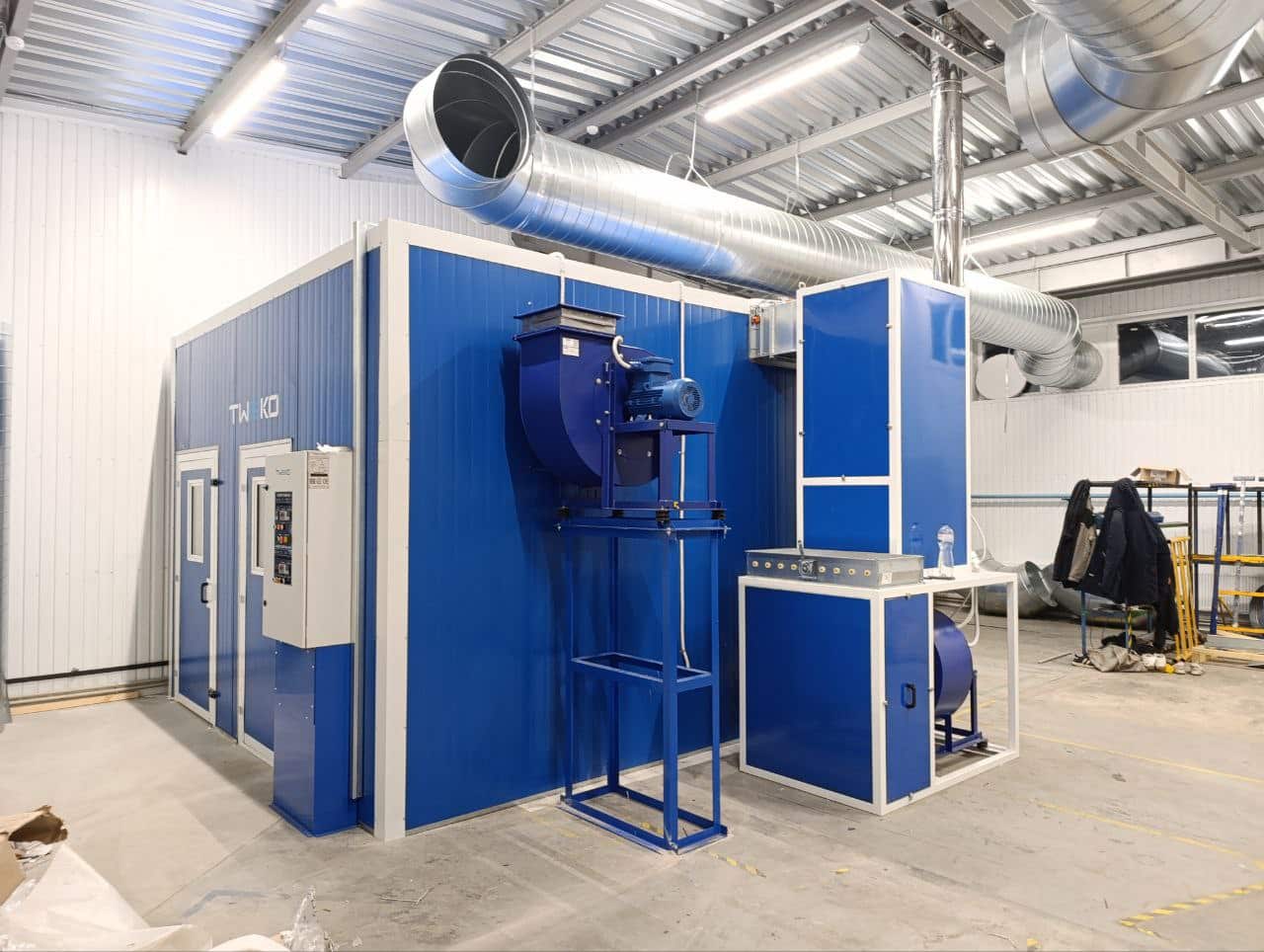
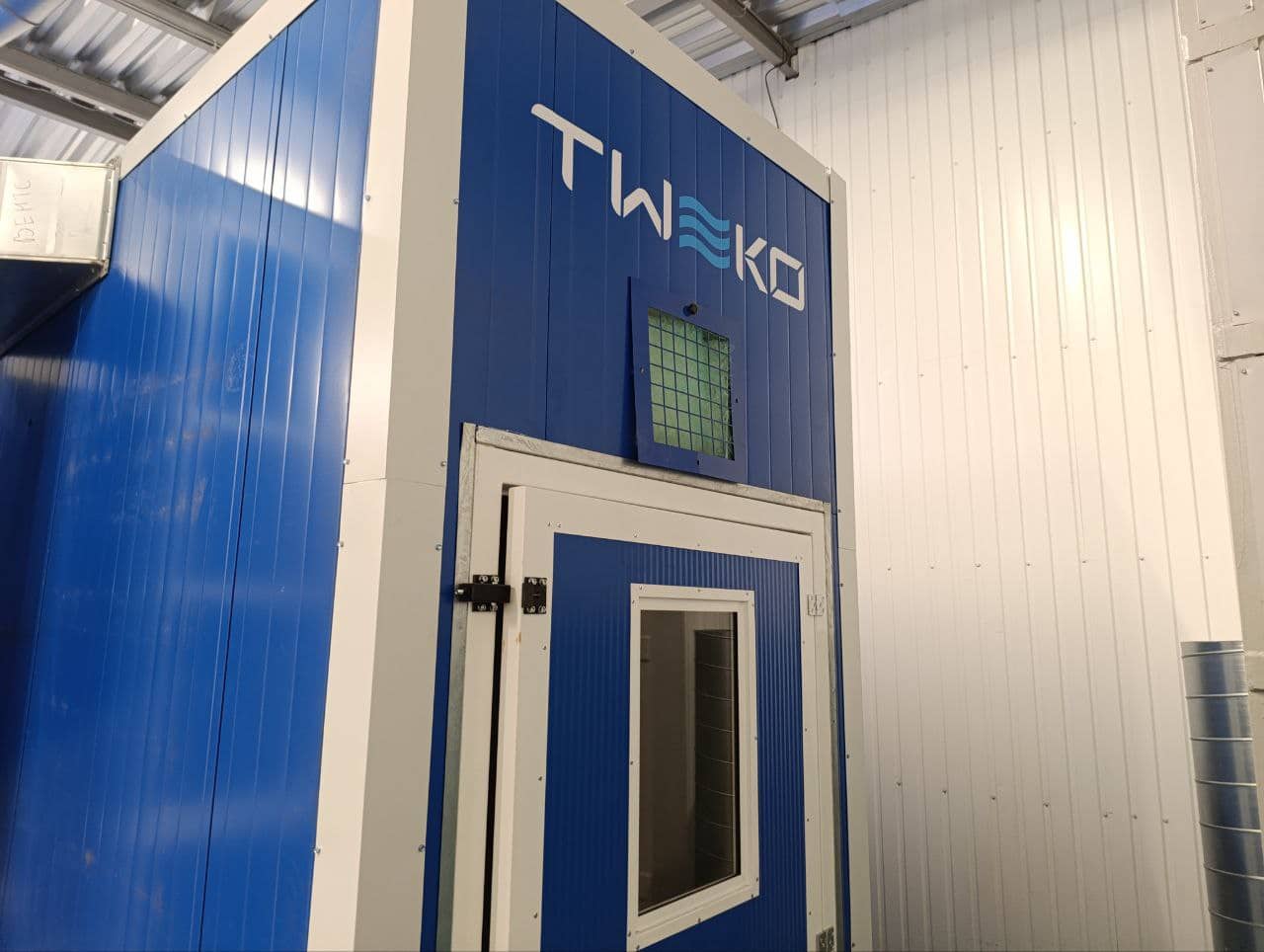
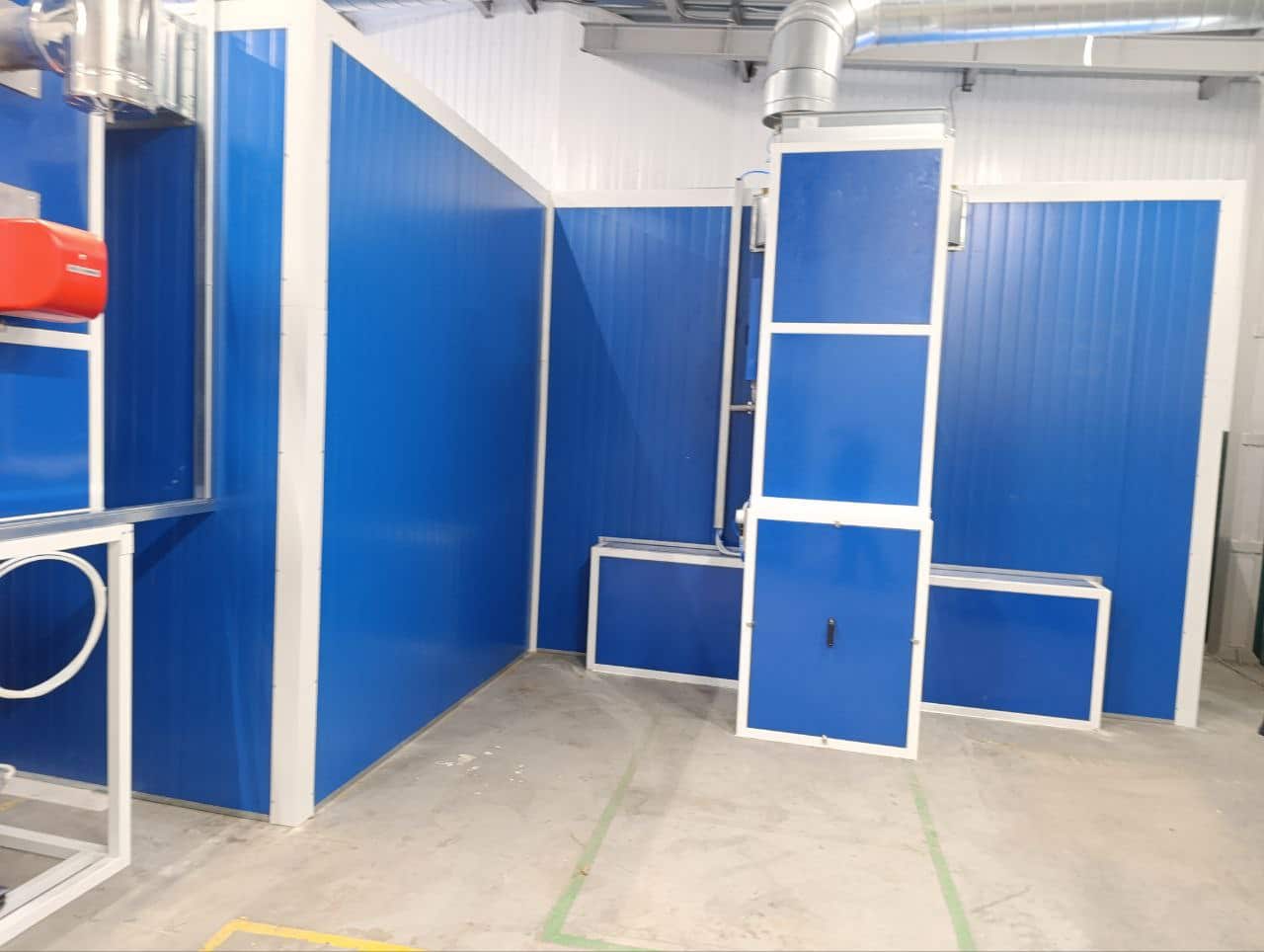
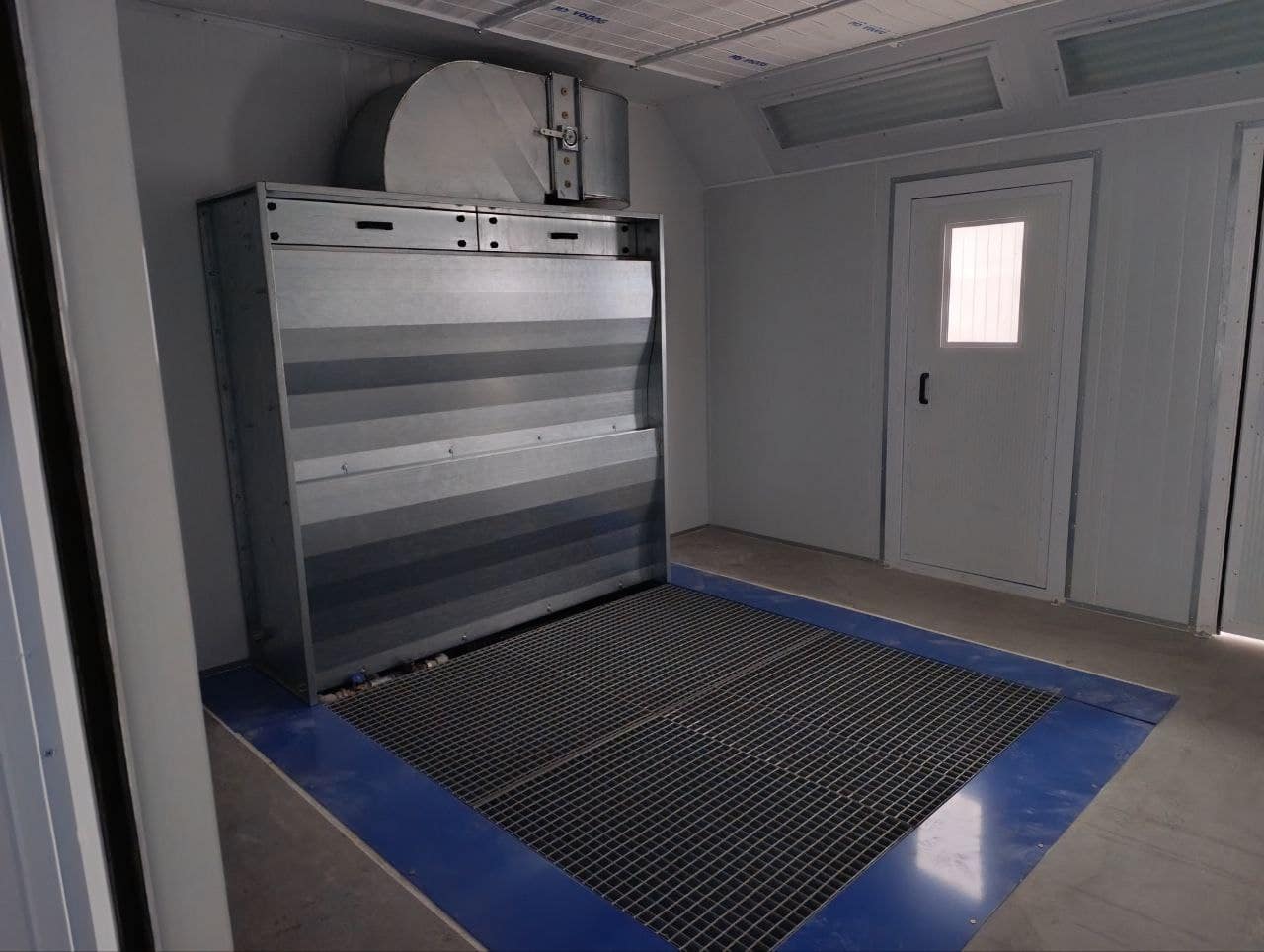
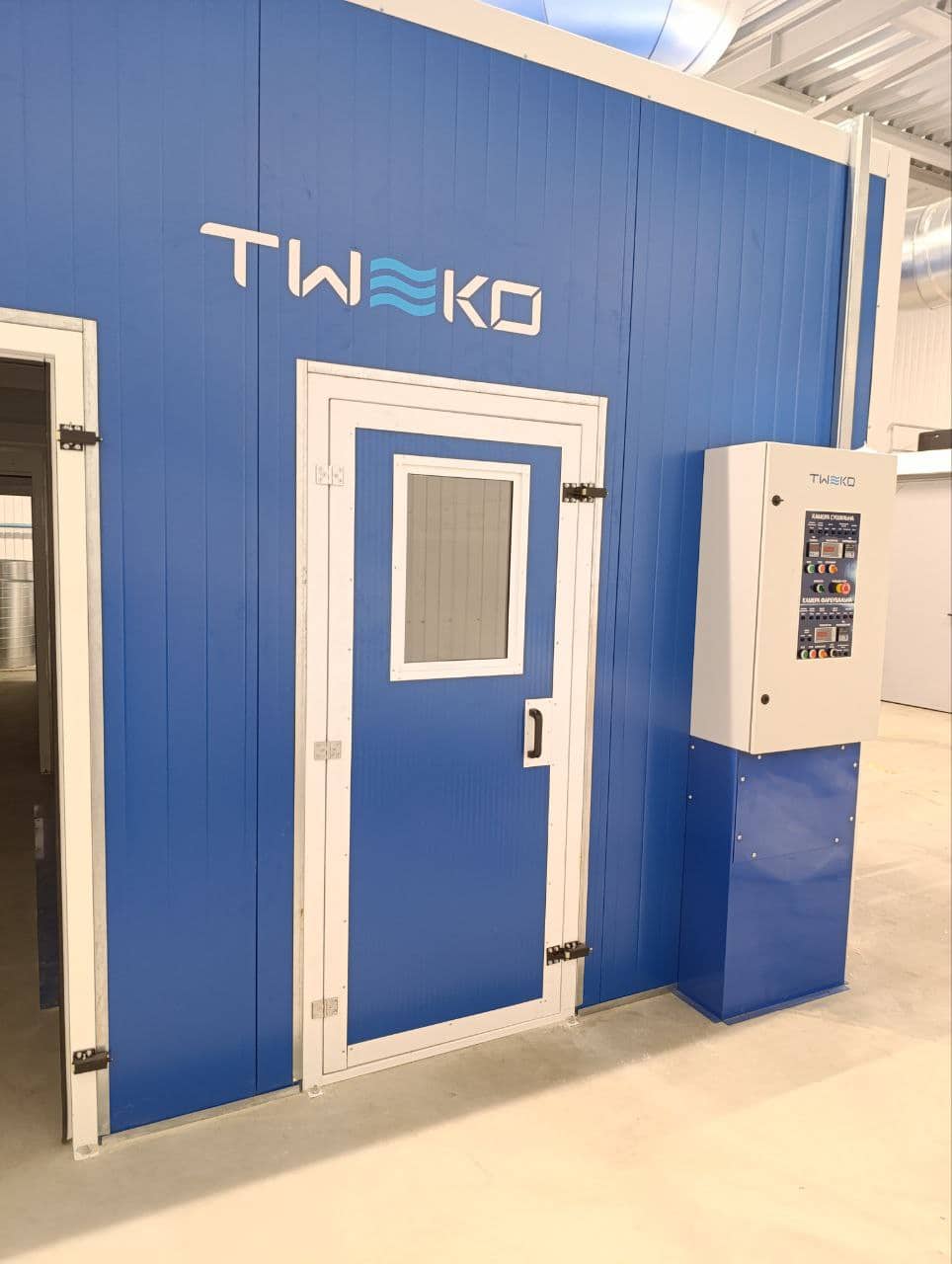
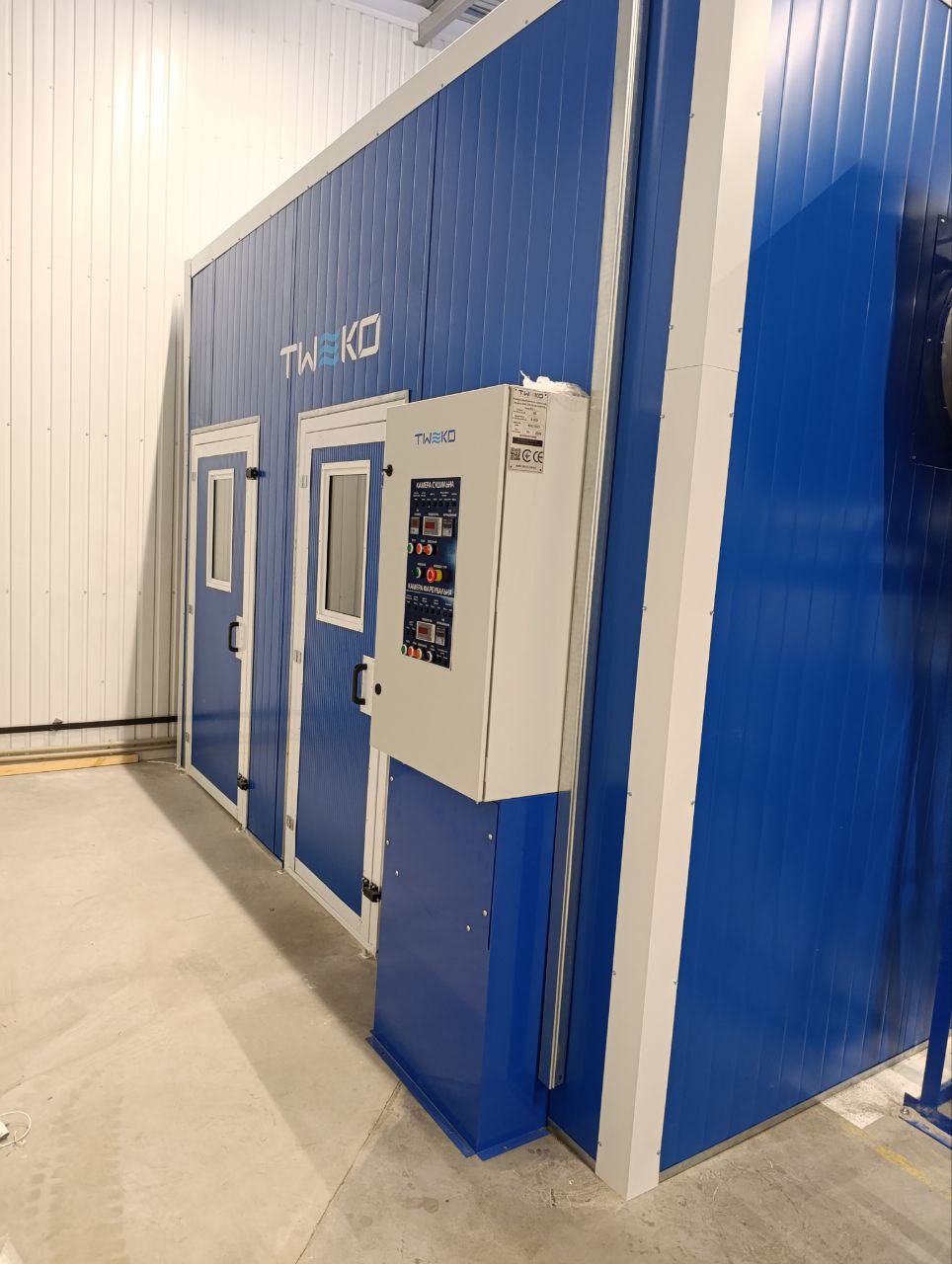
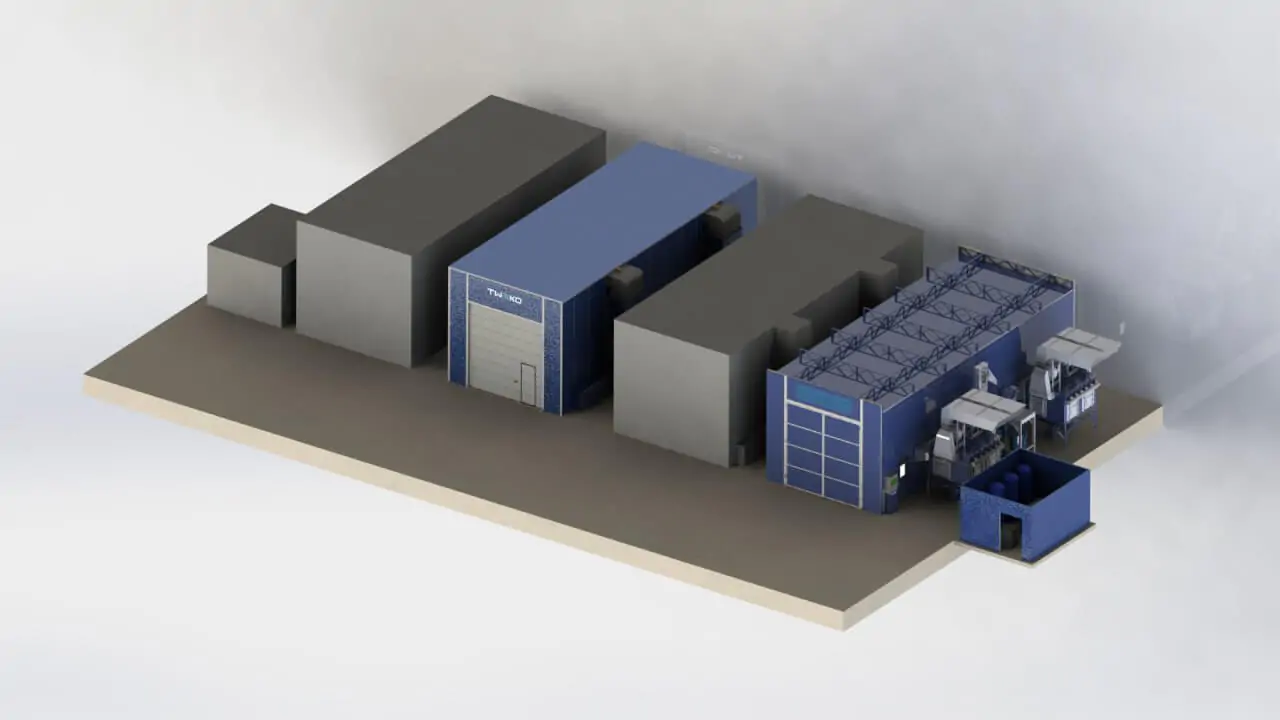
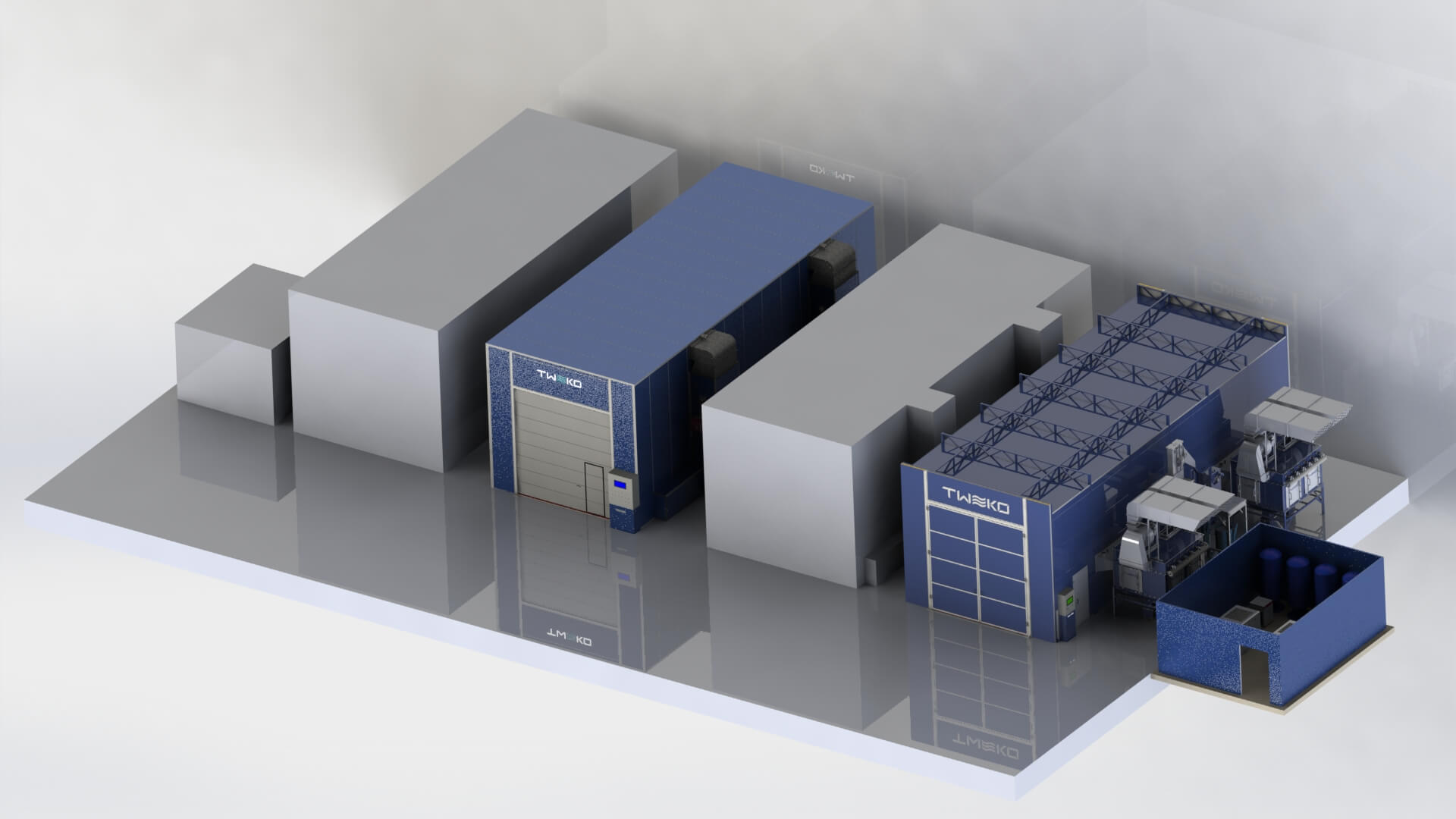
 The chamber is equipped with:
![ubr-03.-v-04[1]](https://t-weko.com/wp-content/uploads/sites/18/2025/12/ubr-03.-v-041.jpg)
![ubr-03.-v-01[1]](https://t-weko.com/wp-content/uploads/sites/18/2025/12/ubr-03.-v-011.jpg)
![ubr-03.-v-08[1]](https://t-weko.com/wp-content/uploads/sites/18/2025/12/ubr-03.-v-081.jpg)
![ubr-03.-v-07[1]](https://t-weko.com/wp-content/uploads/sites/18/2025/12/ubr-03.-v-071.jpg)
 The booth is equipped with:
![ubr-02-04[1]](https://t-weko.com/wp-content/uploads/sites/18/2025/12/ubr-02-041.jpg)
![ubr-02-01[1]](https://t-weko.com/wp-content/uploads/sites/18/2025/12/ubr-02-011.jpg)
![ubr-02-06[1]](https://t-weko.com/wp-content/uploads/sites/18/2025/12/ubr-02-061.jpg)
![ubr-02-07[1]](https://t-weko.com/wp-content/uploads/sites/18/2025/12/ubr-02-071.jpg)
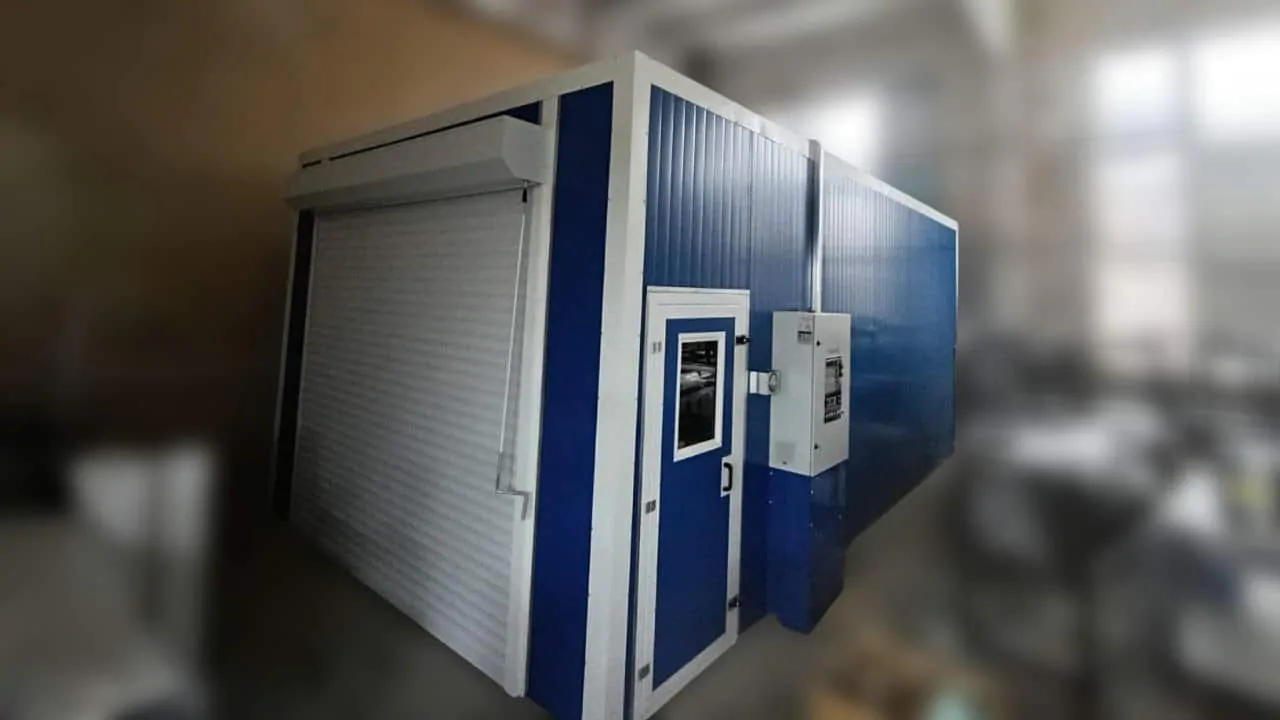
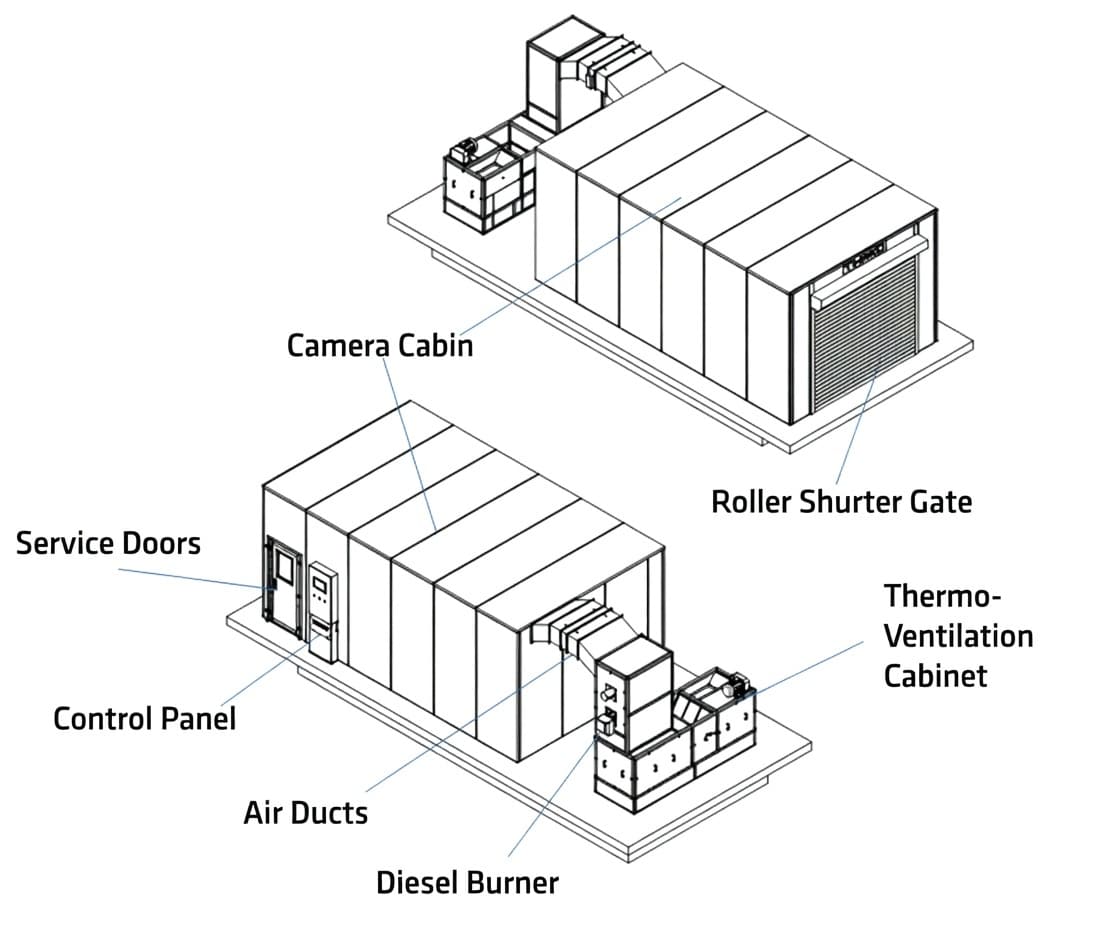
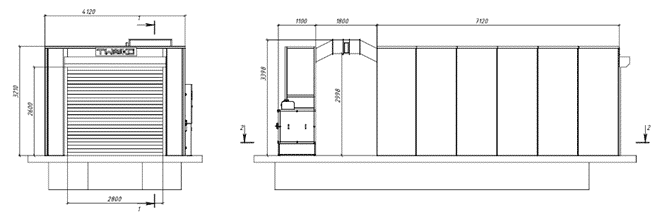
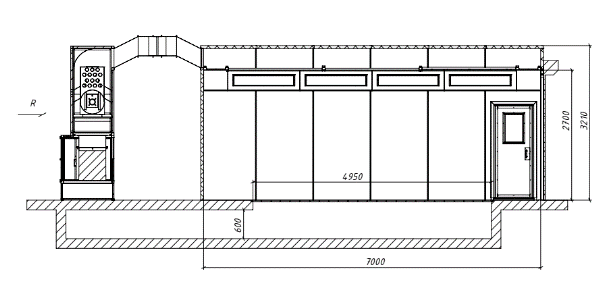
![01[1]](https://t-weko.com/wp-content/uploads/sites/18/2026/03/011.jpg)
![02[1]](https://t-weko.com/wp-content/uploads/sites/18/2026/03/021.jpg)
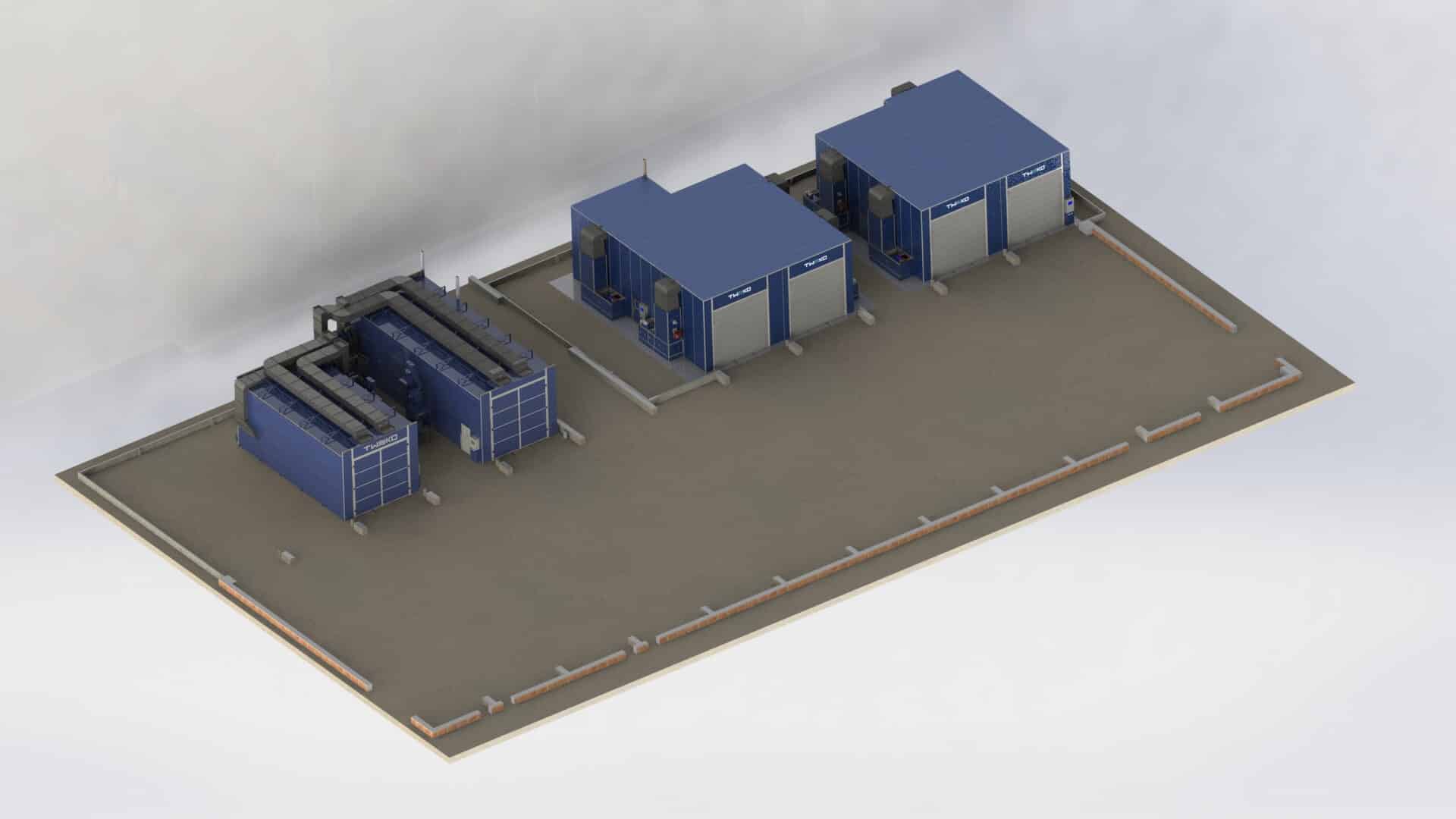
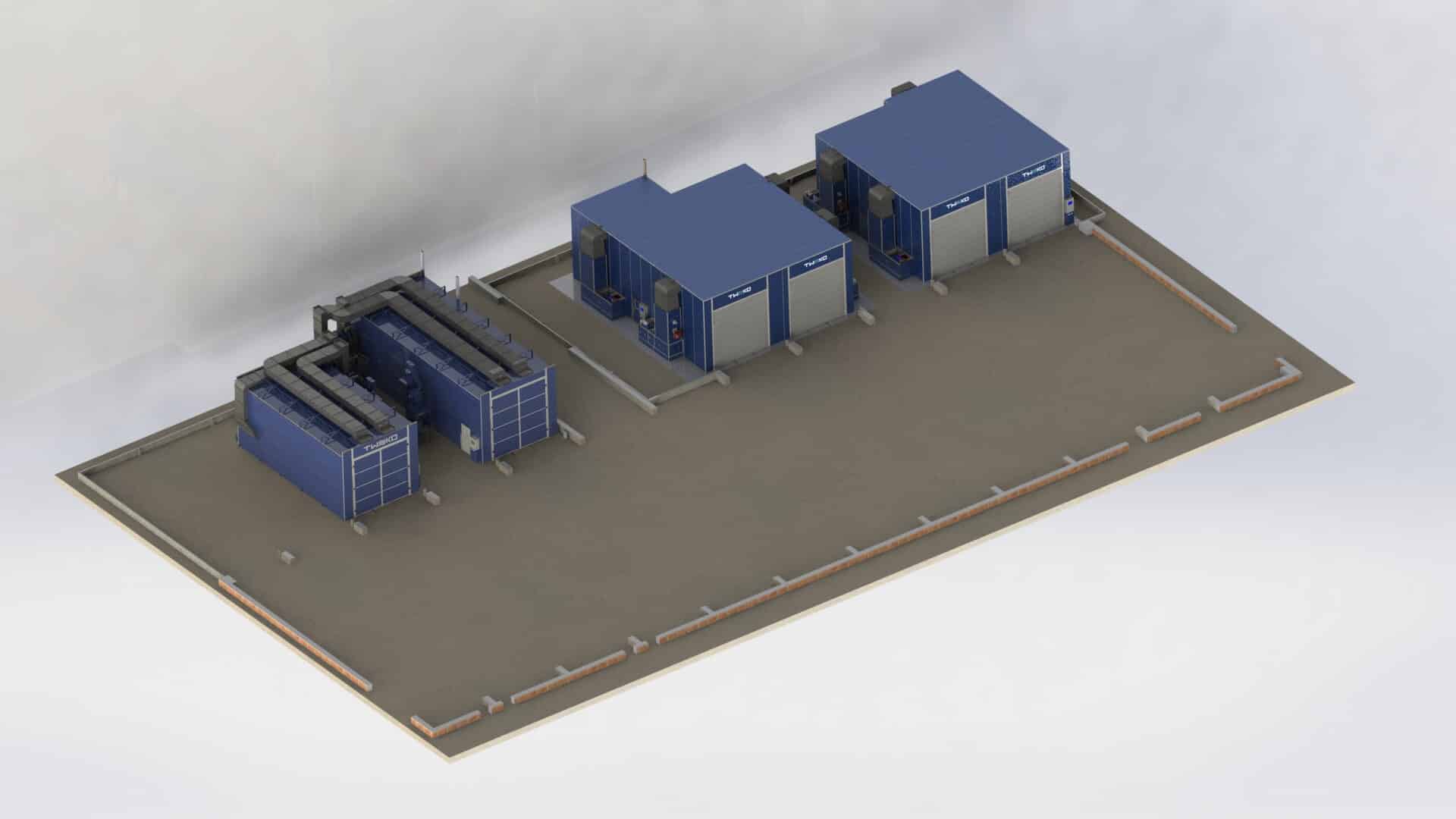
 Structurally, the chambers are manufactured as metal-frame cabins with internal wear-resistant lining, designed for operation under intensive abrasive load. The layout provides convenient service access and safe processing of oversized products within the production workflow.Spent abrasive collection from the working area is implemented via a mechanized scraper floor, which continuously transports material to subsequent processing units without operator intervention.Abrasive delivery to the blasting process is performed by a bucket elevator, after which the media passes through a separator to remove dust, fine fractions, and foreign inclusions. Cleaned abrasive is accumulated in a hopper and returned to the process, ensuring stable blasting parameters and rational media consumption.For dust removal and maintenance of the specified air regime, the chambers are equipped with an industrial-grade filtration and ventilation system that provides controlled air exchange in the blasting zone.


![122-202466-03-2[1]](https://t-weko.com/wp-content/uploads/sites/18/2025/05/122-202466-03-21.jpg)
![122-202466-03-1[1]](https://t-weko.com/wp-content/uploads/sites/18/2025/05/122-202466-03-11.jpg)
![122-202466-02-1[1]](https://t-weko.com/wp-content/uploads/sites/18/2025/05/122-202466-02-11.jpg)
![122-202466-02-3[1]](https://t-weko.com/wp-content/uploads/sites/18/2025/05/122-202466-02-31.jpg)
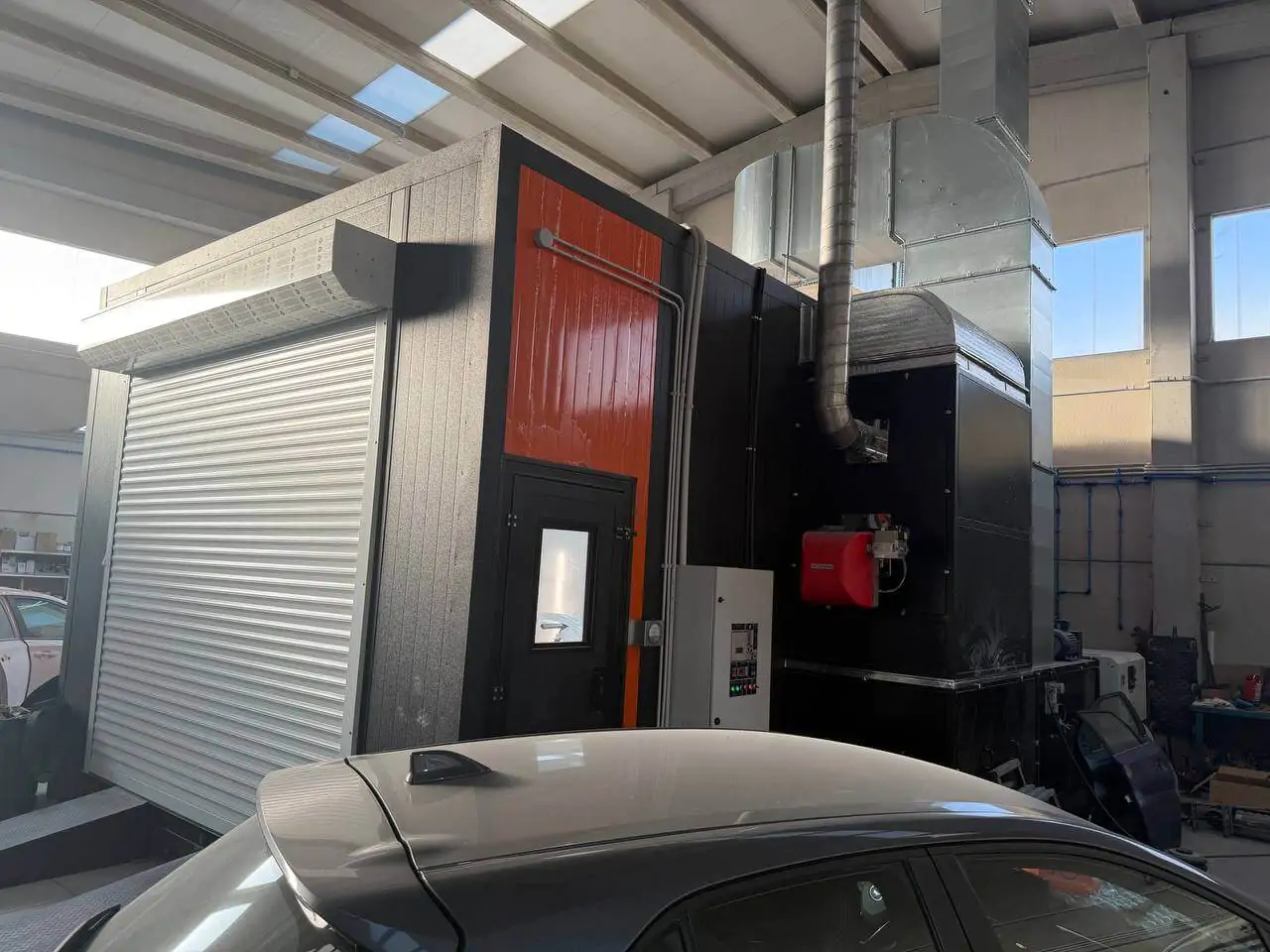
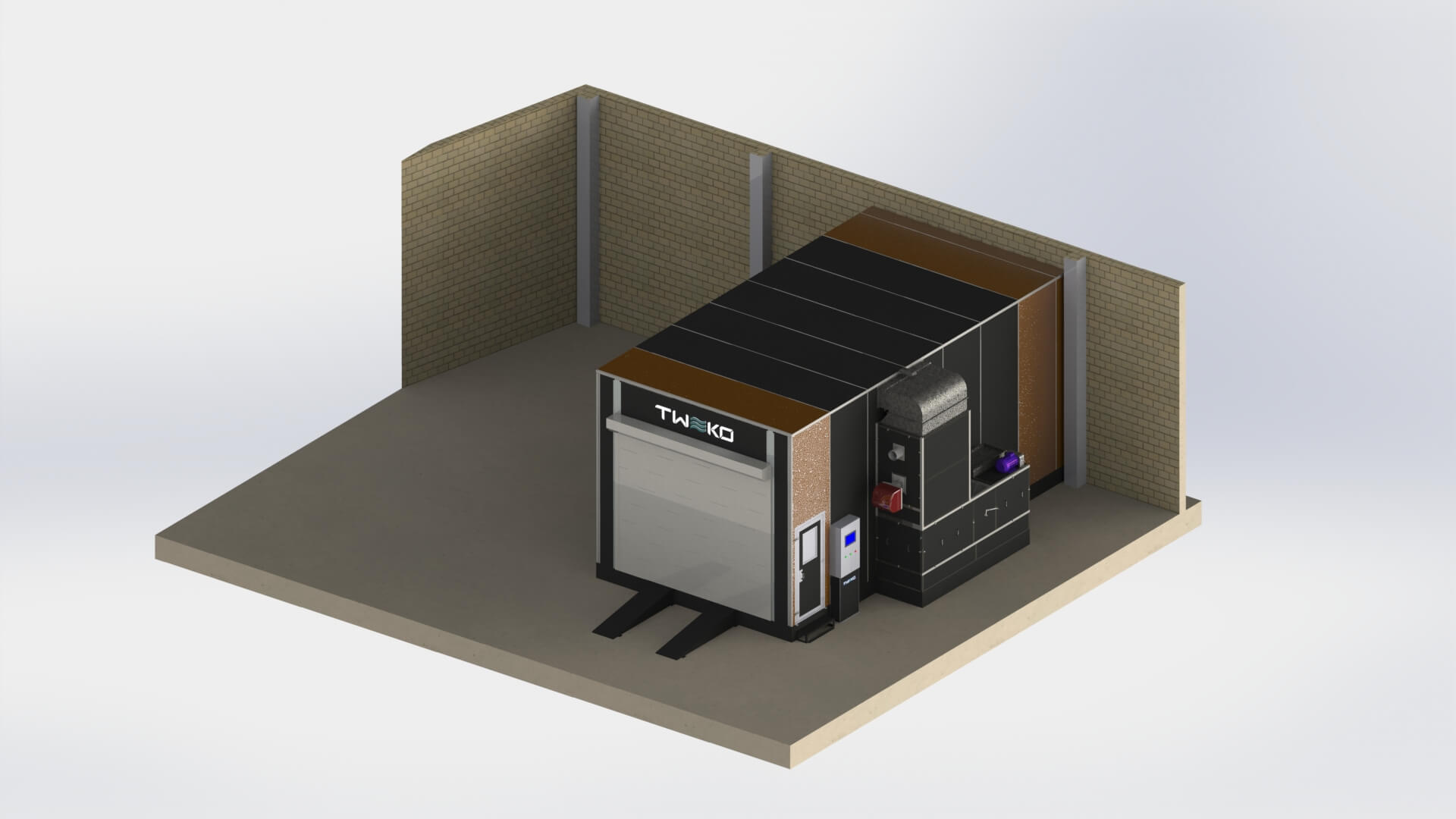
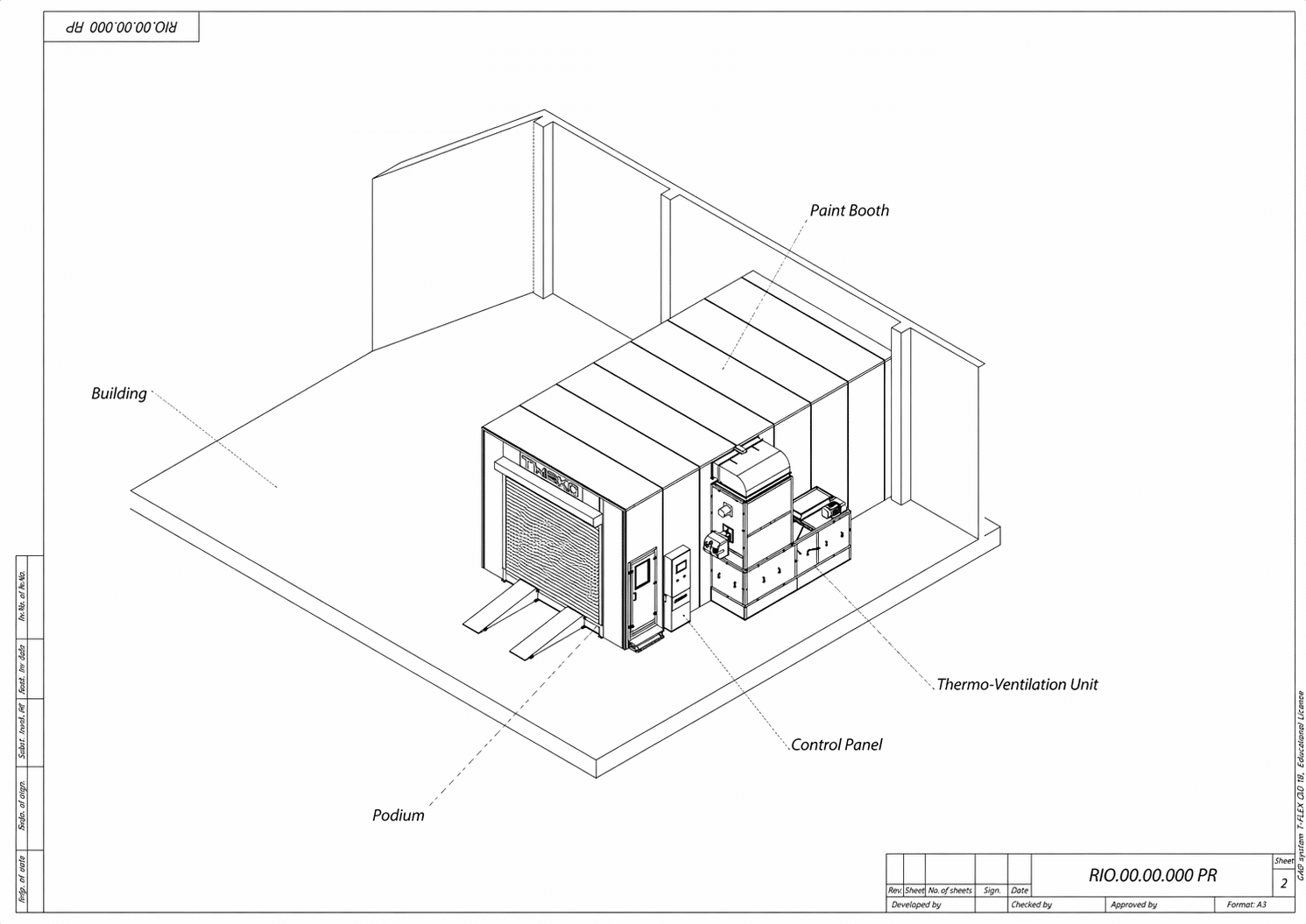
![rio-v2-4[1]](https://t-weko.com/wp-content/uploads/sites/18/2025/10/rio-v2-41.jpg)
![rio-v2-3[1]](https://t-weko.com/wp-content/uploads/sites/18/2025/10/rio-v2-31.jpg)