Check whether this equipment fits your jobAn AI consultant will ask a few questions about your production
KASO Abrasive Blasting Chambers: Reliable Metal Cleaning Equipment
Pre-order
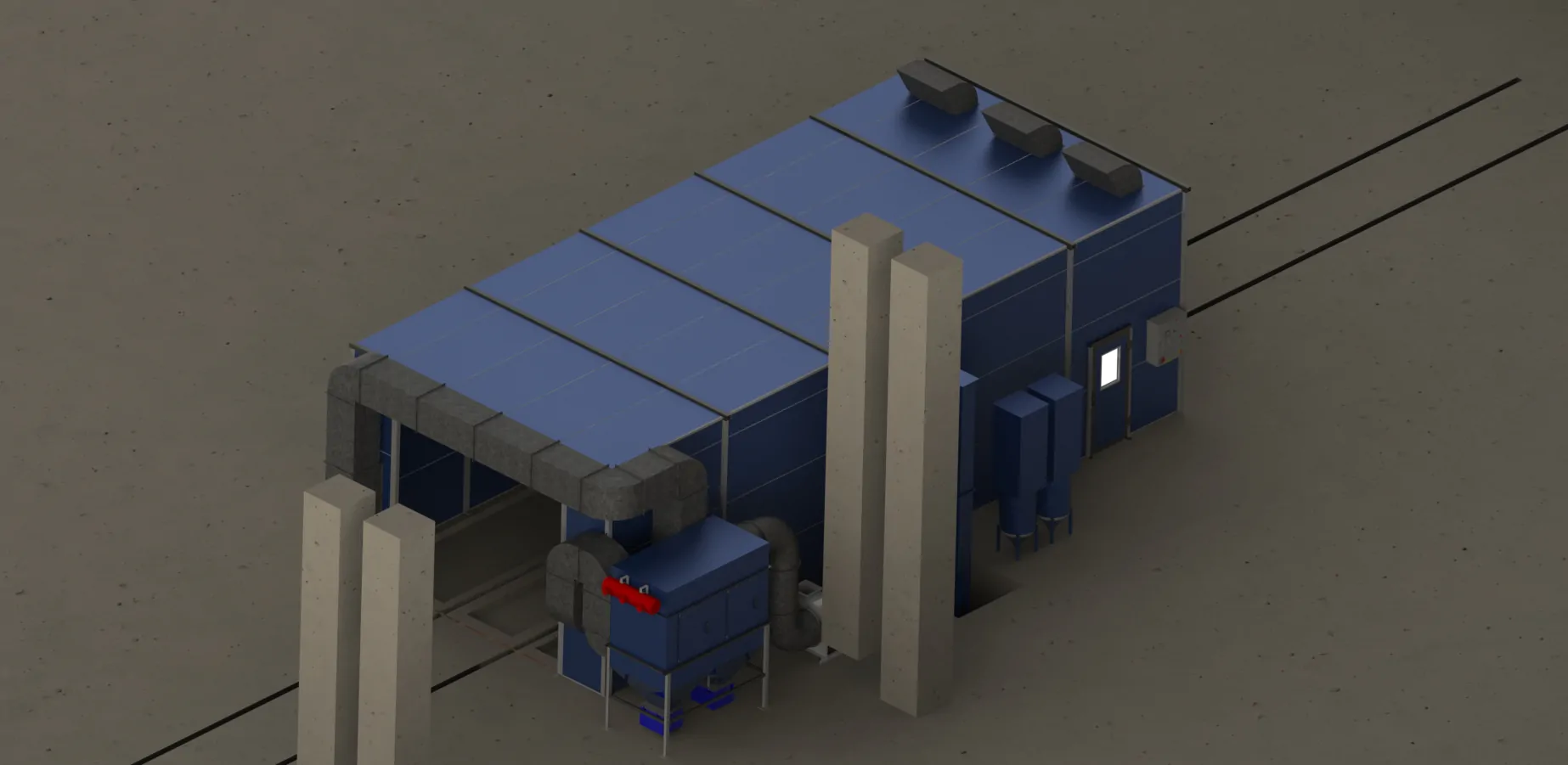
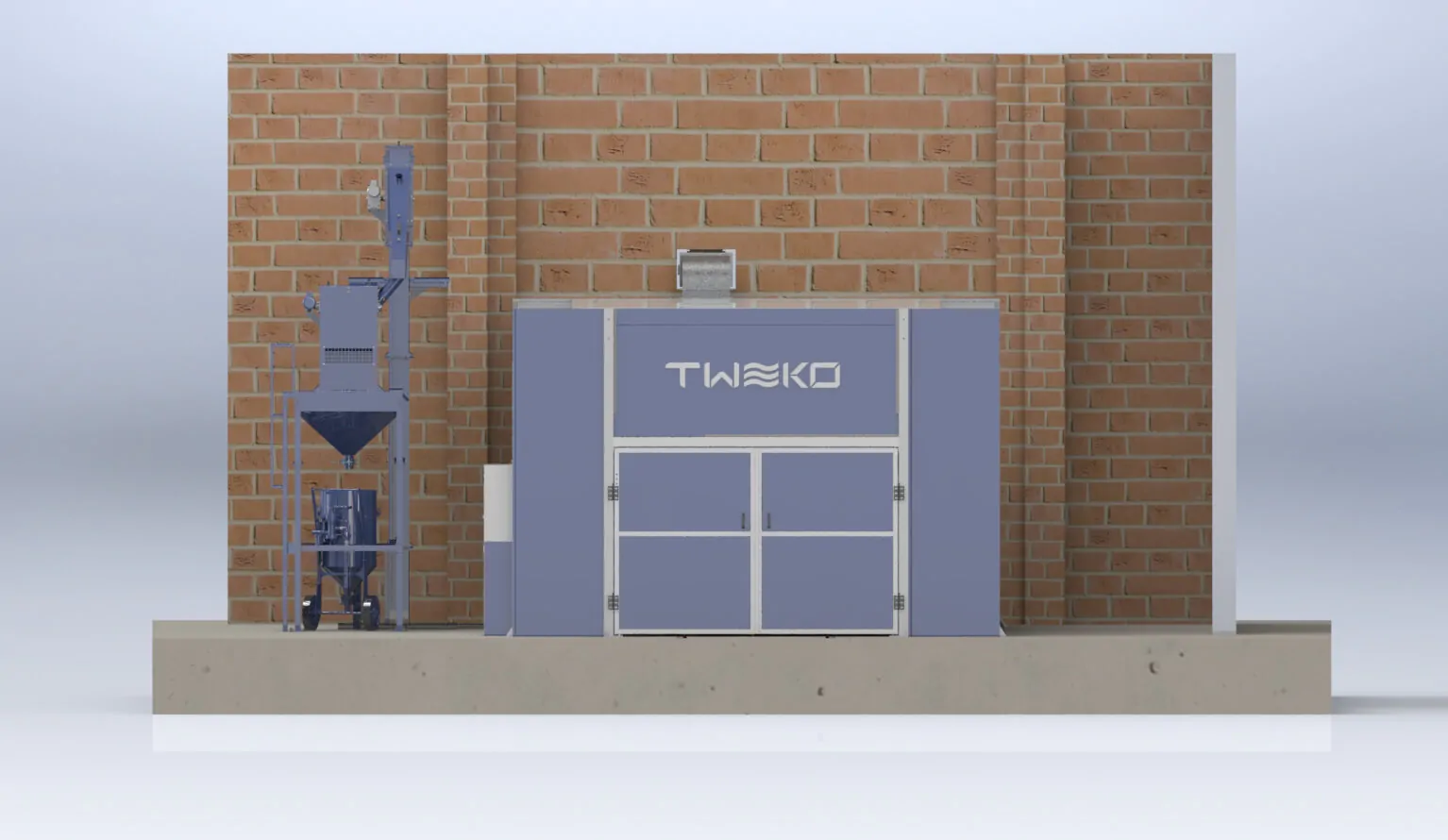
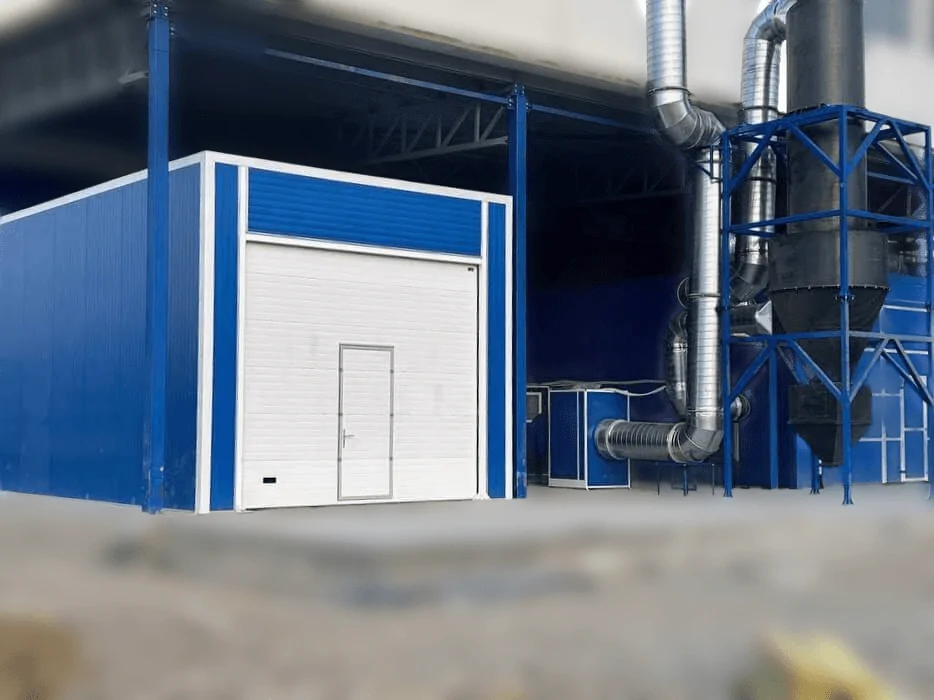
The KASO series comprises abrasive blast rooms with a closed-loop abrasive recycling system. A scraper floor automatically collects spent abrasive, while a bucket elevator and separator clean it and return it for reuse without manual intervention. The filtration and ventilation unit with F9 filter cartridges and pulse-jet cleaning limits the dust concentration at the outlet to no more than 8 mg/m³. The rubber-lined enclosure and LED lighting providing at least 700 lux help ensure safer working conditions for the operator.
Closed-loop abrasive recyclingAutomatic abrasive recovery via scraper floorF9 filter cartridges, dust concentration ≤8 mg/m³LED lighting ≥700 luxPLC-based control panel
KASO series abrasive blast rooms are designed for cleaning the surfaces of metal and other products from rust, mill scale, old paint coatings and other contaminants before painting or applying a protective coating. The blast room contains abrasive and dust within the working area, protects the operator from ricochet, and automatically collects, cleans and returns the abrasive for reuse. The closed abrasive cycle can significantly increase cleaning productivity and overall blasting efficiency.
The blast room can use cast and angular steel or chilled iron shot with a diameter of 0.5–1.0 mm, metal oxides and carbides, glass beads and other abrasive media. Each blast room is custom-engineered for the dimensions of the products, the number of items processed per shift and the number of operators working at the same time.
Steel structuresParts with complex geometryLarge-sized products
How the blast room works
KASO is an equipment system in which all elements are linked into one functional chain and operate to a single algorithm: the enclosure, scraper conveyor, NORYia bucket elevator, abrasive separator, shot storage hopper, FVU filtration and ventilation unit and control panel. Each unit is selected individually, so the blast room’s capacity matches the needs of the specific production.
5–24working area length, m
12,000–30,000FVU airflow capacity, m³/h
6abrasive recycling capacity, t/h
≤8dust concentration at the outlet, mg/m³
All units are controlled and monitored from a central panel based on a programmable logic controller (PLC).
Spent abrasive, together with dust and removed contaminants, falls through the floor gratings onto the scraper conveyor. Longitudinal modules move the material to the transverse module, which carries it to the bucket elevator pit. Collection is automatic and does not interrupt blasting.
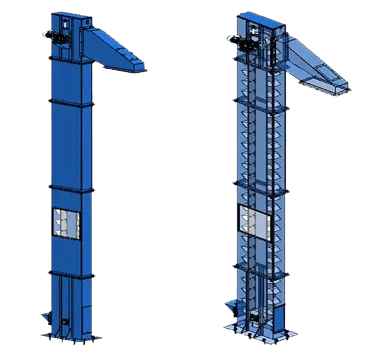
The bucket elevator lifts the mixture to the separator, which separates reusable abrasive from dust, coarse debris and broken grains. The cleaned abrasive is stored in the hopper and fed to the blast machine for reuse. Recycling extends abrasive service life and improves the quality of surface cleaning.
Air filtration
Dust-laden air from the enclosureBaffle plate and hopperF9 cartridgesFanClean air discharge
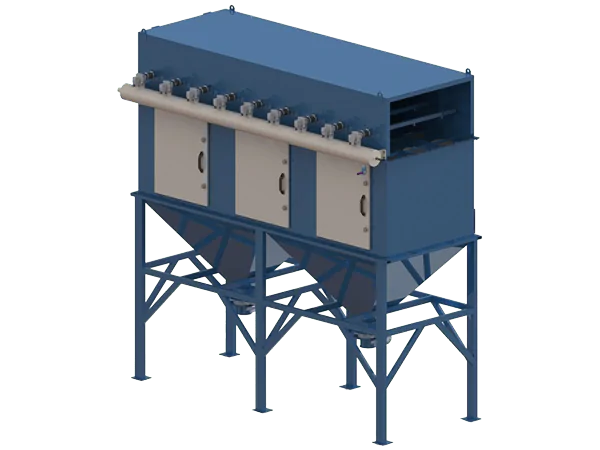
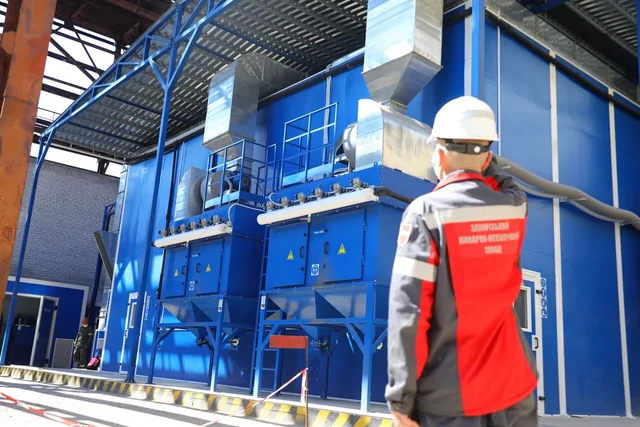
The FVU filtration and ventilation unit continuously extracts dust-laden air from the enclosure. At the inlet, a baffle plate changes the direction of the airflow so that large, heavy dust particles drop straight into the hopper, reducing the load on the filters. The air is then evenly distributed between F9 cylindrical cartridges: dust is retained on their outer surface, and clean air leaves the unit. Dust concentration at the outlet does not exceed 8 mg/m³.
The cartridges are cleaned by compressed-air pulses from a receiver: solenoid valves send a pulse into each cartridge, shaking the dust off into the hopper, from where it is removed through a discharge device.
Design
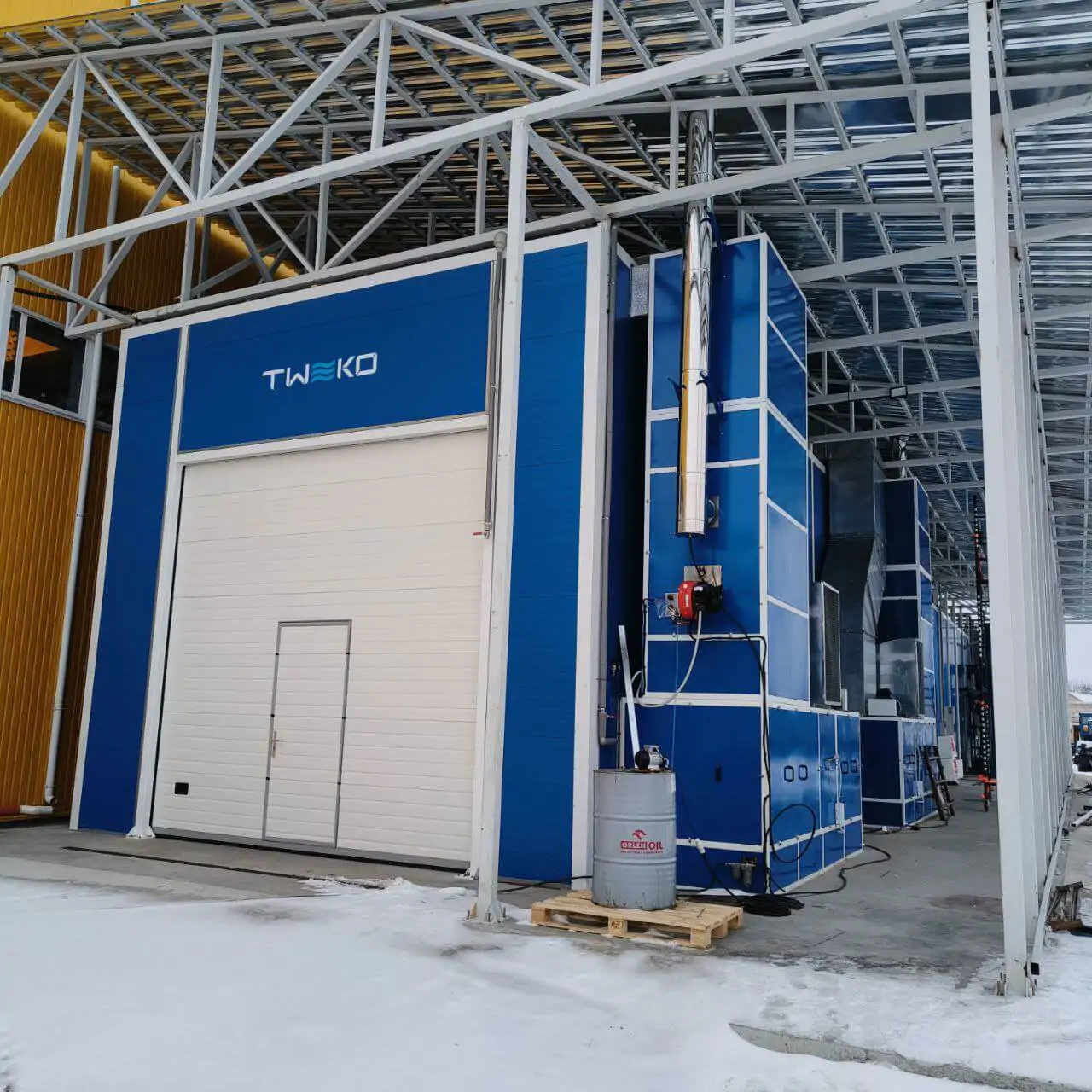
Enclosure — a load-bearing steel frame made of rectangular tubing with a protective paint coating, and walls of sandwich panels with thermal insulation. The enclosure isolates the blasting area and prevents abrasive and dust from escaping.
Doors — sealed entrance doors from 3 × 2 to 4 × 5 m and a personnel door of 800 × 2,000 mm.
Protective lining — the walls, entrance doors and personnel door are lined on the inside with a protective rubber lining that prevents shot ricochet and panel deformation and extends the service life of the blast room.
Lighting — two upper rows of LED T8 luminaires behind reinforced impact-resistant glass, from 6 to 32 luminaires depending on the room size; illumination in the working area is at least 700 lux. Side rows of luminaires can be added if required.
Scraper conveyor — longitudinal modules 600–1,000 mm wide and one transverse module, covered with grating. Carriages with scrapers are driven by electromechanical drives: the scrapers move the material on the forward stroke and lift on the return stroke. The conveyor is designed for each specific blast room to cover the maximum possible floor area.
NORYia bucket elevator — a modular design with base, intermediate and top sections and a section with an inspection window; a 125 mm belt with 0.7 l buckets is driven by a geared motor. Capacity: 6 t/h.
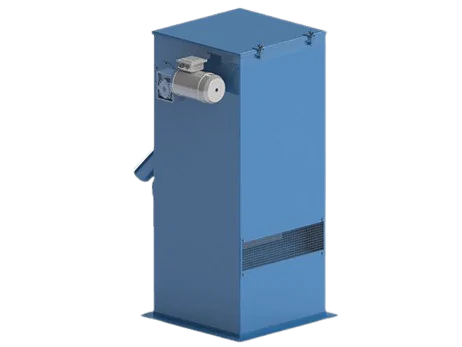
Separator — drum type (SBT) or vibratory type (SVT) with a capacity of 6 t/h. Reusable abrasive passes through the screen into the hopper, coarse particles are discharged separately, and dust is drawn off by an airflow set by a flow regulator.
Shot storage hopper — 0.7 m³ (or 1.1 m³) for intermediate storage of cleaned abrasive and quick filling of the blast machine.
Control panel
The PLC-based panel automatically runs the main working processes — operation of the elevator, separator and FVU — and displays the status of the main units, which simplifies control and reduces the risk of operator error. As standard, the panel includes:
timer and operating hours counter;
FVU pressure transducer for monitoring cartridge clogging or damage;
power indicator and emergency stop switch;
Start and Stop buttons;
scraper floor motion controller and lighting switch;
indication of enclosure pressure and operation of the main units.
Control system components come from leading global manufacturers (ETI, INVT). The panel configuration can be modified according to the technical requirements.
Blast machine and operator protection
The scope of supply includes a blast machine with a 200 l pressure vessel and pneumatic remote start/stop control. The abrasive feed is adjusted manually with a metering valve. The kit also includes a Venturi nozzle, abrasion-resistant blast hose, nozzle holder and couplings, as well as operator personal protective equipment:
blasting helmet with breathing air supply;
breathing air filter and air temperature regulator;
operator protective suit.
Cleaning rate and compressed air consumption depend on the nozzle diameter: according to reference data, from 10 to 65 m²/h at cleanliness grade SA 2, with air consumption of 3 to 22 m³/min at 8 bar.
Safety
Protective rubber lining of the enclosure and doors prevents shot from ricocheting towards the operator.
Luminaires are protected by reinforced impact-resistant glass.
The operator works in a helmet supplied with filtered breathing air and wears a protective suit.
The FVU captures dust from the working area; dust concentration at the outlet does not exceed 8 mg/m³.
Emergency stop switch and fault indication for the main units on the control panel.
The equipment is approved by the State Labour Service of Ukraine (Derzhpratsi) for use in Ukraine.
Site preparation and connections
Power supply — 3-phase, 380 V, 50 Hz; total power consumption from 18.6 to 39 kW depending on the room size.
Compressed air for the blast room — 650 to 800 l/min at 8 atm, excluding the blast machine. Air quality according to ISO 8573-1:2010 — at least class [7:5:4].
Compressed air for the blast machine — depends on the nozzle diameter, from 3 to 22 m³/min at 8 bar.
Earthing — provided by the customer in accordance with the electrical installation regulations.
Building works — foundation, floor works, exhaust air ducts, power and compressed air supply lines and earthing of the blast room are not included in the scope of supply or installation, but can be carried out under a separate contract.
Made to order
Each KASO blast room is engineered to the customer’s technical requirements: working area dimensions, number of scraper floor modules, FVU capacity, separator type and hopper capacity are selected to suit the products and production volumes. The blast room can be supplemented with:
mobile lifting platforms — installed along the enclosure walls, they allow the operator to move quickly and safely along the product at any height; travel along the walls, up and down, and extension of the basket towards the product are controlled from a panel in the work basket;
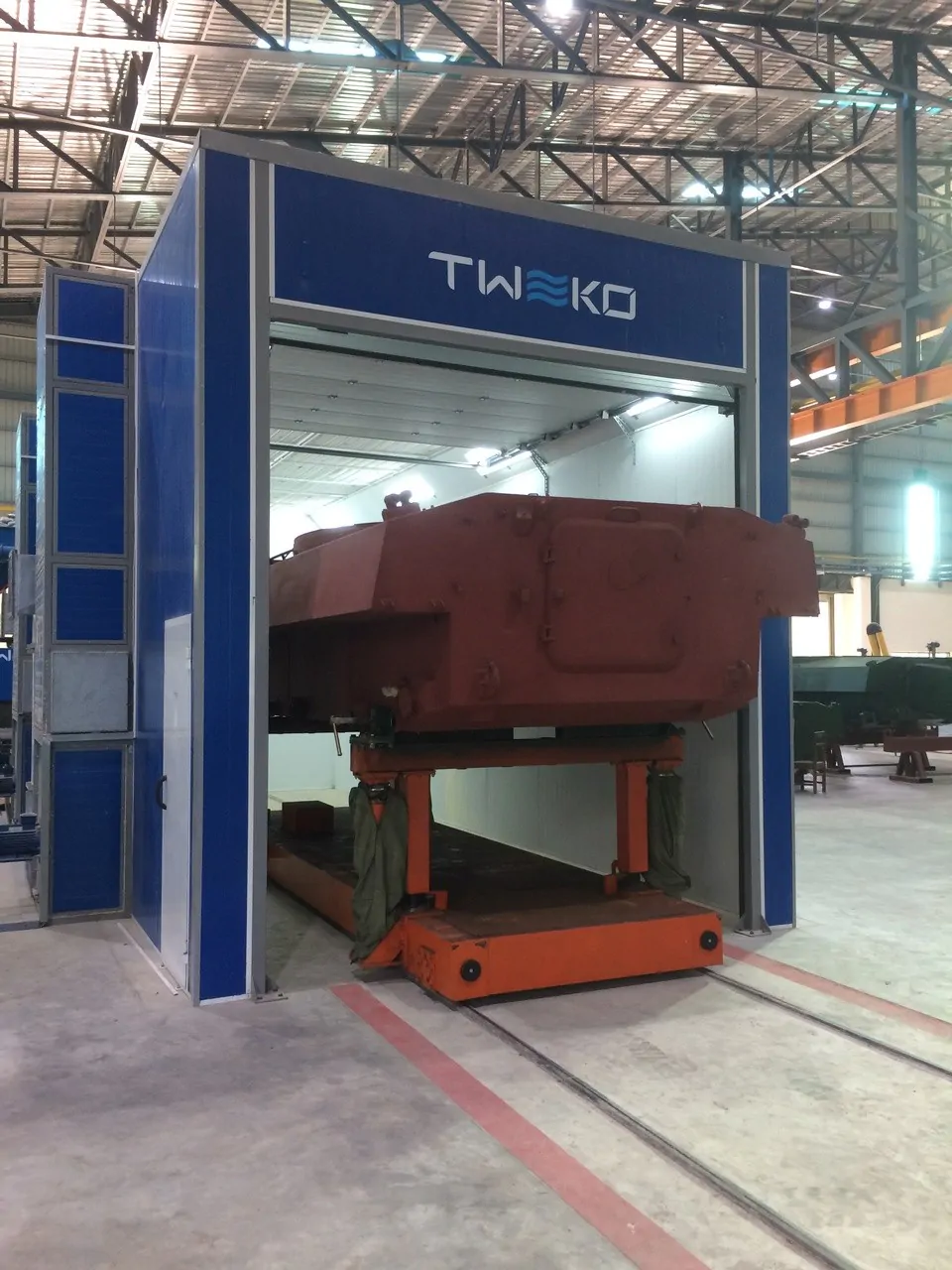
a rail transfer cart for moving products into the blast room and between production areas;
a compressor unit with a compressed air dryer and receivers;
side rows of luminaires for better visibility in larger rooms.
Lead times: design documentation — 15 working days, manufacturing — 50 working days, installation and commissioning — 25 working days. Warranty: 12 months.
Need a blast room for your products?
Send us the dimensions and weight of your products, the abrasive type and the required capacity — we will select a KASO configuration and prepare a quotation.
Scope of Supply of KASO Abrasive Blast Rooms
For the basic configuration*
Component
Quantity
Blast room enclosure
Blast room enclosure
1 set
Entrance doors
1 pc
Personnel door
1 pc
LED luminaires with impact-resistant glass
1 set
Set of floor gratings, max. load 218 kg
1 set
Abrasive recovery and recycling
Shot scraper conveyor
1 pc
Shot bucket elevator
1 pc
Abrasive separator
1 pc
Shot storage hopper
1 pc
Air filtration
Filtration and ventilation unit
1 pc
Cartridge air filters
1 set
Set of connecting hoses and air ducts
1 set
Control
Control panel with automation and monitoring systems
1 set
Blasting equipment
Abrasive blast machine with operator personal protective equipment
1 set
* The scope of supply is the same for all models in the series and applies to the basic configuration. For the full scope of supply, please contact our sales team.
Technical Specifications of KASO Abrasive Blast Rooms
For the basic configuration*
Parameter
KASO-5
KASO-7
KASO-10
KASO-12
KASO-15
KASO-20
KASO-24
Blast room
Internal working area dimensions (L×W×H), m
5 × 4 × 3
7 × 5 × 3.5
10 × 5 × 4
12 × 6 × 5
15 × 6 × 5
20 × 6 × 6
24 × 6 × 6
Entrance doors (W×H), m
3 × 2
3 × 3
3 × 3.5
4 × 4
4 × 4
4 × 5
4 × 5
Personnel door (W×H), mm
800 × 2,000
LED T8 luminaires, 1,200 mm × 4, pcs
6
8
12
16
20
24
32
Shot hopper capacity, m³
0.7 (1.1)
Compressed air consumption of the blast room at 8 atm (excluding the blast machine), l/min
650
650
700
730
750
800
800
Total power consumption, kW
18.6
23.7
27.6
31
39
39
39
Power supply
3-phase, 380 V, 50 Hz
FVU filtration and ventilation unit
Overall dimensions (L×W×H), m
1.7 × 3.1 × 1.6
2.1 × 3.1 × 1.6
2.5 × 3.1 × 1.6
2.5 × 3.1 × 1.6
3.6 × 3.6 × 1.6
3.6 × 3.6 × 1.6
3.6 × 3.6 × 1.6
Effective filter area, m²
168
216
324
486
540
540
540
Airflow capacity, m³/h
12,000
15,000
18,000
24,000
27,000
30,000
30,000
Power consumption, kW
11
15
22
22
30
2 × 15
2 × 15
Maximum fan pressure, Pa
2,200
2,500
2,400
2,200
2,500
2,500
2,500
Filter element, filtration class
Cylindrical cartridge F9
Electromechanical scraper conveyor
Module working width, mm
600–1,000
Number of modules, pcs
3–5
3–6
3–6
3–6
3–7
3–7
12–14
Abrasion-resistant rubber thickness, mm
2
Scraper pitch, mm
200
Floor grating load, kg/m²
≤ 200
Floor grating size, mm
600–1,000 × 30
Floor module height without gratings, mm
110
Power consumption, kW
5.5–6.6
6.6–7.7
6.6–7.7
6.6–7.7
6.6–7.7
6.6–7.7
13.2–15.4
NORYia bucket elevator
Capacity, t/h
6
Belt speed, m/s
≤ 0.3
Bucket pitch, mm
250
Bucket volume, l
0.7
Elevator belt width, mm
125
Power consumption, kW
1.1
SBT drum-type separator**
Capacity, t/h
6
Motor power, kW
1.1
Noise level, dB(A)
≤ 85
SVT vibratory separator**
Capacity, t/h
6
Motor power, kW
0.25
Noise level, dB(A)
≤ 85
* Specifications are given for the basic configuration. Dimensions and equipment are finalised during design according to the customer’s technical requirements. ** The blast room is supplied with one separator: drum type (SBT) or vibratory type (SVT).