
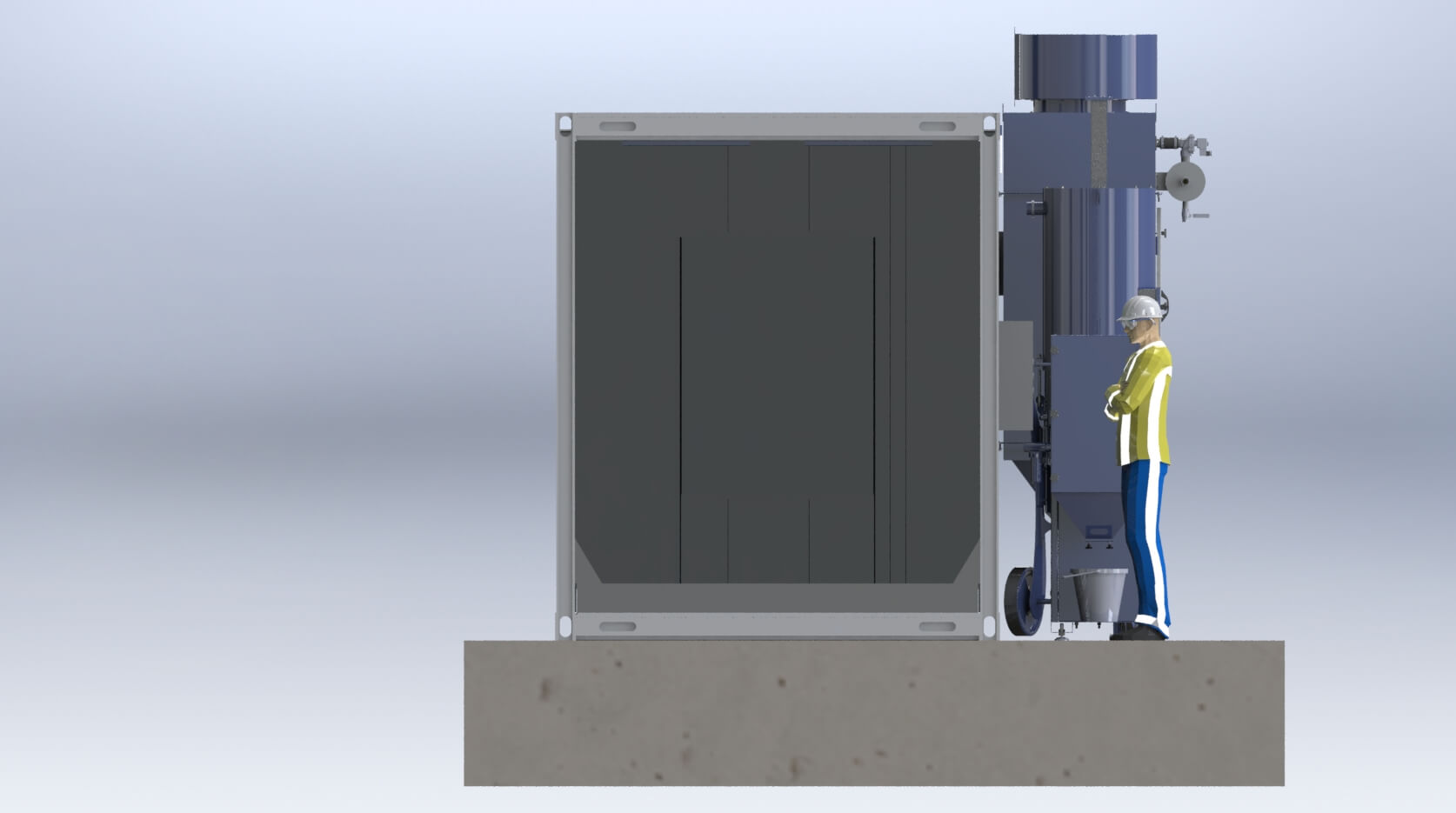
System configuration
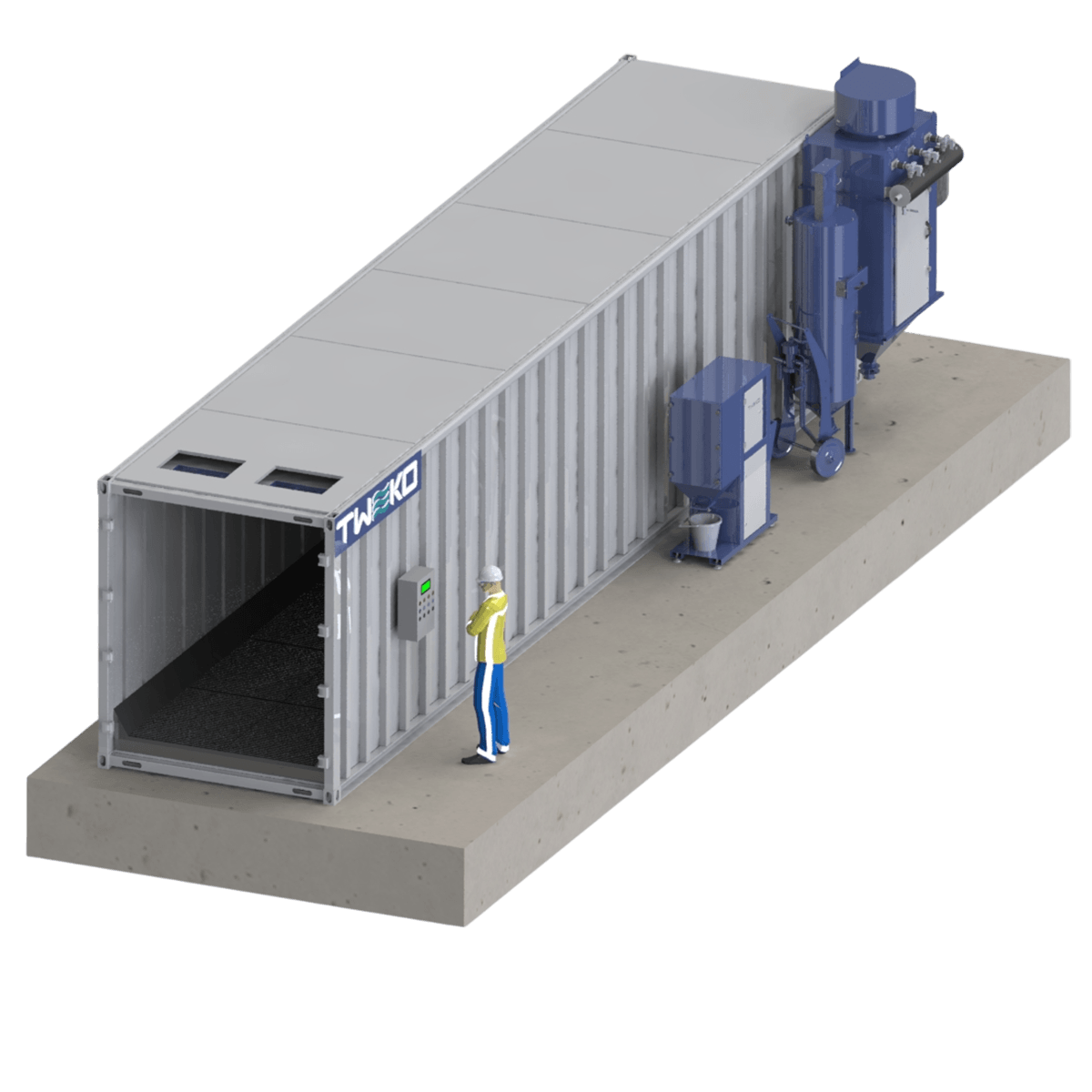
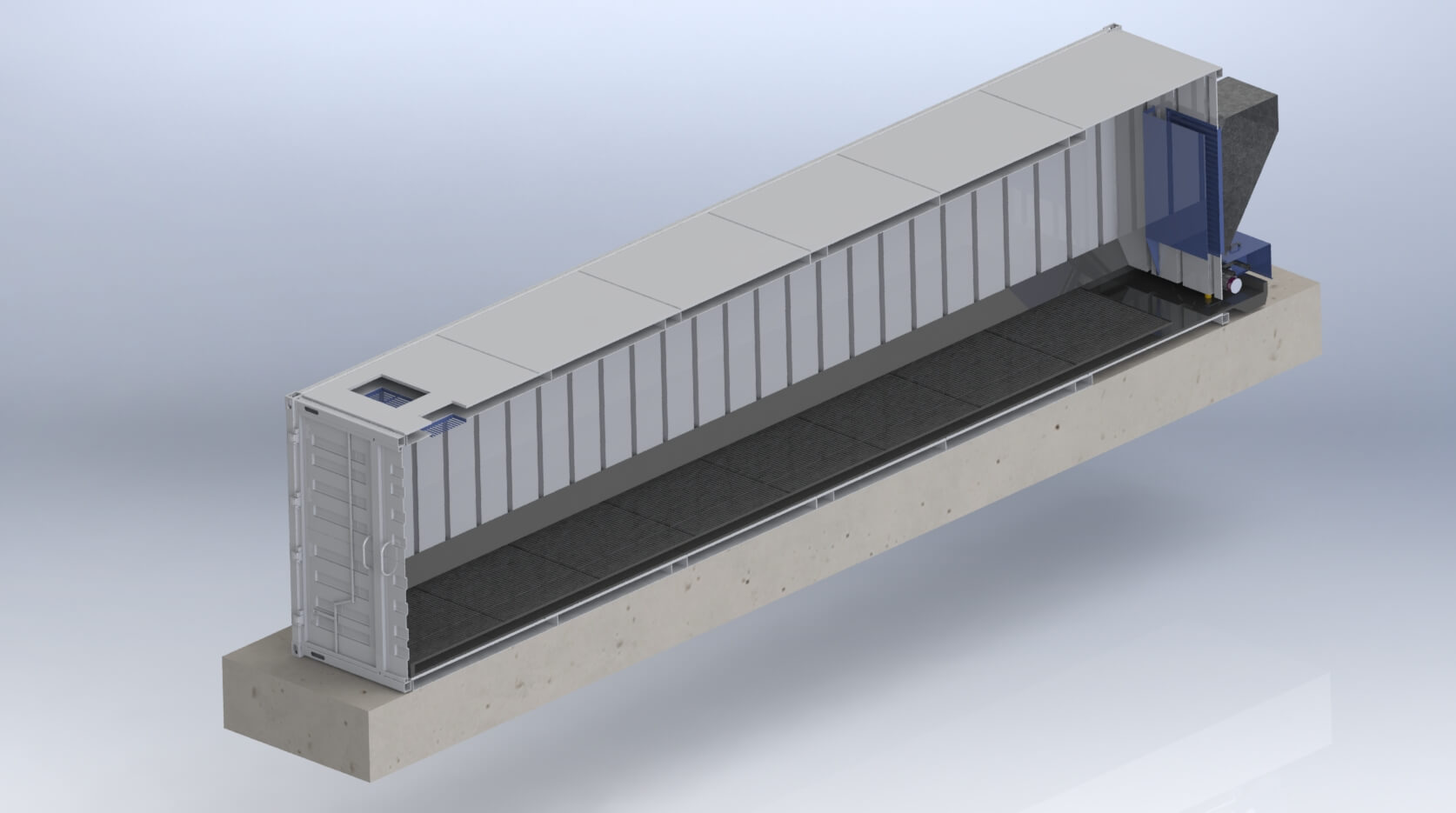
The entire length of the container is used as a 12,000 × 2,350 × 2,430 mm working area, with no internal technical compartment. Workpieces are loaded through the standard end doors, providing access across the full width of the container. The floor of the working area incorporates an abrasive collection conveyor covering the entire floor area.
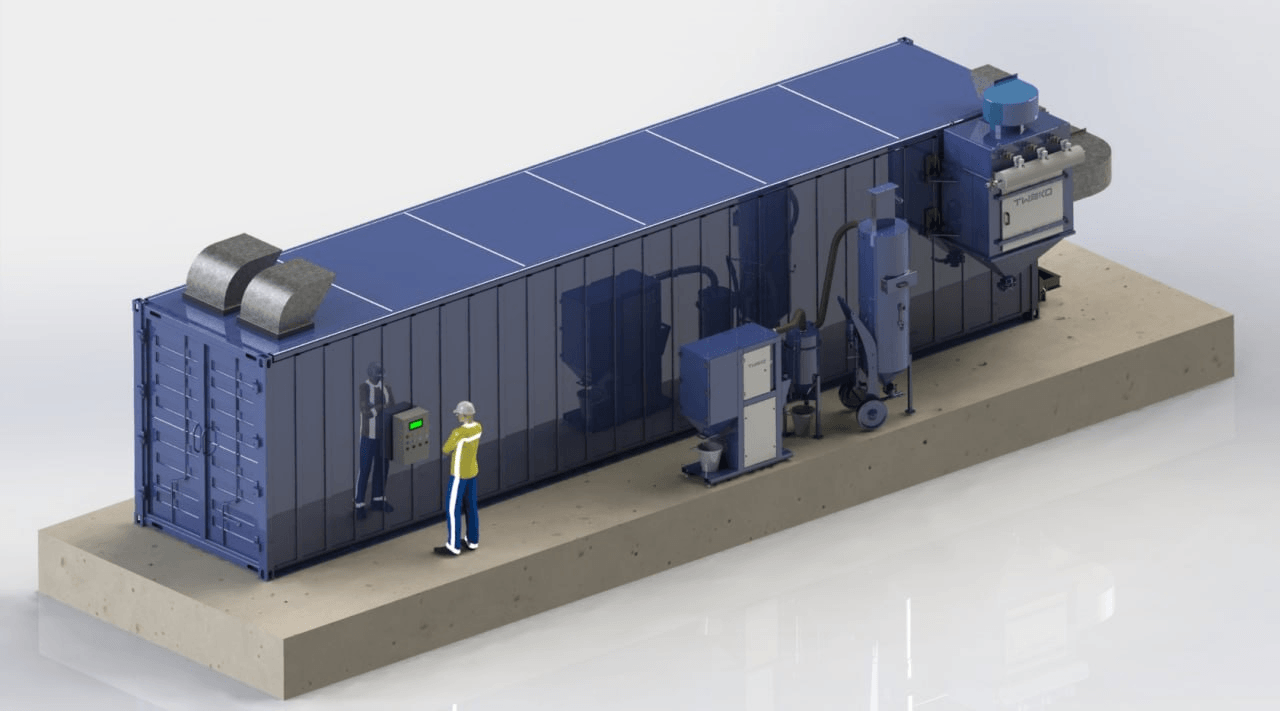
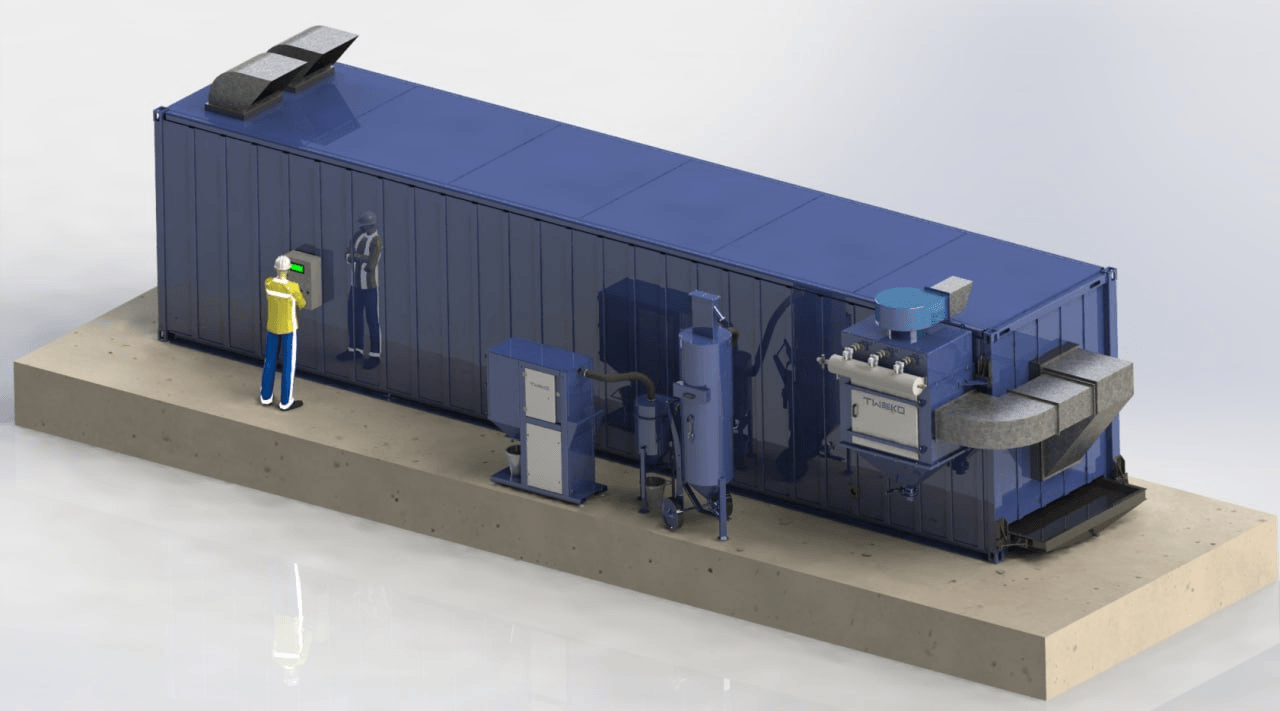
Process equipment is located behind the end wall of the chamber: a filtration and ventilation unit, a vacuum unit for abrasive collection and regeneration, an air duct line and the scraper floor drive. The control panel is mounted on the external wall near the doors, so the equipment can be started and stopped outside the dusty zone.
Closed-loop abrasive recovery
Surface cleaning
The operator blast-cleans the workpiece using abrasive propelled by compressed air. Removed rust, mill scale and old coating material fall together with the abrasive onto the chamber floor.
Collection by scraper floor
The scrapers move the mixture of abrasive and blast-cleaning debris along the chamber towards the collection point at the end. This eliminates the need for manual removal and handling of spent abrasive.
Regeneration
The vacuum unit collects the mixture and separates dust and broken abrasive particles. Reusable abrasive is then collected for further use.
Return to the blasting process
The recovered abrasive is returned to the blasting machine for reuse, while the separated dust and blast-cleaning debris are collected in the hoppers of the filtration and ventilation unit.
The closed-loop system significantly reduces abrasive consumption compared with single-pass blasting and eliminates the need to clean the working area manually after each blasting cycle. A separate opening is provided for inserting the abrasive recovery hose to remove residual abrasive from hard-to-reach areas without opening the chamber doors.
Air extraction and airflow
Fresh air enters the chamber naturally through two air inlets in the roof above the door area. The airflow travels along the entire working area towards the extraction grille at the opposite end, carrying dust and fine abrasive particles with it.
The filtration and ventilation unit maintains negative pressure inside the chamber, preventing dust-laden air from escaping through gaps and spreading to adjacent areas. Captured dust is collected in the unit hoppers, while the cleaned air is discharged into the atmosphere. The filters are regenerated by pulse-jet cleaning with compressed air.
Construction
- Chamber body — 40-foot shipping container with openings for the supply and exhaust grilles, scraper floor section and abrasive recovery hose access. Corner fittings are retained, allowing the chamber to be handled and transported using standard container-handling equipment.
- Scraper floor — abrasive collection conveyor covering the entire working area, with the drive located outside the end wall of the chamber.
- Filtration and ventilation unit — air-extraction unit with filters, dust collection hoppers and a pulse-jet compressed-air regeneration system, mounted at the end on its own frame.
- Vacuum unit — mobile abrasive collection and regeneration unit on a trolley: mixture intake, separation of dust and fine particles, and accumulation of reusable abrasive.
- Air duct line — set of air ducts from the chamber exhaust grille to the filtration and ventilation unit with fastening elements.
- Blasting machine — abrasive feed unit using compressed air, complete with hoses and nozzle.
- Control panel — externally mounted panel for controlling the scraper floor and air-extraction system.
Safety and working conditions
- Negative pressure created by the filtration and ventilation unit keeps dust within the chamber.
- Air extracted from the working area is cleaned before discharge into the atmosphere.
- The control panel is located outside the chamber, allowing the equipment to be started and stopped without entering the dusty working area.
- Mechanised abrasive collection eliminates manual cleaning of the working area after the blasting cycle.
- Compressed air supplied to the equipment must meet ISO 8573-1 quality class [4:6:3].
- Work inside the chamber must be carried out using appropriate personal protective equipment (PPE), including respiratory, eye and skin protection, in accordance with applicable occupational safety requirements.
Site and utility requirements
The system is not intended for outdoor operation. Before installation, the customer shall provide:
Foundation slab
A level concrete slab for the chamber and external process equipment, with dimensions exceeding the system size of 12,951 × 3,559 mm.
Protection from precipitation
A building or canopy with roof and site drainage, including gutters, downpipes and drainage channels in the ground or foundation slab. Where canopy dimensions are limited, additional side walls may be required to provide adequate protection from precipitation.
Power supply
Two 380 V / 50 Hz power supply cables: one rated for 7 kW (scraper floor and filtration and ventilation unit) and one for 6 kW (vacuum unit). Each cable must be protected by a separate circuit breaker and have a free cable length of 2,000 mm.
Compressed air
Three compressed-air connection points are required: blasting machine — 1,100–1,400 l/min at 8–10 bar; filtration and ventilation unit — 300 l/min at 6 bar; vacuum unit — up to 100 l/min at 4–6 bar. Compressed-air quality class: ISO 8573-1 [4:6:3].
Utility connections, drainage and earthing are not included in the scope of supply or installation work, but can be performed under a separate contract. Abrasive material and personal protective equipment (PPE) for the operator are not included in the scope of supply.
Custom manufacturing
KASO-C systems are custom-manufactured to meet individual project requirements. The working area length, extraction capacity, abrasive type, process equipment configuration and site layout are determined according to the customer’s technical specifications.
Need a KASO-C system for your project?
We will configure the system to suit your workpieces and site conditions.
How to pay
- Cash (when delivered from stores)
- Non-cash payment (for customers)
- Online payment through LiqPau (Privat24/Visa/MasterCard)
Delivery methods:
- Nova Poshta
- Self-pickup
- Transport company
- Delivery
- Intime
Related Products

KASO Abrasive Blasting Chambers: Reliable Metal Cleaning Equipment
KASO abrasive blasting chambers from TWEKO are professional blast cleaning equipment designed for safe and...