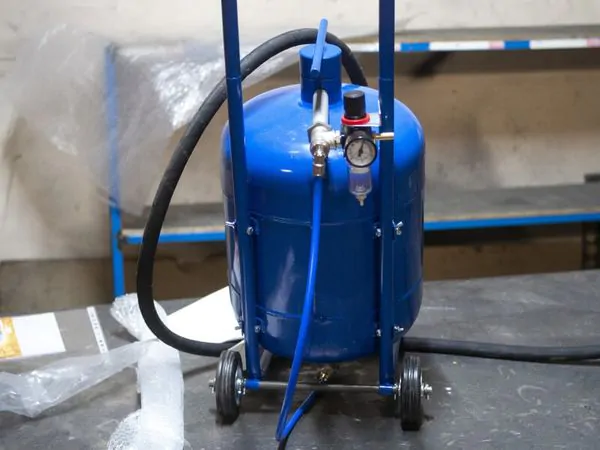
A sandblaster is a device that is used to clean and treat surfaces with abrasive materials. It allows you to quickly and qualitatively remove rust, old paint and other contaminants. Many craftsmen prefer to assemble a sandblasting machine on their own, which allows not only to save money, but also to adapt the device to specific tasks, including work in the blast chamber. In this text, we will consider in detail how to make a sandblasting machine with your own hands: from the choice of compressor to the adjustment and testing of the manufactured system.
How does a sandblaster work? The main components of a sandblaster and their purpose
The main components of the unit include several elements, each of which fulfils an important function for the normal operation of the unit:
- Compressor – a device that supplies compressed air to pressurise the machine.
- An abrasive cylinder is a tank that holds sand or other abrasive material.
- A sandblasting gun is a tool that directs a stream of air and abrasive to the surface to be treated.
- Regulators and valves control the pressure and air flow in the system.
These are also the various hoses and connections that supply air and abrasive from the compressor to the gun.
Operating principle of the sandblasting machine
The principle of operation of a sandblaster is quite simple. It is based on mixing abrasive material with a stream of compressed air and the directed ejection of this mixture onto the surface to be treated. Pressurised air is supplied through a hose to the gun, where it is mixed with the abrasive. Sand or other abrasive is blasted at high velocity through the nozzle of the gun, cleaning or sanding the surface.

Selecting a compressor for sandblasting
Understand what capacity of the compressor is needed for sandblasting before manufacturing, it is quite important, because the quality of the work performed by it directly depends on this. It is necessary to take into account not only the power of the device, but also its ability to maintain the necessary pressure for a long time.
The capacity of the machine is determined by the volume of compressed air it can supply per minute (l/min or cubic metres/hour). For a sandblaster, this capacity should be at least 300-400 l/min, or better – about 500 l/min for quality treatment of large surfaces. At lower values the compressor will not be able to maintain a constant pressure, which will negatively affect the quality of work.
The choice of compressor for sandblasting should be based on its capacity, receiver volume and ability to maintain a stable pressure. Compressors with receivers of 50-100 litres and a capacity of 3 kW or more are most often suitable for sandblasting machines.
As to what pressure is required for sandblasting, it should be at least 6-8 bar. Depending on the type of abrasive and the task at hand, the pressure can vary: for more delicate work it can be lower and for hard materials it can be higher.
Selecting a sandblasting gun
The sandblasting gun is an important system element that directly affects the accuracy and efficiency of machining. It consists of a housing, a nozzle, a chamber for mixing abrasive and air, and a control knob. The abrasive and air are mixed in the chamber and the mixture is blown through the nozzle at high speed. An important part is the air supply valve, which allows the flow and pressure to be adjusted.
An understanding of which sandblasting gun to choose can be obtained by studying its characteristics. Pay attention to the nozzle material – wear-resistant materials prolong the life of the device. Also look at the size of the nozzle – it affects the flow of air and abrasive, as well as the width of the processing stream. The handle should be ergonomically designed to reduce fatigue when working for long periods of time.
Preparing components for assembly
Before starting to build the sandblaster, all of the above components and tools must be prepared. They must be carefully inspected for damage and checked for compatibility.
To assemble the sandblaster you will need:
- Spanners for tightening connections.
- Foam tape or sealant for sealing threaded connections.
- Hoses resistant to high pressure.
- Connecting fittings and clamps.
- Compressed air (compressor).
- Abrasive cylinder.
Check that the hoses are not cracked, the compressor is working properly and the gun is not clogged with abrasive. Also check all connections for leaks.
Setting up and testing of the sandblasting machine
After the sandblaster has been assembled, it must be set up. First check the pressure level in the system. Adjust the pressure on the compressor and the machine to 6-8 bar. After starting the machine, make sure that the system pressure is stable and the compressor does not overheat.
For optimum long-term operation of the sandblaster, the air flow and the amount of abrasive entering the gun must be set correctly. These parameters depend on the type of material to be blasted and the application.
Also do not forget to check all connections for leaks on the homemade unit. If there are air leaks, tighten the connections or replace the sealing elements.
Following this simple guide, you can make a reliable and effective homemade sandblaster, which will cope with various tasks for processing and cleaning surfaces.