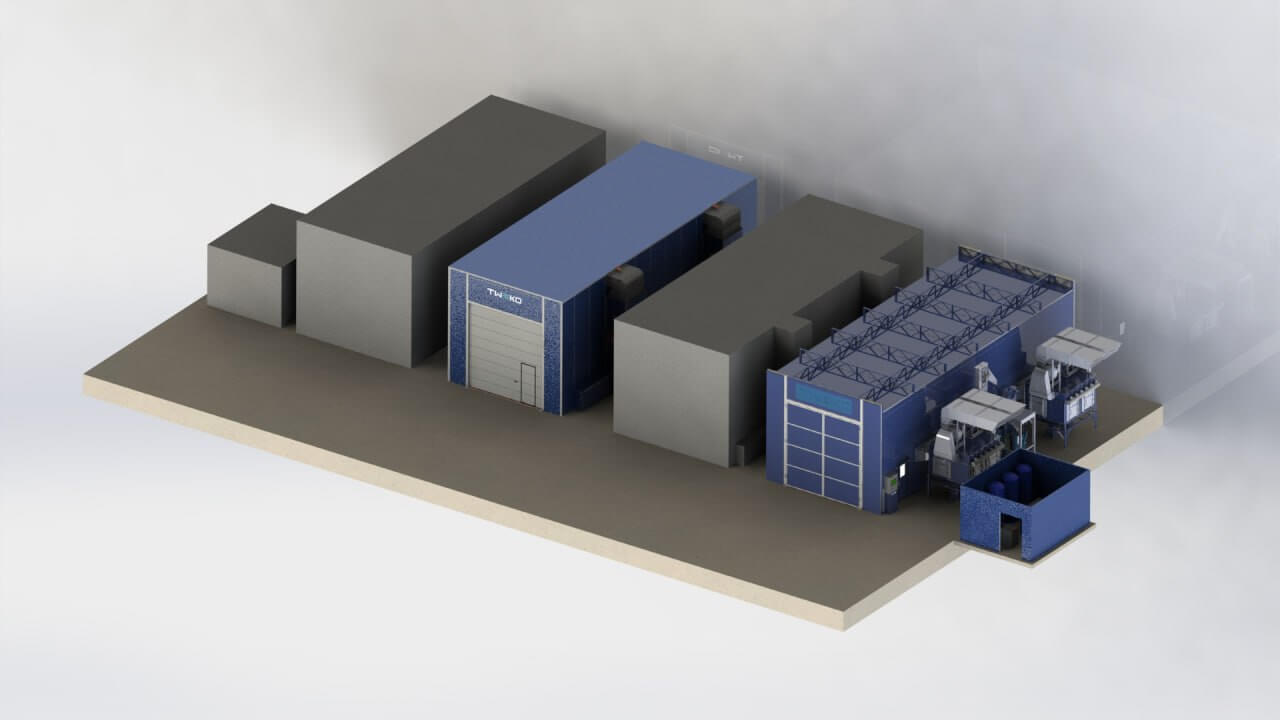
In September 2024, a major Ukrainian machine-building enterprise approached TWEKO with a request to develop and supply a technological complex for a complete production cycle of surface preparation, abrasive blasting, washing, spray painting, and drying of oversized products.
As part of the project, TWEKO selected the optimal equipment configuration, including an abrasive blasting chamber, a spray painting and drying booth, and auxiliary modules. The scope also covered system integration, engineering utilities installation, electrical works, commissioning, and handover of the complex for industrial operation in October 2025.
About the Client
The client is a Ukrainian design-and-manufacturing enterprise in the machine-building sector, specializing in the development, production, maintenance, and repair of specialized automotive and industrial equipment, as well as the supply of components and service support.
The enterprise provides a full range of services, including engineering design, manufacturing, technical maintenance and repair of equipment, as well as component supply and service support.
Thanks to its well-developed production base and the implementation of engineering innovations, the company is one of the stable system manufacturers in its market segment.
Solution
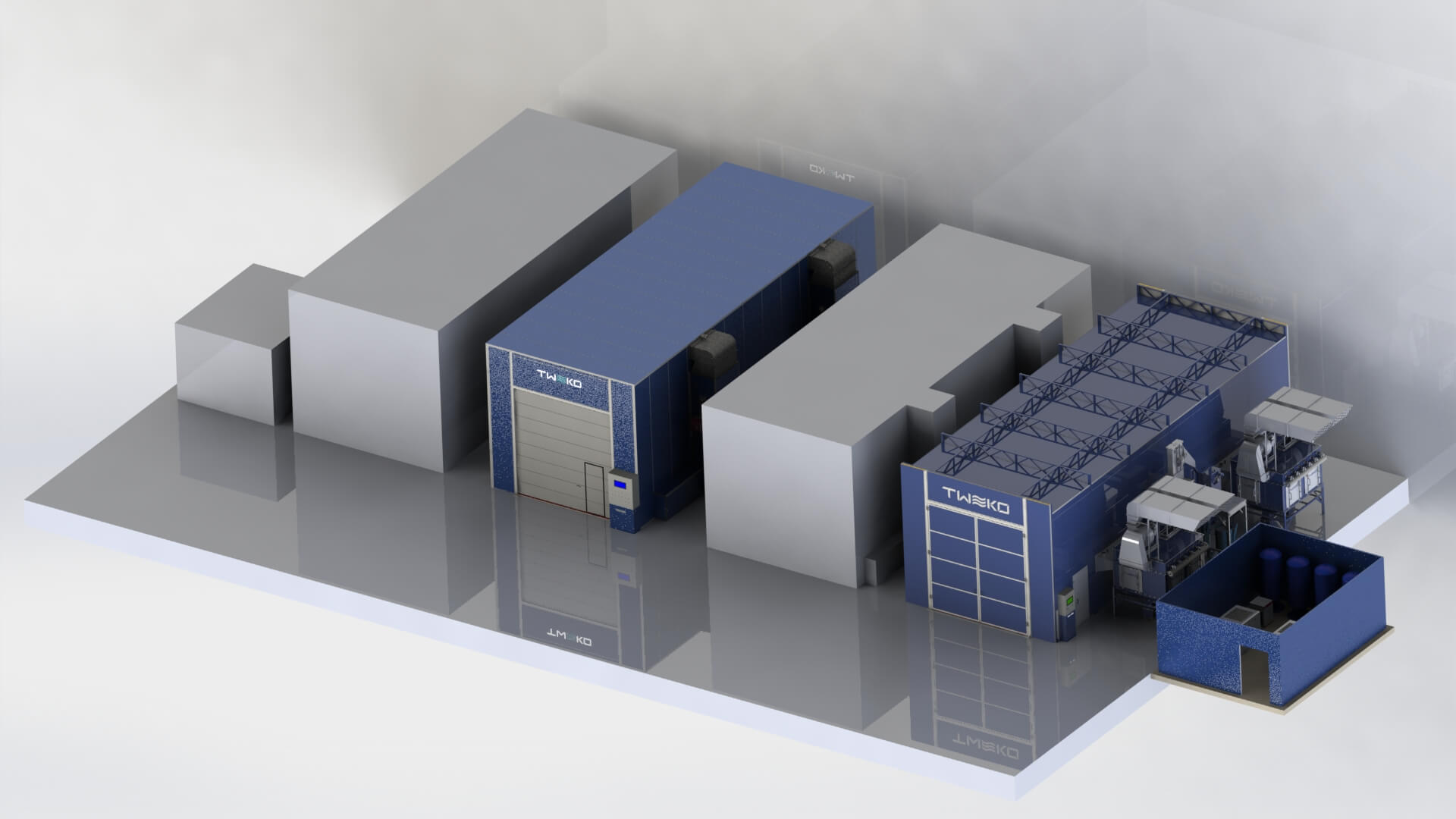
To ensure a complete cycle of surface preparation and coating application, TWEKO implemented a comprehensive technological solution that includes an abrasive blasting chamber, a pass-through paint-drying booth, as well as auxiliary engineering and technological systems integrated into a single production process.
-
- Abrasive Blasting Chamber
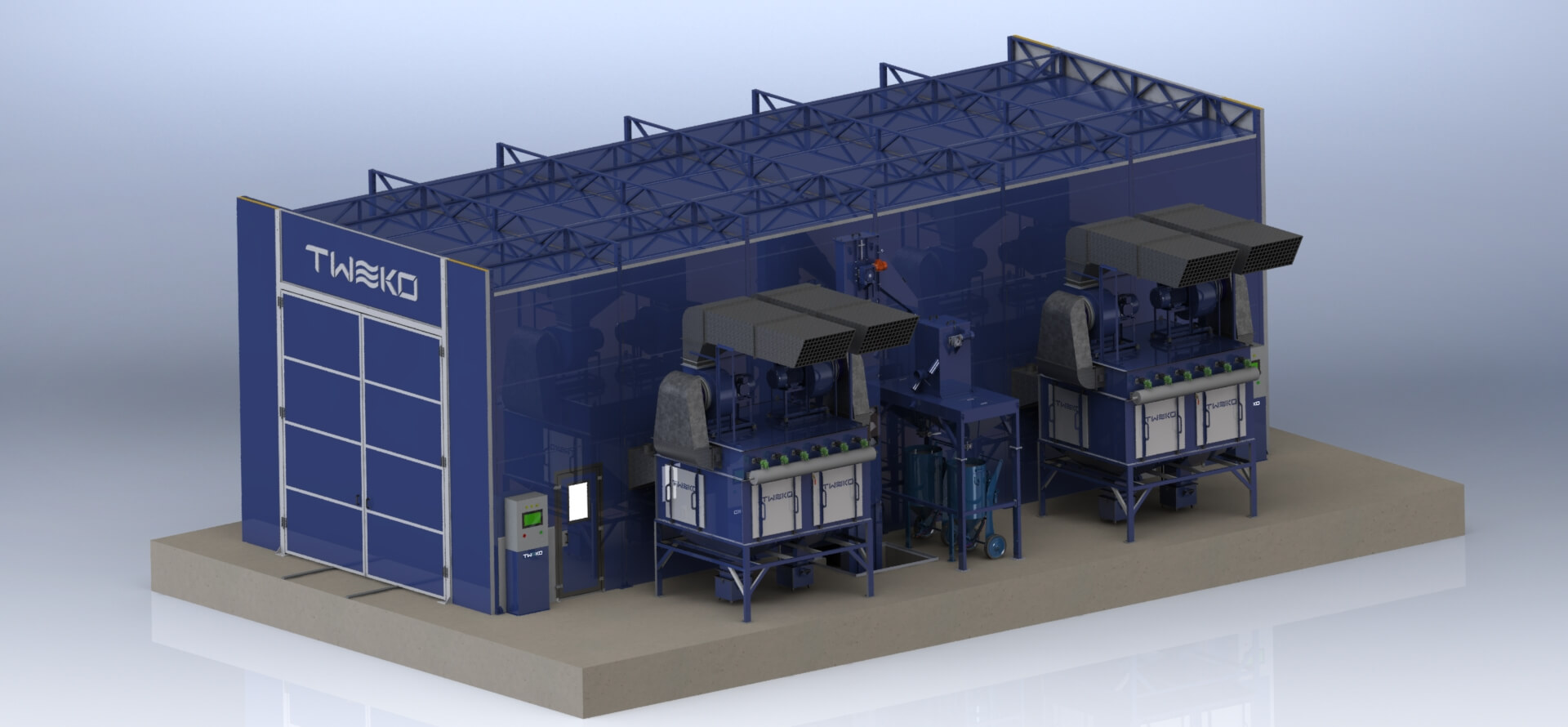
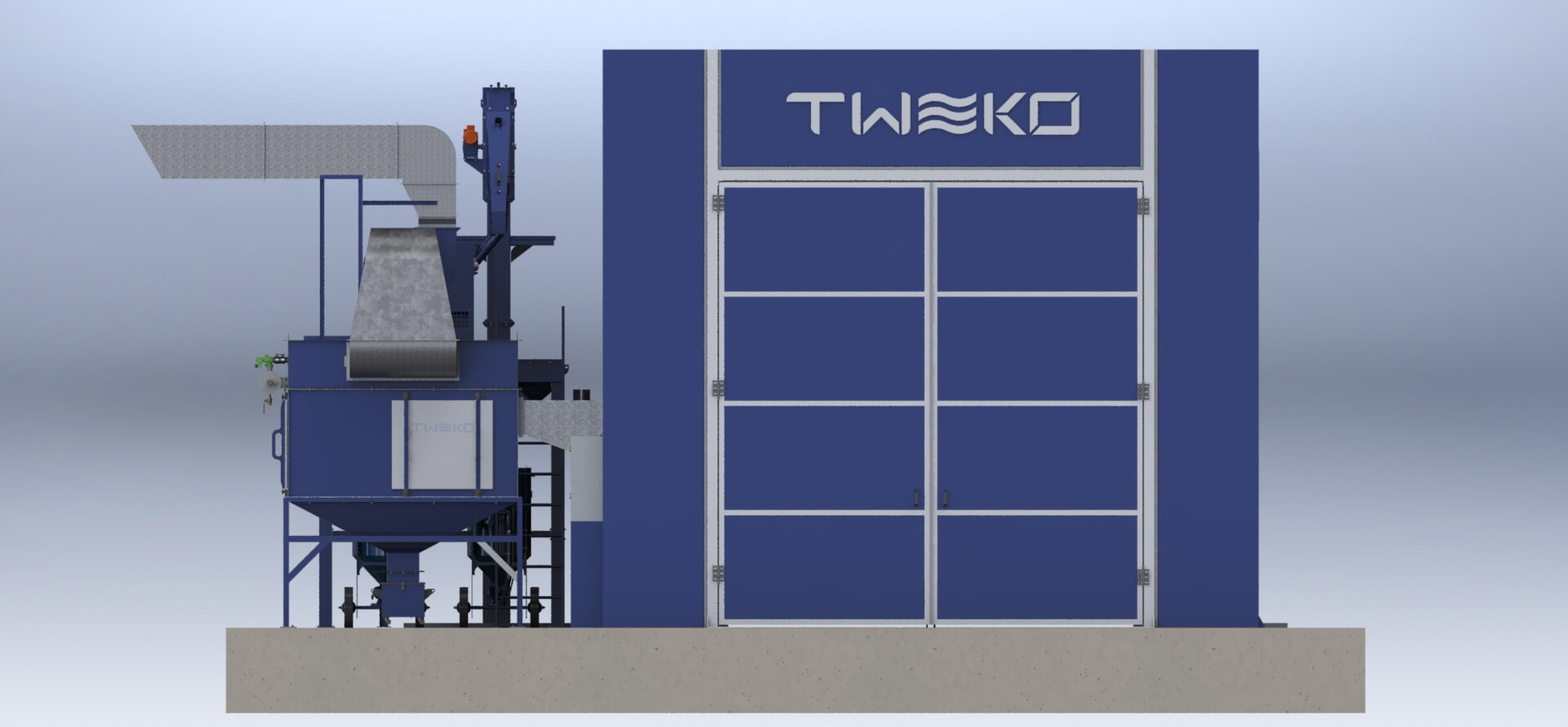
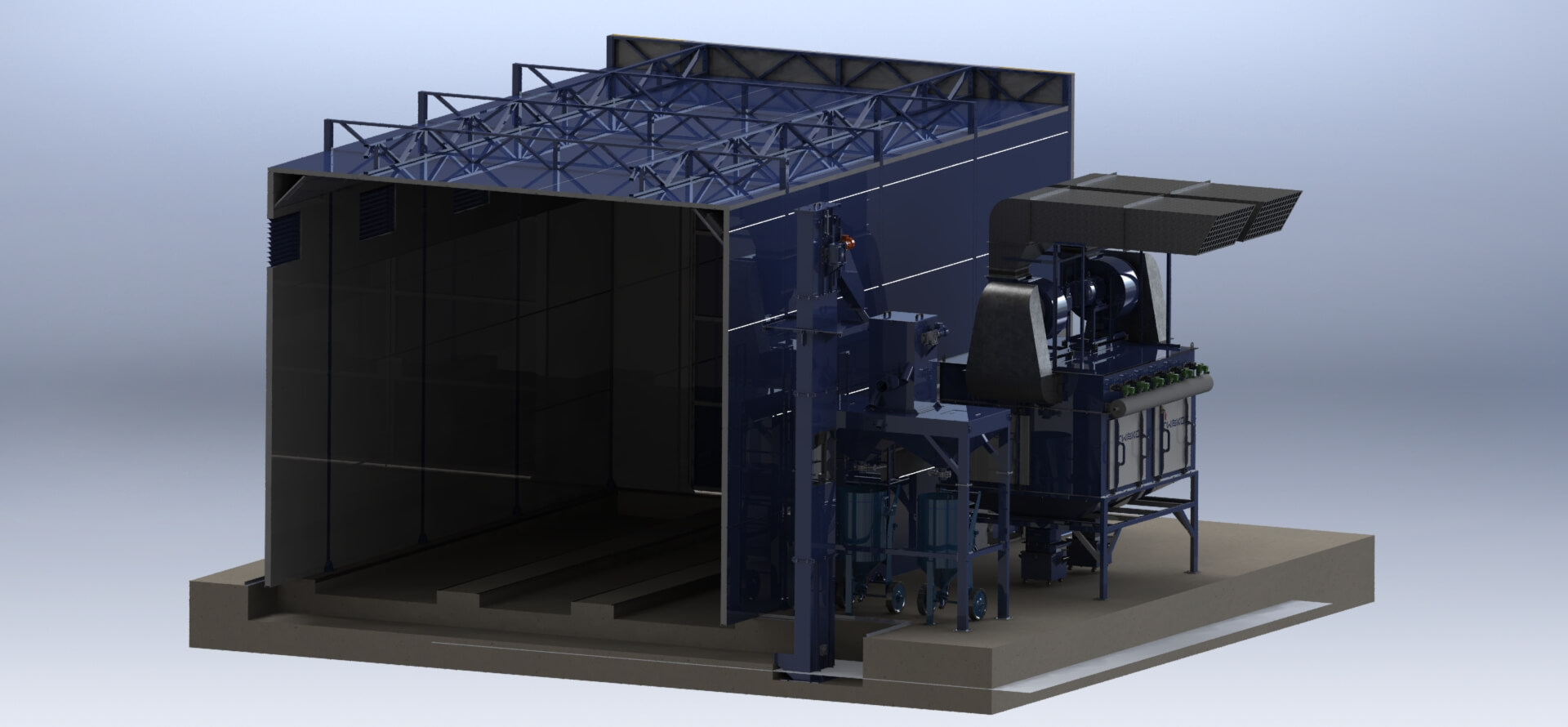
For the surface preparation stage, an abrasive blasting chamber of the KASO series manufactured by TWEKO was implemented — the KASO-15 pass-through model with a single abrasive blasting working zone. Chambers of the KASO series are designed for industrial cleaning of metal products from rust, scale, old coatings, and other contaminants, ensuring stable surface quality prior to subsequent technological operations.The pass-through layout of the KASO-15 chamber enables continuous processing of oversized assemblies and units and integration of the equipment into a flow-oriented production process, minimizing downtime and manual operations. The chamber design and engineering systems are adapted for intensive industrial operation and meet the requirements of heavy engineering and serial production facilities. The chamber is equipped with:
- A mechanized abrasive collection and regeneration system with a closed-loop cycle, including a scraper floor, bucket elevator, separator, and storage hopper, providing automatic return of cleaned abrasive to the working process.
- Filtration and ventilation units with cartridge filtration and pulse-jet filter regeneration, designed for effective removal of dust-laden air from the working zone during abrasive blasting operations.
- A ventilation system with controlled extraction of dust-laden air, ensuring compliance with permissible sanitary and acoustic parameters in the service area.
- An automated control panel with status indication of key chamber components, monitoring operation of ventilation units, abrasive regeneration systems, and transport mechanisms.
- Through-type entrance and exit gates designed for processing oversized products in a flow-through mode, as well as personnel service doors equipped with interlocking elements.
- Wear-resistant internal protective lining and an industrial lighting system for the working zone, adapted for intensive abrasive blasting conditions.
The chamber structure, engineering systems, and control automation were implemented in accordance with the requirements of the technological process and the operating conditions of the enterprise, ensuring stable industrial operation of the equipment and its full integration into the customer’s production infrastructure.
- Abrasive Blasting Chamber
 The chamber is equipped with:
- Paint and Drying Booth
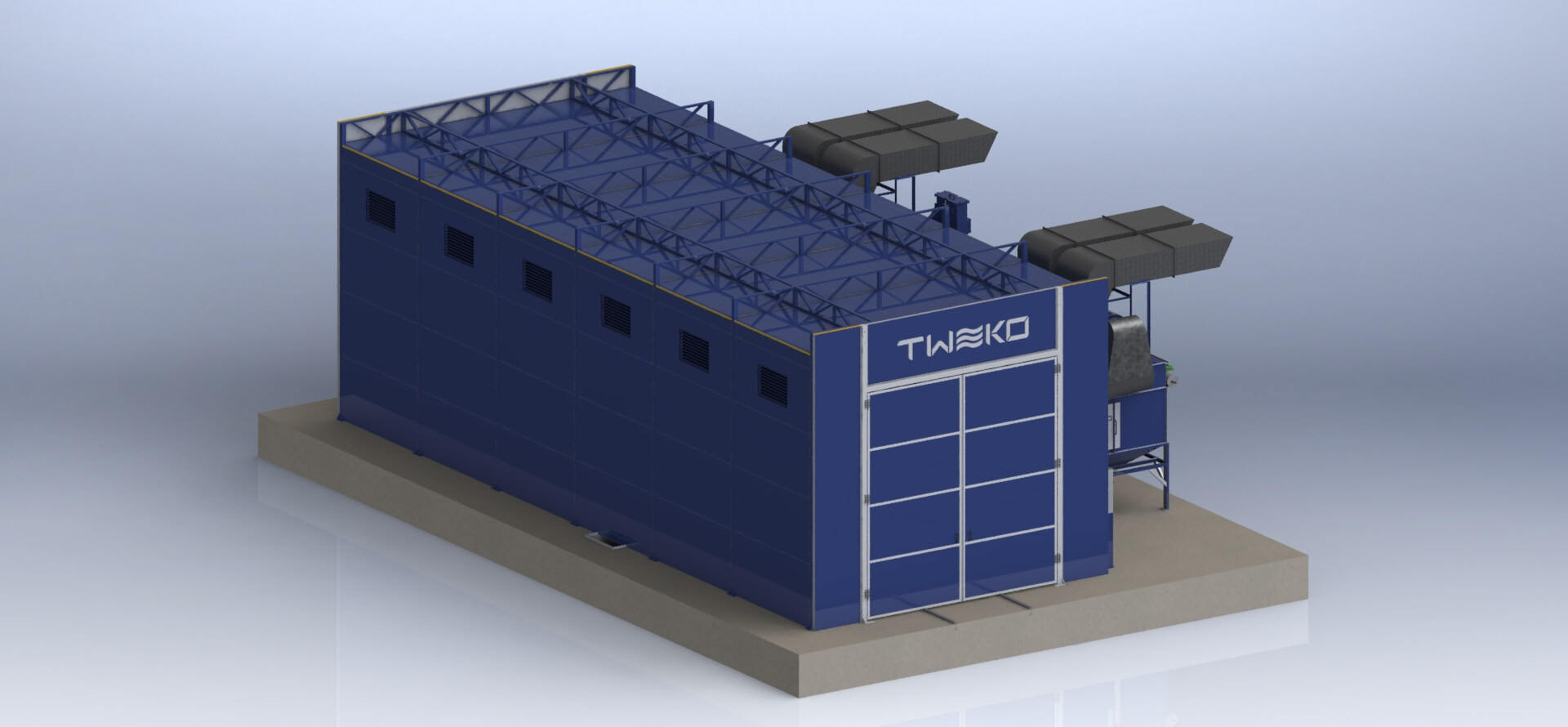
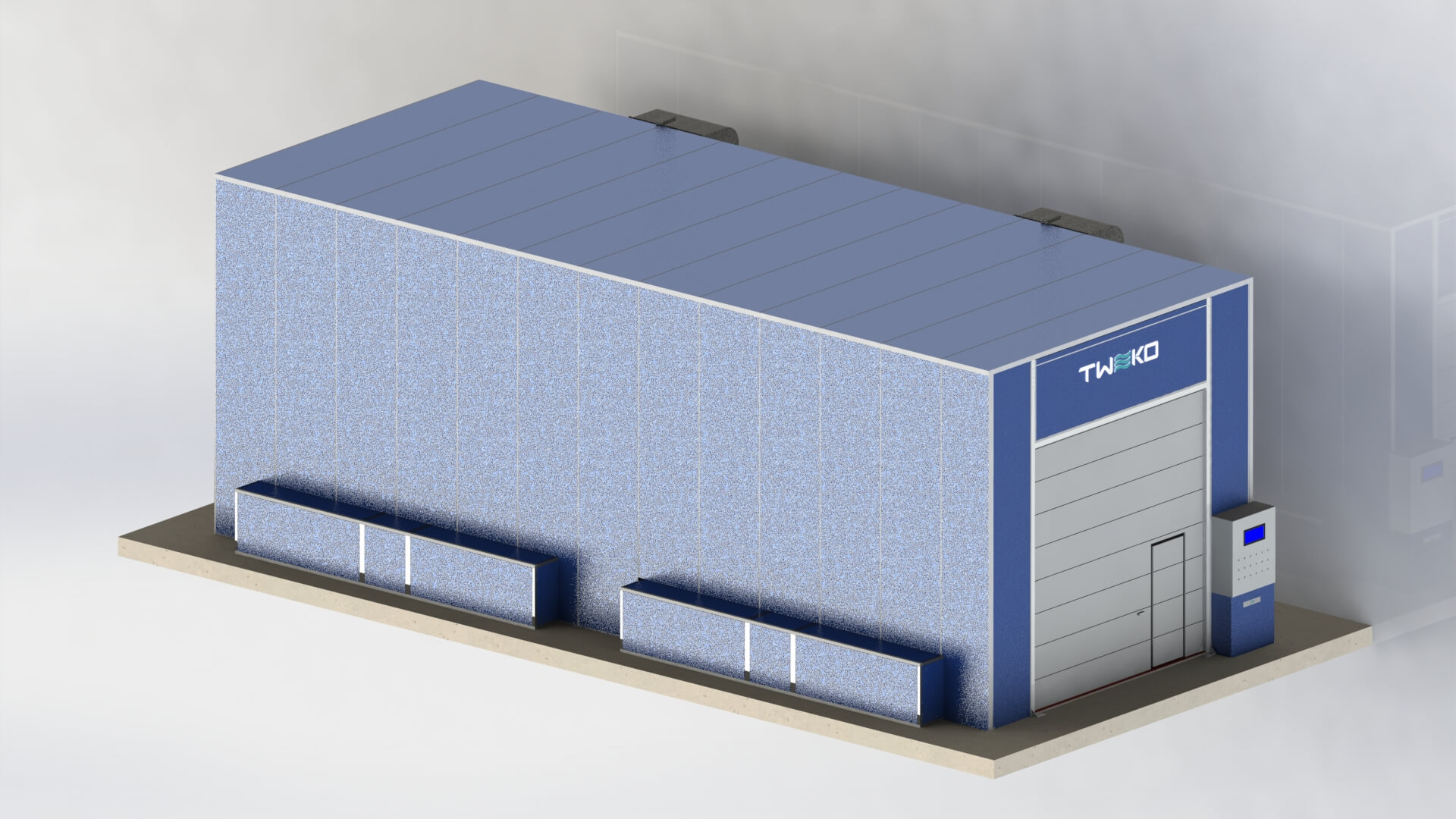
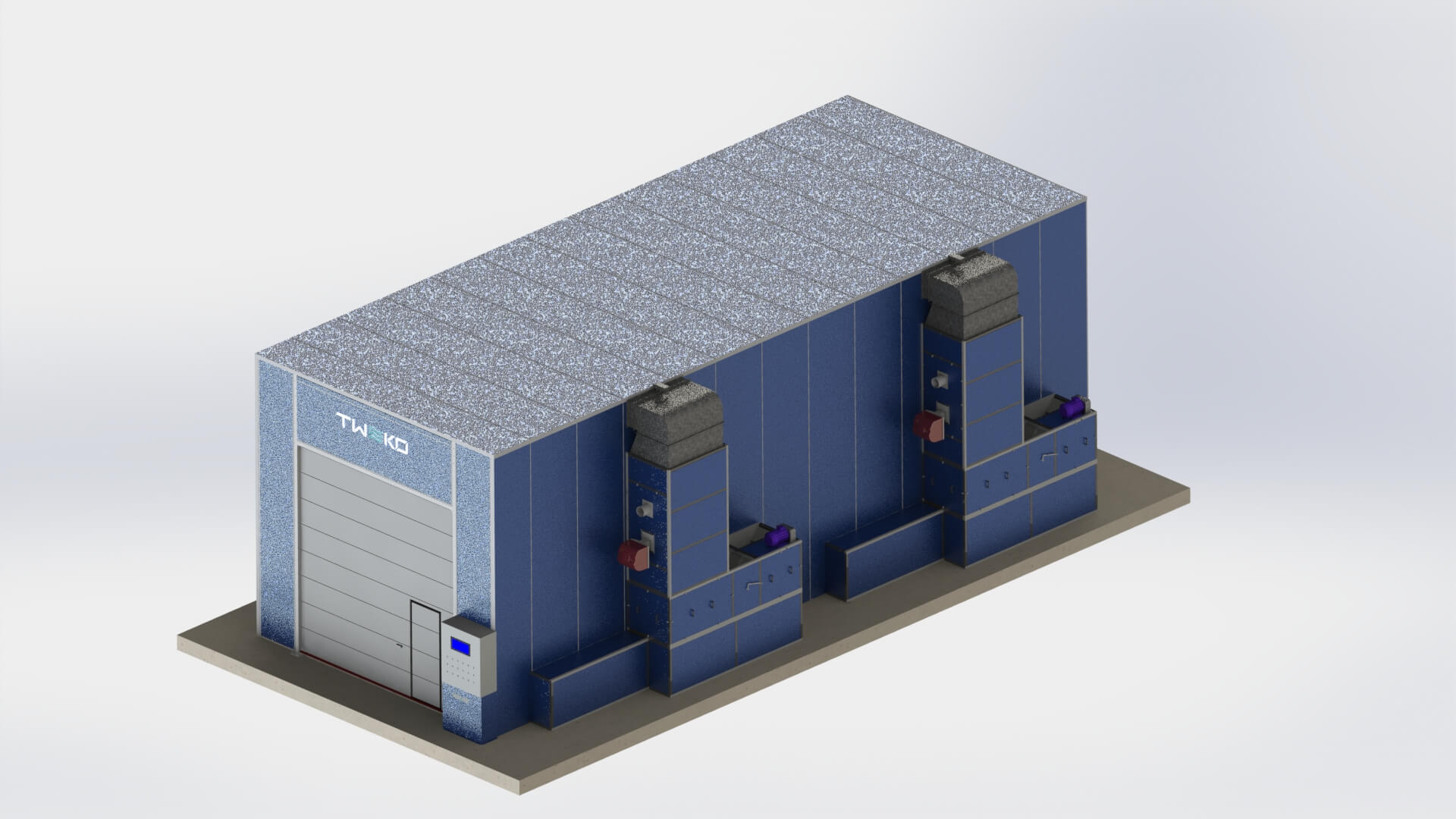
For the coating application and drying stages within the complex, a spray painting and drying booth of the IKFS Diagonal series, model IKFS-2-15, was implemented. The booth is designed for processing oversized products under industrial production conditions.The booth is designed with a pass-through layout featuring two working zones and a diagonal airflow arrangement. This configuration ensures uniform air distribution during painting, efficient removal of paint aerosols, and stable drying conditions throughout the entire volume of the product, regardless of its dimensions and geometry.The booth is equipped with:
- A supply-and-exhaust ventilation system with controlled air exchange, ensuring uniform airflow distribution within the working zones and stable conditions for coating application.
- Filtration systems for supply and exhaust air, designed to clean the working zone atmosphere and reduce emissions of paint material aerosols.
- Thermal ventilation units integrated into the booth structure, providing air heating, circulation, and automatic maintenance of preset temperature regimes during the drying process.
- An automated control system with an operator control panel, enabling management of painting, drying, purging, and cooling modes, as well as monitoring of ventilation and thermal systems.
- Technological interlocking and monitoring systems that prevent equipment operation under unacceptable temperature, pressure, or engineering system conditions.
- Entrance, exit, and inter-zone gates designed for the flow-through processing of oversized products and ensuring airtightness of working zones during painting and drying.
The booth design, air exchange system, and control automation were implemented in accordance with the technical specification and design documentation, ensuring stable operation of the paint and drying equipment under industrial conditions and its integration into the enterprise’s unified technological process.
 The booth is equipped with:
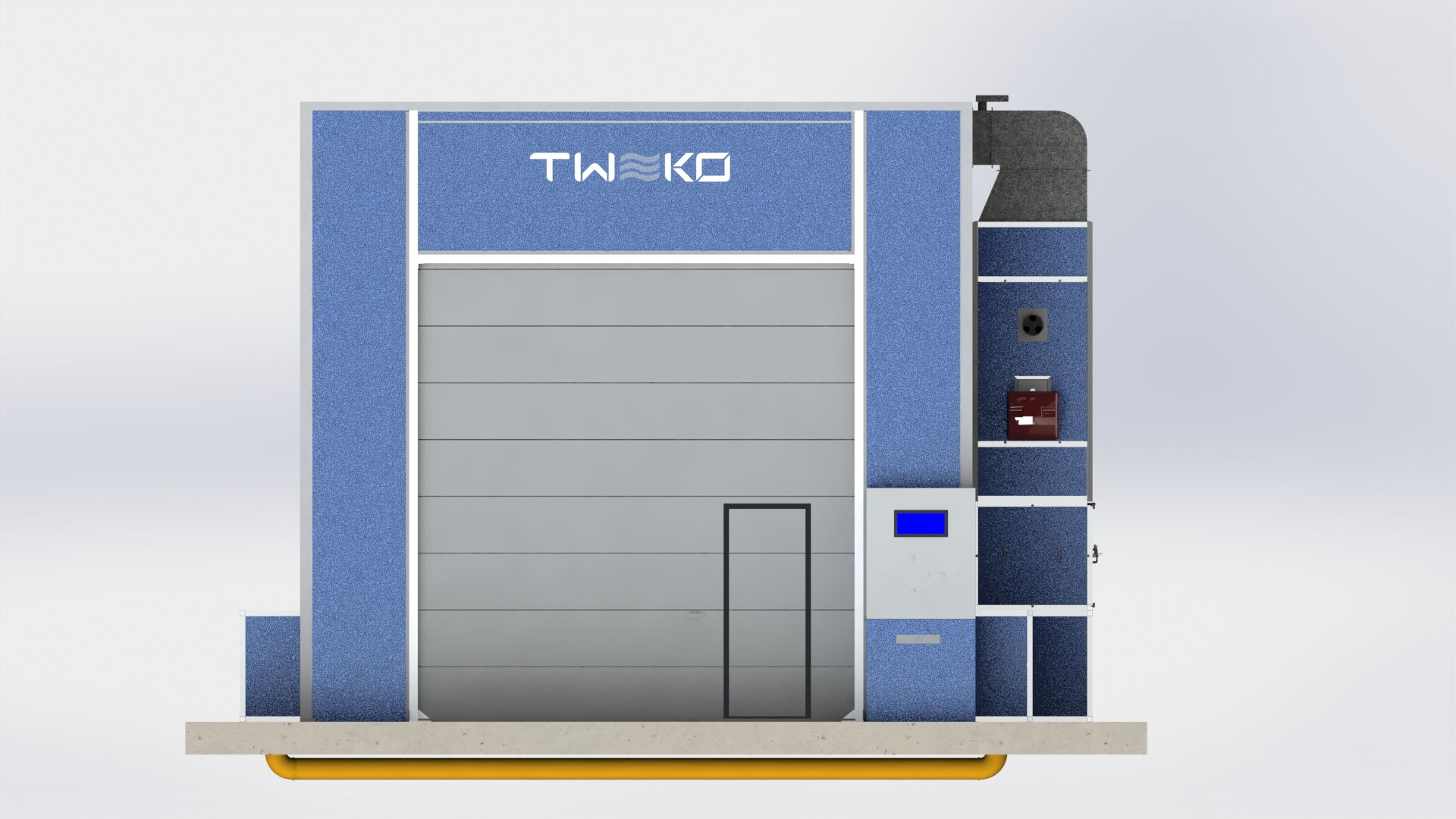
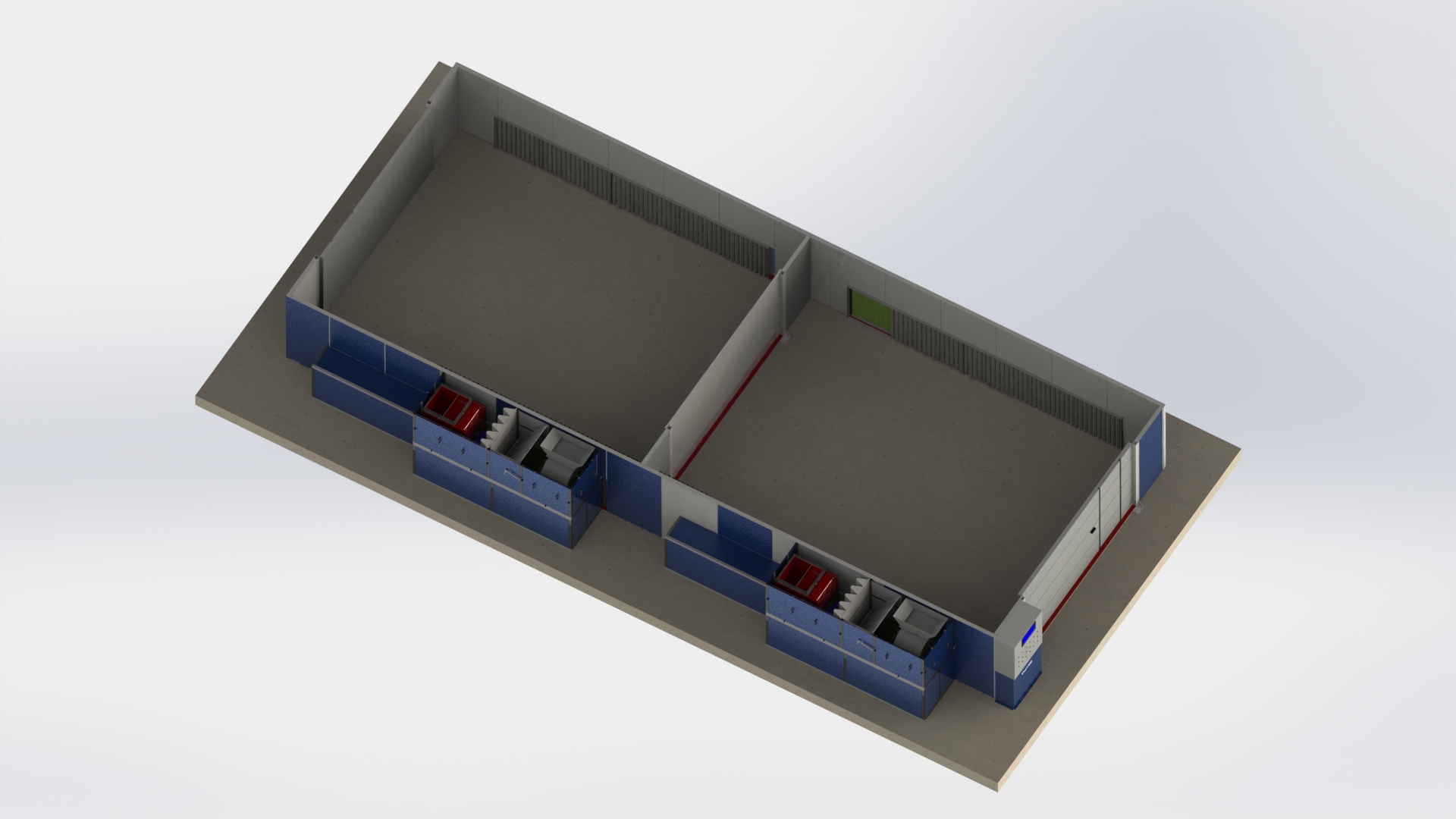
All technological modules — the abrasive blasting chamber, the spray painting and drying booth, and auxiliary engineering systems — were integrated into a single technological complex. Within the scope of the project, engineering utilities were installed, electrical installation and commissioning works were carried out, after which the equipment was put into industrial operation within the established timeframe.
Technical Specifications of the Complex
| Component | Abrasive Blasting Chamber | Paint and Drying Booth |
|---|---|---|
| General Characteristics | ||
| Chamber type | Pass-through, single-zone | Pass-through, two-zone |
| Total length* | ≈ 11.5 m | ≈ 15.2 m |
| Dimensions | ||
| Internal dimensions (working area) | ≈ 11.0 × 6.5 × 5.2 m | ≈ 7.5 × 6.0 × 5.0 m (each zone) |
| Overall dimensions | ≈ 11.5 × 10.1 × 5.8 m | ≈ 15.2 × 7.3 × 5.7 m |
| Service Access | ||
| Service doors | 840 × 1,975 mm, 2 pcs | Provided |
| Ventilation and Air Exchange | ||
| Ventilation type | Filtration and ventilation system | Supply and exhaust ventilation |
| Ventilation capacity | 30,000 m³/h × 2 units | 32,500 m³/h — supply 25,000 m³/h — exhaust |
| Technological Systems | ||
| Main purpose | Abrasive blasting surface preparation | Painting and drying of products |
| Heating system | Not provided | Diesel burners, 2 units |
| Maximum chamber temperature | — | up to 60 °C |
| Power Supply and Lighting | ||
| Equipment power supply | 380 V / 50 Hz | 380 V / 50 Hz |
| Lighting power supply | 220 V / 50 Hz | 220 V / 50 Hz |
| Maximum lighting power | up to 2 kW | up to 3 kW |
| Acoustic Parameters | ||
| Noise level outside the chamber | up to 70 dB | up to 70 dB |
Key Components of the Abrasive Blasting Chamber (KASO) and Paint & Drying Booth (IKFS)
| Component | KASO | IKFS |
|---|---|---|
| Cabin | Metal cabin of a pass-through design with a single working zone, equipped with entry and exit gates, personnel service doors, internal wear-resistant protective lining, industrial lighting system, and sealing elements adapted to abrasive blasting operating conditions. | Metal cabin of a pass-through design with two independent working zones, featuring entry, exit, and inter-zone gates, personnel service doors, ceiling and wall-mounted lighting systems, and a sealed structure designed for painting and drying modes. |
| Material Processing System | Mechanized abrasive collection and regeneration system with a closed-loop cycle, including a scraper floor, bucket elevator (bucket conveyor), separator, storage hopper, and automatic return of cleaned abrasive to the working process. | Paint application and product drying system utilizing thermo-ventilation units, controlled air exchange, and automatic maintenance of specified process parameters. |
| Filtration and Ventilation System | Filtration and ventilation units with cartridge filtration and pulse-jet filter cleaning, air duct systems, and efficient extraction of dust-laden air from the working zone. | Supply and exhaust ventilation system with side exhaust plenums, filtration systems for supply and exhaust air, and controlled air flow distribution within the working zones of the booth. |
| Material Flow and Working Area | Pass-through processing layout for large-scale products and heavy assemblies, eliminating the need for reverse movement or intermediate technological operations. | Pass-through painting and drying layout for large-format products with division into two independent working zones for sequential or parallel processing. |
| Heating / Drying System | Not provided. The chamber is designed exclusively for abrasive blasting surface preparation without thermal treatment. | Thermo-ventilation units integrated into the booth structure, providing air heating, circulation, and automatic maintenance of drying modes. |
| Control System | Automated control panels with status indication of main units, monitoring of ventilation operation, abrasive regeneration systems, and material transport mechanisms. | Automated control panel with a programmable logic controller (PLC), pressure and temperature sensors, temperature controller, timers, and hour meter. |
| Safety and Operation | Impact-resistant industrial lighting, protective internal lining elements, interlock systems, centralized equipment operation monitoring, and interlocking of technological units. | Fire protection dampers, pressure monitoring in working zones, technological interlock systems, air flow control, and protection against operation under unacceptable parameters. |
Project Implementation
The project was implemented in stages and covered the period from September 2024 to October 2025, involving TWEKO’s engineering, design, manufacturing, and service departments, as well as the customer’s construction and installation contractors.
At the initial stage, the customer’s technical requirements were analyzed, taking into account the dimensions and weight of large-format products, their transportation inside the chambers, and the specific conditions of the production site.
- development of layout solutions for the abrasive blasting chamber and the pass-through spray painting and drying booth with division into two working zones;
- determination of the placement of thermo-ventilation units, ventilation, and filtration systems;
- definition of requirements for foundations, pits, canopies, and engineering utilities;
- preparation of recommendations for the compressor system (room dimensions, operating conditions, temperature requirements).
The design solutions were refined in close cooperation with the customer and their construction organization.
- drawings of the KASO abrasive blasting chamber and IKFS spray painting and drying booth;
- drawings of frames, gates, partitions, and ceiling structures;
- documentation for the scraper floor, separator, bucket elevator, and abrasive storage hopper;
- schematics of ventilation systems, side exhaust plenums, and air ducts;
- recommendations for pneumatic pipelines and compressor system integration.
The documentation was used for in-house equipment manufacturing and for coordinating work with contractors.
- metal structures of the chambers;
- abrasive collection and regeneration systems;
- ventilation and filtration units;
- automation and control components.
Equipment was assembled and shipped in stages in accordance with the readiness of the construction works on site.
- installation of chamber frames and enclosure structures;
- installation of the scraper floor, conveyors, separator, and abrasive hopper;
- installation of ventilation units, air ducts, and filtration systems;
- installation of thermo-ventilation units for the spray painting and drying booth;
- routing of electrical and pneumatic utilities;
- integration of control panels and automation systems.
Installation was carried out in accordance with approved procedures and under technical supervision.
- verification of ventilation and filtration system performance;
- configuration and testing of automation and control systems;
- inspection of abrasive collection and regeneration system operation;
- preparation of the complex for operation with a single-zone KASO chamber and a two-zone IKFS booth.
The complex was commissioned for industrial operation in October 2025 with the issuance of the full set of technical documentation.
Operating Principle of the Complex
The technological complex is designed according to a pass-through layout and ensures the sequential execution of surface preparation, coating application, and drying operations for oversized assemblies and components.
Abrasive Blasting (KASO-15)
The workpiece is fed into the abrasive blasting chamber through the entrance gate and positioned within the working zone. Surface treatment is carried out using abrasive blasting units with a centralized abrasive supply and regeneration system.
During the blasting process:
- spent abrasive falls onto the scraper floor;
- is mechanically transported to the separator;
- is cleaned and separated from contaminants;
- is returned to the storage hopper for reuse.
Dust-laden air from the working zone is extracted through filtration and ventilation units, where it is cleaned before discharge. The operation of the abrasive recovery system, ventilation, and auxiliary mechanisms is coordinated via control panels.
Painting and Drying (IKFS-2-15)
After surface preparation is completed, the workpiece is transferred to the spray painting and drying booth, which is also designed as a pass-through, two-zone system. The booth allows painting and drying operations to be carried out in separate zones or enables parallel processing of two workpieces.
During painting:
- a controlled air exchange is maintained inside the booth;
- air is supplied via the intake ventilation system and extracted through side exhaust plenums;
- exhaust air passes through filtration before discharge.
In drying mode:
- thermo-ventilation units are activated;
- the control system ensures air circulation and maintains the specified process parameters;
- upon completion of drying, the booth switches to purge and cooling mode.
Control and System Interaction
All stages of the complex operation are integrated into a single control system, which enables:
- management of operating modes for each chamber;
- coordination of ventilation, abrasive regeneration, and drying processes;
- safe and stable operation of the equipment.
Thanks to the pass-through layout and the two-zone organization of working areas, the complex is integrated into a continuous production flow and adapted to the actual operational needs of the customer.
Results for the Customer
As a result of the project implementation, the customer received a fully functional technological complex integrated into the enterprise’s production infrastructure and adapted for processing oversized products and assemblies with complex geometry.
The implemented solution provided:
- a closed production cycle for surface preparation, painting, and drying within a single complex, without the need to involve external production facilities;
- a pass-through processing logic with a two-zone paint and drying section, enabling flexible production planning and adaptation to current operational tasks;
- stable equipment operation under intensive industrial conditions due to robust industrial design, automated control systems, and regulated installation;
- controlled processing conditions at each stage of the technological process — from abrasive blasting to painting and drying;
- the possibility of further development of the production area, taking into account the embedded engineering solutions and modernization reserves;
- reduced technological risks through the use of coordinated design solutions and standardized installation and commissioning procedures.
The complex was commissioned for industrial operation with the transfer of a complete set of technical documentation, enabling the customer to switch to standard operating mode without additional equipment modifications.
Conclusion
The completed project demonstrated TWEKO’s capabilities in delivering comprehensive engineering solutions for industrial enterprises — from technical concept development and design to manufacturing, installation, and commissioning of equipment for industrial operation.
Within the scope of the project, a technological complex for abrasive blasting and paint-and-dry processing was designed and integrated, tailored for handling oversized products and adapted to the customer’s real production conditions. The pass-through layout, two-zone organization of working areas, and coordinated interaction of all engineering systems ensured stable and controlled operation of the complex.
The project was implemented in compliance with applicable technical requirements, safety standards, and site-specific production conditions, confirming the effectiveness of a systematic engineering approach to complex industrial challenges. The achieved result provides a solid foundation for further development of the customer’s production facilities and scaling of technological processes.
If your enterprise requires a customized technological solution for surface preparation, painting, and drying operations, the TWEKO team is ready to propose an optimal equipment configuration tailored to your production specifics and real operating conditions.